
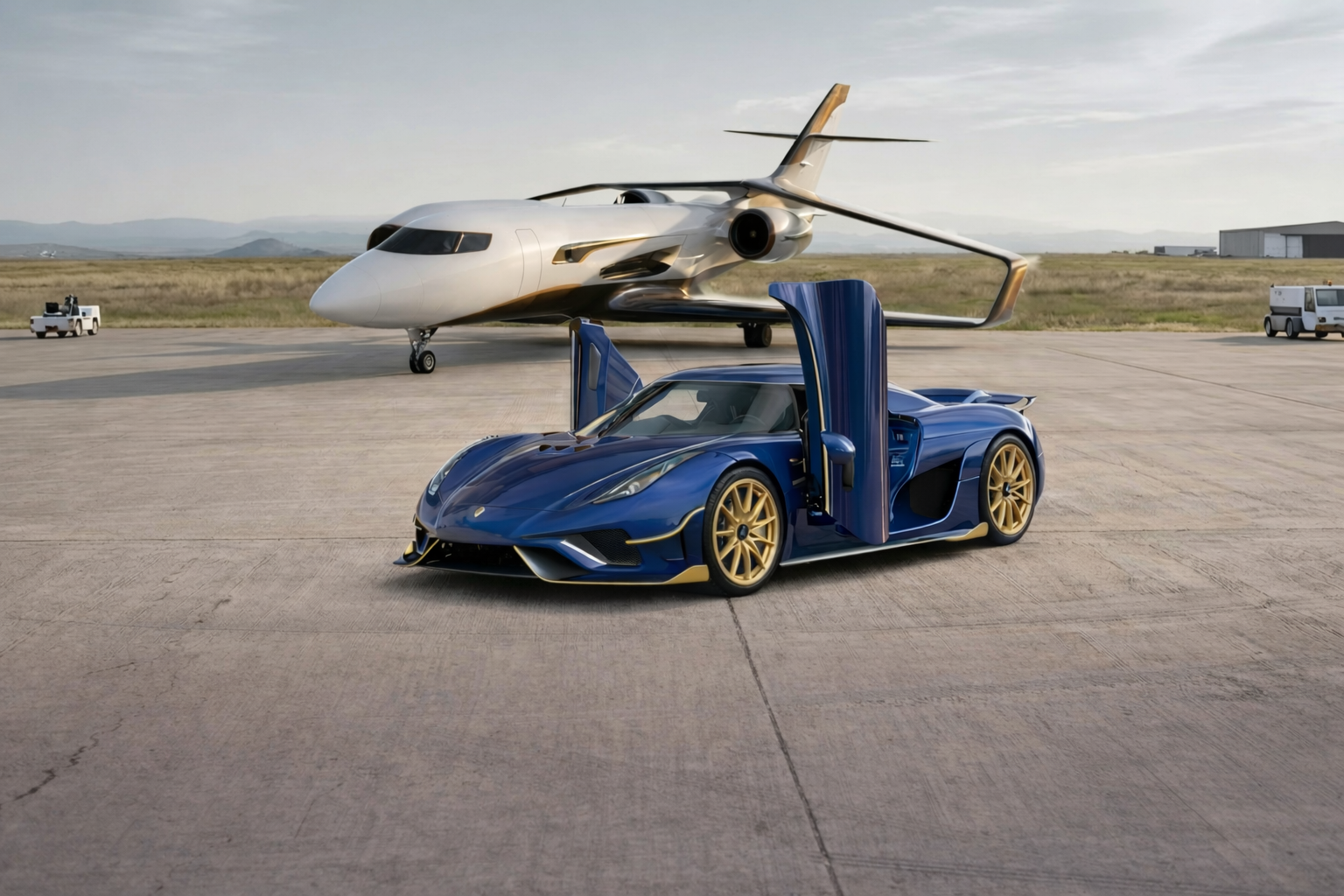
The model sits on a clean surface. No visible seams. No conventional wings stretching outward in isolation. Instead, the structure loops back into itself.
A continuous form.
At first glance, it feels unfamiliar. Then the logic begins to emerge. Air does not separate at the tips. It circulates.
This is the Koenigsegg Aircraft Concept.
For those familiar with Koenigsegg’s approach to engineering, the direction feels consistent. Efficiency comes from rethinking fundamentals, not refining existing templates. In this case, the template is the aircraft wing itself.
The concept introduces a closed-wing structure designed to address one of aviation’s persistent challenges, drag.
Understanding the idea requires looking at how air behaves, and how design can reshape that behavior.
The Engineering Behind the Koenigsegg Aircraft Concept
Traditional aircraft wings create lift by managing airflow.
As air moves over and under the wing, pressure differences generate upward force. At the wing tips, however, this flow begins to curl. The result forms wingtip vortices, circular patterns of air that create drag.
Drag reduces efficiency.
More power is required to maintain speed. Fuel consumption increases as a result.
The Koenigsegg Aircraft Concept approaches this differently.
Instead of allowing airflow to escape at the tips, the wing structure connects back into itself. This creates a closed loop, preventing the formation of strong vortices.
The effect is measurable.
Reduced vortices lead to lower induced drag, particularly at lower speeds and during climb phases.
The structure also redistributes load.
A closed-wing design spreads aerodynamic forces more evenly across the frame. This can reduce stress on individual components, allowing for lighter construction.
Material selection supports this approach.
Advanced composites provide strength while maintaining low weight. These materials allow the structure to maintain its shape under varying conditions.
Another factor involves stability.
Closed-wing configurations can improve control by balancing airflow more consistently across the aircraft. This stability becomes particularly relevant during maneuvering.
The concept does not eliminate complexity.
It shifts it.
Engineering challenges move from managing vortices to designing a structure that supports continuous airflow without compromising weight or flexibility.
Design Philosophy and Future Potential of the Koenigsegg Aircraft Concept
The design reflects a broader philosophy.
Koenigsegg approaches engineering by questioning established forms. In automotive design, this has led to unconventional solutions. The same thinking appears here.
The aircraft does not follow traditional proportions.
Its shape prioritizes airflow continuity over visual familiarity. This creates a form that feels both engineered and intentional.
Potential applications extend beyond concept.
Private aviation may benefit from increased efficiency. Reduced drag can translate into lower fuel consumption or extended range.
Urban air mobility introduces another possibility.
Compact aircraft designed for short-distance travel could adopt similar principles. Efficiency becomes critical in these environments.
Propulsion systems also interact with the design.
Hybrid or electric systems could pair with low-drag structures to improve overall performance. Reduced resistance supports lower energy requirements.
Interior design follows function.
Cabin layouts would likely reflect the structural form, integrating space within the looped configuration. This introduces new possibilities for how interiors are arranged.
Adoption depends on feasibility.
Certification, manufacturing processes, and operational considerations all influence whether such designs move beyond concept stages.
Still, the direction remains clear.
Efficiency drives innovation.
The Mechanism of Drag Reduction Explained
Drag consists of multiple components.
Induced drag results from lift generation. Parasite drag comes from surface friction and shape.
The closed-wing concept primarily addresses induced drag.
By connecting the wing tips, it reduces the pressure difference that causes air to curl into vortices. This limits energy loss.
The result improves lift-to-drag ratio.
Aircraft can maintain performance with less energy input.
This mechanism aligns with broader trends in aviation.
Reducing energy consumption remains a central objective across both commercial and private sectors.
Positioning Within Aerospace Innovation
The Koenigsegg Aircraft Concept sits within a growing field of experimental designs.
Engineers continue to explore alternatives to conventional wing structures. Each concept tests different approaches to efficiency, stability, and performance.
What distinguishes this concept is its origin.
It emerges from a company known for rethinking mechanical systems at a fundamental level.
This perspective introduces ideas that may not originate within traditional aerospace pathways.
Cross-industry thinking becomes part of the process.
The model remains still. Air does not move around it yet. No vortices form. No drag appears.
The concept exists in potential.
What matters is the idea it represents. A shift in how problems are approached. A willingness to redesign structures that have remained unchanged for decades.
Whether it reaches production or not, the direction holds.
Efficiency will continue to shape the future of flight.
FAQs
1. What is the Koenigsegg Aircraft Concept?
The Koenigsegg Aircraft Concept is a futuristic aircraft design featuring a closed-wing structure aimed at reducing drag and improving efficiency.
2. How does a closed-wing design reduce drag?
It reduces wingtip vortices, which are a major source of induced drag, improving aerodynamic efficiency.
3. Is the Koenigsegg aircraft real or just a concept?
Currently, it exists as a concept design, exploring new possibilities in aviation engineering.
4. What are the benefits of reduced drag in aircraft?
Lower drag leads to improved fuel efficiency, increased range, and reduced energy consumption.
5. Could this design be used in future aircraft?
Potentially, yes. Adoption depends on engineering feasibility, certification, and industry acceptance.