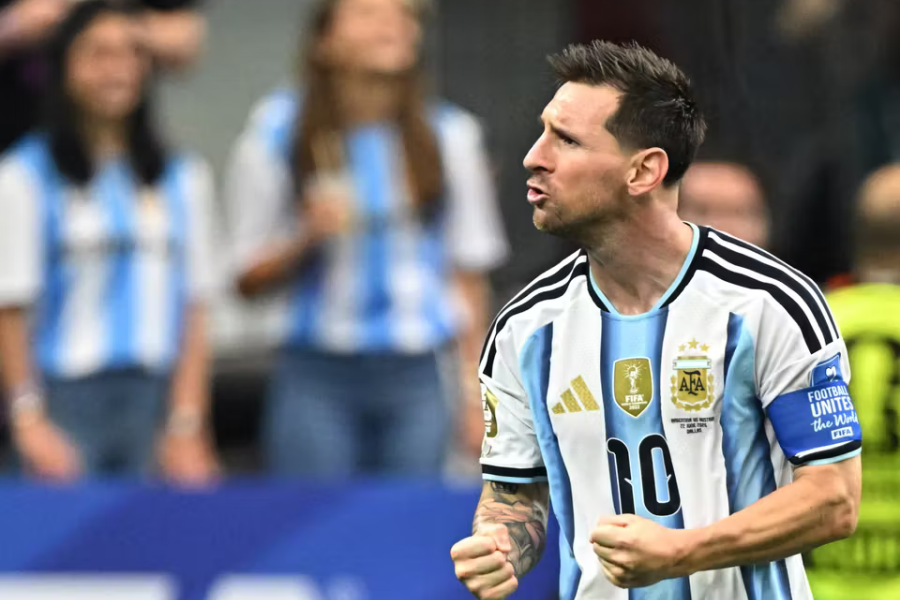
For twelve years, Miroslav Klose’s record of 16 World Cup goals looked untouchable. On 22 June 2026, Lionel Messi finally took it from him. In the 38th minute of Argentina’s group game against Austria, Messi met a cross with a first-time finish to score his 17th World Cup goal, making him the outright all-time leading scorer in World Cup history. He added to the tally later in the tournament, extending a record that may stand for a very long time.
The Record That Redefined World Cup History
Scoring at a World Cup is different from scoring anywhere else. Tournaments come around only every four years, matches are few, and defences are the best in the world. That is why the all-time scoring record is one of the most prestigious individual marks in football.
Before Messi, it belonged to some of the game’s great finishers. Brazil’s Ronaldo held it with 15 goals until Klose passed him at the 2014 World Cup in Brazil. For Messi, better known as a creator and dribbler than a pure goal poacher, to overtake them both says a lot about his longevity.
Messi’s Journey Across Six Tournaments
Messi made his World Cup debut as an 18-year-old in Germany in 2006, scoring against Serbia and Montenegro. In 2010 he was Argentina’s star but went without a goal. In 2014 he carried his team to the final in Rio, winning the Golden Ball as the tournament’s best player, only to lose to Germany.
Russia 2018 was a disappointment, with Argentina knocked out by France in the last 16. Then came Qatar 2022, the tournament that defined his career. Messi scored seven goals, including two in a dramatic final against France, and lifted the trophy at last, winning a second Golden Ball.
At the 2026 World Cup in North America, his sixth tournament, Messi arrived as a world champion with nothing left to prove, and still found a way to make history.
The Match That Made History
The record-breaking moment came against Austria. Messi had missed a penalty early in the game, but he did not let it affect him. In the 38th minute, Thiago Almada delivered a cross, Enzo Fernández let the ball run through, and Messi struck it first time into the net.
The goal opened the scoring and sent Argentina’s fans into celebration, not just for the lead but for the history. Klose himself had said earlier in the year that if anyone broke his record, he hoped it would be Messi.
The Numbers Behind the Record
Messi entered the 2026 tournament on 13 World Cup goals, three behind Klose. He closed the gap during Argentina’s opening matches before overtaking the German against Austria. Klose (16), Brazil’s Ronaldo (15) and Germany’s Gerd Müller (14) were the long-time leaders of that list, while Kylian Mbappé also climbed fast in 2026, reaching Klose’s old mark of 16.
Messi also holds the record for most World Cup matches played, a tally built across two decades of tournaments.
What Makes Messi Different
Previous record holders were mostly out-and-out strikers. Klose was a master of movement and heading; Ronaldo was a devastating finisher; Müller was a penalty-box predator. Messi has scored his goals while also being Argentina’s main playmaker, creating chances for others and dictating the pace of games.
His goals have come from long-range strikes, penalties, close-range finishes and moments of individual brilliance. That versatility, combined with remarkable consistency across six tournaments, is what sets him apart.
How Argentina Built Around Him
Under coach Lionel Scaloni, Argentina has built a team designed to support Messi rather than rely on him alone. Hard-working midfielders such as Enzo Fernández and Rodrigo De Paul cover ground, while forwards like Julián Álvarez stretch defences. That structure frees Messi to drift into the spaces where he is most dangerous.
The approach won the Copa América in 2021 and the World Cup in 2022, and it remains the foundation of Argentina’s success.
The Global Impact
Few athletes command attention like Messi. His record-breaking goal was celebrated across Argentina, at Inter Miami where he plays his club football, and by fans worldwide. Social media lit up within seconds, and the moment instantly joined the list of great World Cup memories.
For the tournament itself, hosted across the United States, Canada and Mexico, it was a perfect storyline: one of the greatest players ever making history on one of the biggest stages in sport.
Where It Fits Among Messi’s Achievements
Messi’s career is filled with records: a record number of Ballon d’Or awards, the most goals for Barcelona, the most international goals by a South American player and a World Cup winner’s medal. The World Cup scoring record adds something special because it was won in the competition that matters most to Argentina.
A Record That Will Shape Future World Cups
Breaking Messi’s record will require extraordinary longevity as well as talent. Mbappé, who has scored freely since his teenage years, is the obvious contender, and the expanded 48-team format means more matches per tournament. Still, reaching Messi’s tally will take several more World Cups of sustained excellence.
For now, the record belongs to the little genius from Rosario, achieved, fittingly, at what may be his final World Cup.
FAQ
What record did Lionel Messi break?
He became the all-time leading goalscorer in FIFA World Cup history, overtaking Miroslav Klose’s long-standing record of 16 goals.
When did Messi break the record?
On 22 June 2026, with his 17th World Cup goal in Argentina’s group match against Austria.
Why is the record so important?
World Cup goals are among the hardest to score in football, because the tournament is held only every four years against the best international teams.
How many World Cups has Messi played?
Six: 2006, 2010, 2014, 2018, 2022 and 2026.
Can Messi’s record be broken?
It is possible, with Kylian Mbappé the leading candidate, but it would require several more tournaments of consistent scoring.