Two Hypercars, One Decade, Completely Different Missions
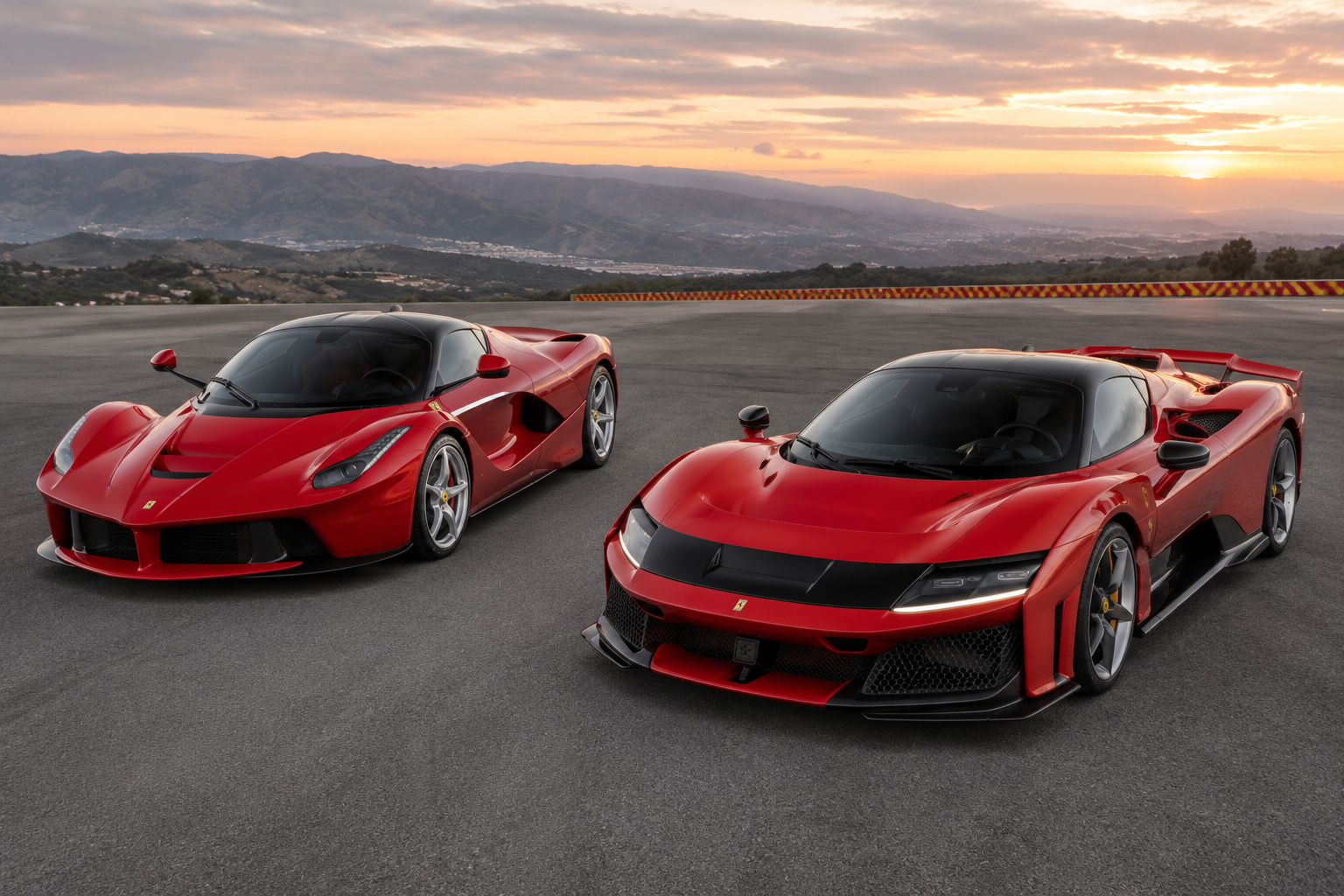
The first thing that stands out inside Ferrari’s private presentation environment is the silence before the covers come off. A decade separates the LaFerrari and the F80, yet the difference feels larger than ten years. Standing near both cars reveals how dramatically Ferrari’s priorities have shifted. The LaFerrari arrived during a period when emotion, naturally aspirated power, and Formula One technology created the ultimate road-going expression of Maranello. The F80 enters a different landscape, one shaped by advanced aerodynamics, electrification, computational performance, and modern motorsport lessons. This Ferrari F80 vs LaFerrari comparison is not simply about horsepower or acceleration figures. It is about understanding how Ferrari interprets speed, exclusivity, and engineering excellence across two generations. Each model serves as a snapshot of its era, reflecting what Ferrari believed a flagship hypercar should represent at a specific moment in automotive history.
The Historical Context: Why Ferrari Builds Hypercars So Rarely
Ferrari treats hypercars differently from the rest of its lineup. These vehicles do not arrive on predictable schedules. They appear when Ferrari believes a technological leap deserves a dedicated showcase. Historically, flagship models have acted as rolling laboratories where racing innovation reaches the road before filtering into future production vehicles. The LaFerrari emerged as the successor to legendary Ferrari halo cars and carried the responsibility of introducing hybrid assistance to Ferrari’s most passionate collectors. The F80 enters a market that expects electrification, advanced aerodynamics, and extreme performance. As a result, the mission has evolved. Ferrari no longer needs to convince buyers that hybrid technology belongs in a hypercar. Instead, it must demonstrate how cutting-edge engineering can preserve excitement while advancing performance. Understanding this context explains why these two cars feel related in heritage yet dramatically different in execution.
Design Evolution: From Sculptural Drama to Aerodynamic Precision
The visual contrast between the two hypercars reveals Ferrari’s changing priorities. LaFerrari remains one of the most emotionally expressive designs ever produced by the brand. The body surfaces flow organically, emphasizing movement even when parked. Every angle appears shaped by both beauty and function. The F80 adopts a more technical approach. Aerodynamic efficiency plays a larger role in determining form. Air channels, active aerodynamic elements, and race-derived solutions influence the visual language. Walking around the vehicles side by side feels like comparing two generations of Formula One thinking translated into road cars. One prioritizes emotional sculpture. The other prioritizes measurable aerodynamic performance. Ferrari has not abandoned beauty. Instead, the company has expanded its definition of what beauty looks like when engineering requirements become increasingly sophisticated.
The Powertrain Revolution: How Ferrari’s Thinking Changed
Perhaps no area better illustrates Ferrari’s evolution than the powertrain. The LaFerrari combined a naturally aspirated V12 with hybrid assistance, creating an experience that blended traditional Ferrari character with emerging technology. The engine remained the emotional centerpiece. Hybrid systems enhanced the experience rather than redefining it. The F80 represents a different philosophy. Electrification becomes a more integrated performance tool. Instead of supporting the engine, advanced hybrid systems actively shape how power reaches the road. The mechanism is particularly interesting because modern electric assistance can fill torque gaps, improve traction, and optimize energy deployment with extraordinary precision. Ferrari’s engineering team now uses hybrid technology as a core performance architecture rather than an auxiliary feature. This shift reflects broader changes in motorsport and high-performance vehicle development across the automotive industry.
The Mechanism Reveal: How Ferrari Extracts Performance Differently Today
A decade ago, Ferrari engineers focused heavily on maximizing mechanical excellence through engine response, chassis tuning, and lightweight construction. Those priorities remain, yet the methodology has changed significantly. The F80 leverages sophisticated software, electric motor integration, energy recovery systems, and active aerodynamics to manage performance in real time. Rather than relying solely on engine output, the vehicle constantly analyzes conditions and adjusts how available power reaches the road. This creates a driving experience that feels remarkably controlled at extreme speeds. LaFerrari delivers performance through raw interaction between engine, driver, and chassis. The F80 introduces layers of intelligence working behind the scenes. The distinction highlights Ferrari’s transition from mechanical dominance toward a future where software and hardware operate as a unified performance system.
Driving Experience: Emotion Versus Capability
The driving experience remains one of the most fascinating aspects of any Ferrari F80 vs LaFerrari comparison. LaFerrari delivers a sense of occasion that begins the moment the V12 starts. The soundtrack, throttle response, and rising intensity create an emotional connection that many collectors consider irreplaceable. The F80 pursues speed through a different route. Precision becomes a defining characteristic. The car feels engineered to extract every available advantage from modern technology. Drivers may discover that confidence arrives earlier because the vehicle manages complexity with extraordinary effectiveness. One car communicates through sensation and sound. The other communicates through capability and control. Neither approach is inherently superior. They simply reflect different interpretations of what Ferrari believes the ultimate driving experience should feel like.
Interior Philosophy: The Driver Environment Across Two Generations
Luxury is rarely the primary objective inside a Ferrari hypercar. Purpose takes precedence. Yet the cabin environments reveal important differences. LaFerrari embraces a more traditional supercar atmosphere where the driver remains closely connected to the machine through physical interaction. The F80 introduces a cockpit shaped by modern performance requirements, digital integration, and advanced information management. Displays, controls, and interfaces reflect how contemporary drivers interact with technology. Ferrari understands that hypercar owners increasingly expect seamless access to data without sacrificing engagement. The result is a cabin that balances technological sophistication with focused driving intent. Examining both interiors reveals how Ferrari has adapted to changing expectations while preserving the central importance of the driver.
Exclusivity and Collector Appeal
Scarcity has always played a significant role in Ferrari’s halo car strategy. Ownership extends beyond transportation into the realm of collecting, investing, and participating in Ferrari’s broader cultural ecosystem. LaFerrari achieved immediate significance because it represented the final chapter of a particular Ferrari era, one deeply connected to naturally aspirated performance. The F80 enters the market as the beginning of something new. Collectors often evaluate these vehicles through different lenses. One celebrates the culmination of a legacy. The other represents the future direction of Ferrari engineering. Both possess strong long-term appeal, although their significance stems from different historical narratives. This dynamic adds another layer to the ownership experience beyond pure performance.
What Ferrari Learned From Racing
Ferrari’s hypercars often function as public demonstrations of lessons learned through motorsport. The LaFerrari reflected technologies and philosophies influenced by Formula One during its era. The F80 benefits from a broader range of racing insights, including advancements in hybrid deployment, energy management, aerodynamic efficiency, and computational vehicle dynamics. The relationship between road and race cars has become increasingly sophisticated. Ferrari now transfers knowledge through software systems, energy strategies, and aerodynamic concepts that would have seemed impossible in earlier generations. Understanding these connections reveals why the F80 feels like more than a faster successor. It represents a fundamentally different interpretation of how racing technology should influence a road-going hypercar.
Ferrari’s Future Through the Lens of the F80
The F80 offers insight into where Ferrari may be heading over the next decade. Electrification, advanced aerodynamics, intelligent performance systems, and increasingly integrated software architectures are likely to shape future flagship models. Ferrari remains committed to emotional engagement, yet the methods used to create that engagement continue evolving. The company understands that future buyers will judge performance through both objective and subjective measures. The challenge lies in preserving Ferrari’s character while embracing new technologies. The F80 serves as an early indicator of how that balance may develop across future generations of the brand’s most important vehicles.
More Than a Comparison, A Story About Ferrari Itself
The most revealing aspect of the Ferrari F80 vs LaFerrari comparison is that neither car invalidates the other. Each reflects Ferrari’s understanding of excellence at a specific point in time. LaFerrari captured the final flourish of an era defined by naturally aspirated emotion supported by emerging hybrid technology. The F80 reflects a future where intelligence, efficiency, and performance coexist within a far more complex engineering framework. Viewed together, the two hypercars tell a larger story about Ferrari’s willingness to evolve without abandoning its identity. The numbers will eventually be surpassed. The technology will continue advancing. What remains significant is the philosophy behind these machines, and how Ferrari chooses to redefine performance while preserving the qualities that have made its flagship cars objects of fascination for generations.
FAQ
What is the biggest difference between the Ferrari F80 and LaFerrari?
The biggest difference lies in Ferrari’s engineering philosophy. LaFerrari centers around a naturally aspirated V12 supported by hybrid technology, while the F80 embraces a more advanced hybrid architecture with greater emphasis on aerodynamics, software integration, and performance optimization.
Is the Ferrari F80 faster than the LaFerrari?
The Ferrari F80 is designed to surpass the LaFerrari in multiple performance metrics through advancements in hybrid systems, aerodynamics, energy management, and overall vehicle dynamics.
Why is LaFerrari still considered special among collectors?
LaFerrari represents a significant chapter in Ferrari history as one of the brand’s most iconic V12 hybrid hypercars. Its emotional driving character and historical importance continue to make it highly desirable.
How has Ferrari’s hypercar philosophy changed over the past decade?
Ferrari has shifted from emphasizing raw mechanical emotion supported by hybrid assistance toward a more integrated approach where electrification, software, aerodynamics, and intelligent performance systems play central roles.
Which hypercar better represents Ferrari’s future?
The F80 provides a clearer indication of Ferrari’s future direction, showcasing how the company intends to combine advanced technology, hybrid performance, and motorsport-derived innovation in the years ahead.