
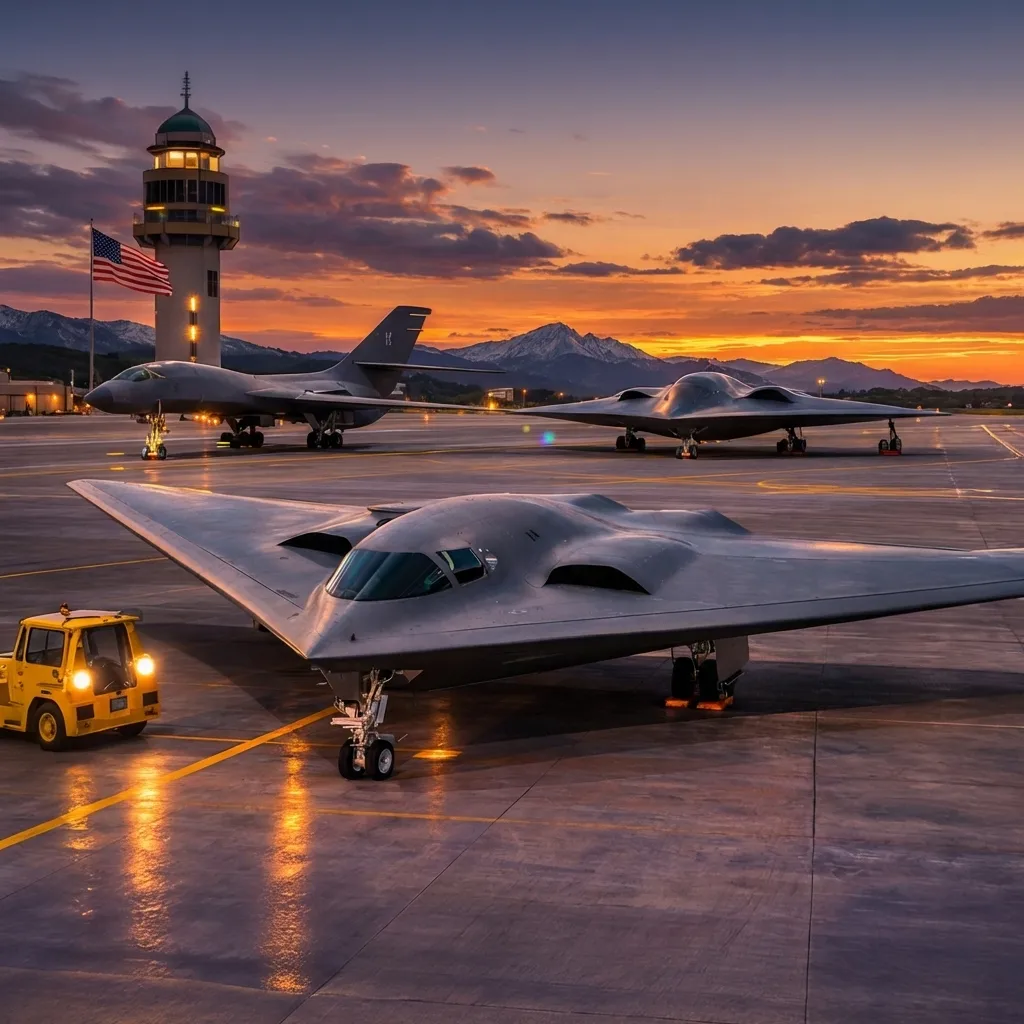
The hangar doors slide open before sunrise at Edwards Air Force Base. Engineers stand near a matte black silhouette under controlled light. The aircraft absorbs the glow rather than reflecting it. Every edge appears deliberate. Every surface carries the quiet logic of stealth design.
The B-21 Raider sits at the center of the United States’ next strategic shift in military aviation. Washington has committed $4.5 billion in additional funding to accelerate production of the aircraft. The investment moves beyond research and development. It focuses on scaling manufacturing, strengthening supply chains, and preparing the bomber fleet for long-term deployment.
This funding decision carries implications that extend far beyond a single aircraft program. Strategic bombers represent the airborne leg of the U.S. nuclear triad, a system designed to maintain credible deterrence across decades of geopolitical change. The B-21 Raider replaces aging platforms while introducing a digital architecture built for evolving missions.
Defense analysts often discuss aircraft in terms of capability. Range, payload, stealth profile. Yet the deeper story sits inside the production ecosystem. Building a modern stealth bomber requires a national industrial network, advanced materials engineering, and a manufacturing rhythm capable of delivering aircraft at scale.
The $4.5 billion allocation signals that the United States intends to accelerate that rhythm.
The Strategic Push Behind B-21 Bomber Production
The new funding initiative centers on expanding B-21 Bomber Production, which represents one of the most significant modernization efforts within the U.S. Air Force.
Strategic bombers have long served as instruments of deterrence and rapid response. Earlier aircraft such as the B-2 Spirit introduced stealth capabilities that allowed penetration of heavily defended airspace. However, those aircraft were produced in limited numbers due to extraordinary cost and manufacturing complexity.
The B-21 Raider follows a different philosophy. Designers built the aircraft with scalable production in mind. Engineers simplified certain manufacturing processes while maintaining the stealth geometry that defines the platform.
The additional $4.5 billion investment allows defense contractors to expand production facilities, train specialized aerospace technicians, and strengthen supplier networks responsible for critical components.
The strategic reasoning is clear. A small fleet of highly advanced aircraft carries influence. A larger fleet changes the balance of operational flexibility.
Military planners view the B-21 Raider as a bomber capable of long-range missions across multiple theaters. The aircraft integrates with space-based intelligence systems, satellite communications networks, and autonomous support platforms.
This integration means the bomber operates less like a solitary aircraft and more like a node inside a larger combat architecture.
Another factor shaping the push for faster production involves the retirement timeline of older bombers. Platforms such as the B-1B Lancer and portions of the B-2 Spirit fleet are approaching the limits of economical maintenance.
Accelerating B-21 Bomber Production ensures the United States maintains a credible long-range strike capability while transitioning away from aircraft designed during earlier strategic eras.
Sections of the aircraft structure move through specialized facilities where engineers assemble composite materials designed to absorb radar signals. These materials form the outer skin of the bomber. Their composition and layering patterns determine how effectively the aircraft blends into background electromagnetic noise.
Manufacturing teams handle these components within climate-controlled environments. Temperature, humidity, and surface contamination all affect the performance of stealth coatings.
The flying-wing design of the aircraft also requires extreme structural accuracy. Unlike conventional bombers with fuselages and tail sections, the B-21 integrates its lifting surfaces directly into the aircraft body.
Even slight misalignments could influence aerodynamic efficiency or radar signature.
Production engineers therefore rely heavily on digital modeling systems that simulate structural tolerances before components reach the assembly floor.
The $4.5 billion funding increase expands the capacity of these specialized facilities. More aircraft move through the system simultaneously, which shortens delivery timelines while maintaining strict quality control.
Technology Driving the Future of B-21 Bomber Production
Beyond physical manufacturing, the most important innovation behind the B-21 Raider lies within its digital architecture.
The aircraft functions as a software-driven platform rather than a fixed configuration machine. Engineers designed the avionics systems so that software updates can introduce new capabilities without redesigning the airframe.
This concept resembles the update cycles used in modern technology products. Mission systems evolve through software improvements, encryption updates, and integration with new sensors.
The approach ensures the bomber remains adaptable across decades of service.
Another technical feature involves the aircraft’s open systems architecture. Traditional military aircraft often rely on tightly integrated proprietary systems. Modifying those systems requires extensive redesign work.
The B-21 adopts a modular framework instead. Components such as sensors, communication systems, and electronic warfare tools can integrate into the aircraft more easily.
This design decision reduces long-term upgrade costs and accelerates the introduction of new technology.
Stealth engineering also benefits from advances in computational modeling. Earlier stealth aircraft required extensive physical testing to refine radar signatures.
The B-21 development program uses advanced simulation environments capable of modeling electromagnetic reflections with remarkable precision.
Engineers can test surface shapes, material combinations, and antenna placements within digital environments before constructing physical prototypes.
The aircraft’s propulsion system also contributes to its stealth profile. Air intake structures sit carefully within the aircraft body to reduce radar visibility and infrared emissions.
Thermal management systems disperse engine heat across specialized surfaces. This reduces the likelihood that infrared sensors will detect the aircraft from long distances.
Such details remain classified in many aspects. Yet the general principles illustrate how engineering disciplines converge within the bomber.
Aerodynamics, materials science, software architecture, and electronic warfare technology all intersect inside the same platform.
Global Implications of Accelerated Bomber Production
The decision to invest billions in B-21 Bomber Production reflects broader geopolitical calculations.
Strategic bombers remain one of the few military assets capable of projecting power across continents without reliance on forward bases.
Aircraft such as the B-21 Raider can travel intercontinental distances, deliver precision weapons, and return without landing.
This capability allows national leaders to maintain deterrence even in regions where access to allied bases may become uncertain.
Geopolitical competition also shapes the pace of bomber modernization.
Several nations are developing advanced air defense systems designed to detect and intercept traditional aircraft. Stealth bombers counter that challenge by reducing detection probability and extending operational reach.
The B-21 also fits into a broader network of military systems that includes satellite reconnaissance, cyber warfare platforms, and unmanned aerial vehicles.
Together, these systems create a layered approach to strategic defense.
Acceleration of bomber production therefore influences not only aircraft inventory numbers but also the architecture of future military operations.
Industrial Impact Across the Aerospace Sector
The B-21 Raider program extends far beyond a single contractor or production facility.
Hundreds of aerospace suppliers contribute specialized components to the bomber. These suppliers manufacture everything from advanced composite materials to precision avionics modules.
Expanding B-21 Bomber Production stimulates activity across this entire industrial network.
Aerospace technicians, materials engineers, and software developers all participate in the program’s supply chain.
Many of the technologies developed for military aircraft later influence civilian aerospace industries as well. Advanced materials research, manufacturing automation, and digital modeling techniques often migrate into commercial aviation over time.
Large defense programs therefore shape innovation trajectories across the broader aerospace sector.
The Long Horizon of Strategic Aviation
Strategic bombers operate on timelines measured in decades.
Aircraft delivered during the early years of B-21 Bomber Production may remain in service well into the middle of the century.
During that time, geopolitical landscapes will shift repeatedly. Technologies will evolve. Defense doctrines will adapt.
The design philosophy behind the B-21 Raider acknowledges this reality. Its modular architecture allows the aircraft to absorb new capabilities as they emerge.
The bomber therefore becomes less a fixed machine and more a platform for continuous evolution.
Inside the hangar at Edwards, technicians continue their quiet work around the aircraft. The outer surfaces reveal little about the complexity beneath them.
Stealth aircraft rarely advertise their presence. Their influence appears in the calculations made by adversaries who know such aircraft exist.
The investment in accelerated B-21 Bomber Production ensures that this influence will persist far beyond the news cycle surrounding a funding announcement.
FAQs
1. What is the B-21 Raider bomber?
The B-21 Raider is a next-generation stealth bomber developed for the U.S. Air Force, designed for long-range missions, advanced stealth capability, and integration with modern digital combat systems.
2. Why is the U.S. investing $4.5 billion in B-21 Bomber Production?
The funding accelerates B-21 Bomber Production, expands manufacturing capacity, and ensures the aircraft enters service quickly as older bombers retire.
3. How many B-21 bombers will be produced?
Defense planners expect at least 100 aircraft in the future fleet, though final numbers may increase depending on strategic requirements.
4. What makes the B-21 Raider different from older bombers?
The aircraft features advanced stealth materials, digital avionics architecture, open systems design, and long-range strike capability built for evolving missions.
5. When will the B-21 bomber enter operational service?
Initial operational deployment is expected later in the decade as B-21 Bomber Production ramps up and testing programs reach completion.