
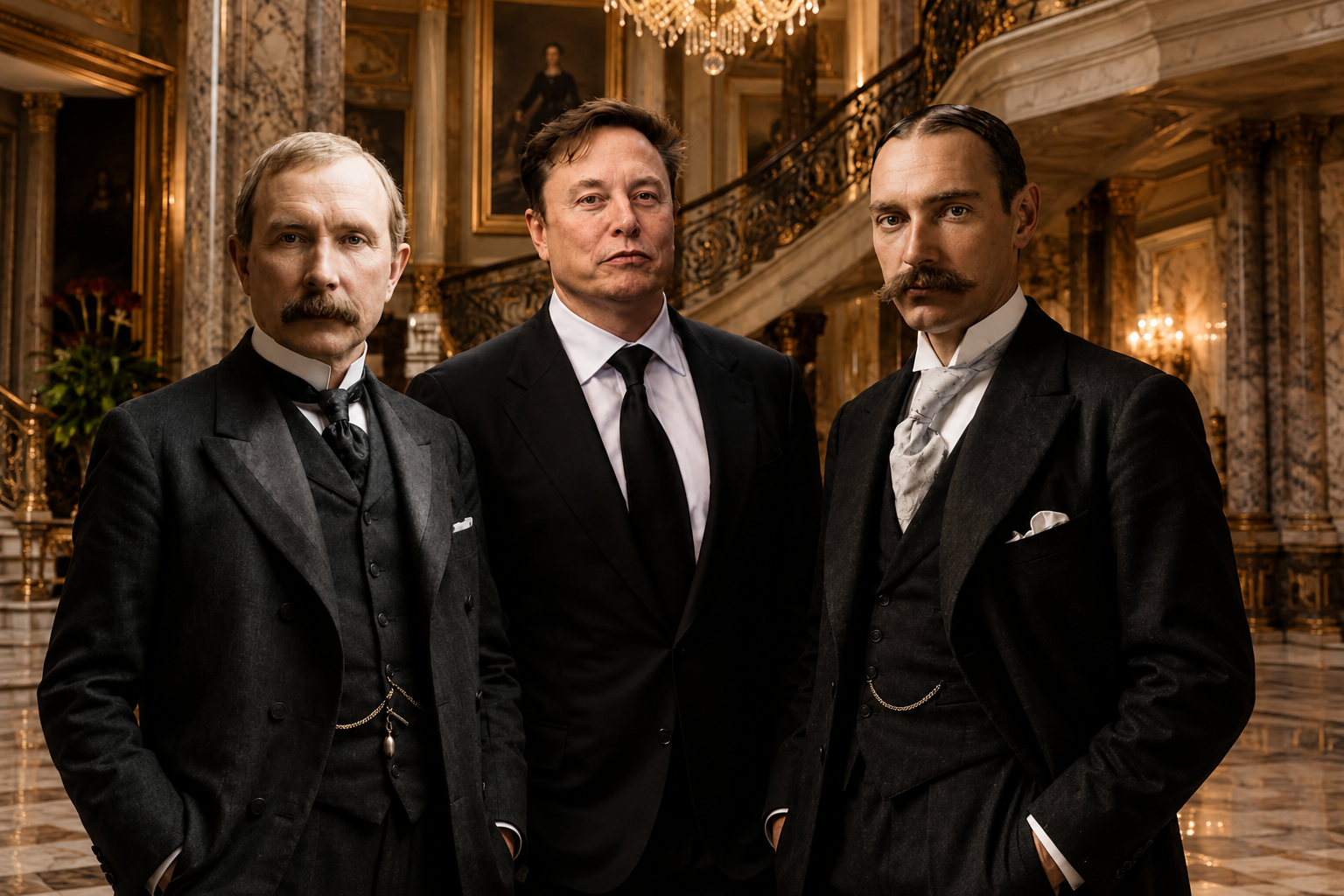
A century and a half ago, being a millionaire put you among the most powerful people on Earth. Today, there are millions of millionaires, thousands of billionaires, and serious analysts openly discussing when the world will see its first trillionaire. The story of the richest men in history is really a story about how wealth itself has changed: what creates it, how fast it grows, and how long it lasts.
Extraordinary Wealth Before Billionaires
Long before stock markets and tech start-ups, the largest fortunes belonged to rulers. Mansa Musa, who governed the Mali Empire in the 14th century, controlled vast gold and salt trade routes; his pilgrimage to Mecca in 1324 was so lavish that it reportedly depressed the price of gold in Cairo for years. Augustus Caesar effectively owned much of Roman Egypt. Their wealth was inseparable from political power.
The Industrial Revolution changed that. For the first time, private individuals could build fortunes that rivalled those of kings by owning factories, railways and trade networks. Manufacturing, steel, banking and later oil created opportunities on a scale the world had never seen.
The Empire Builders
In 19th-century America, a handful of industrialists became symbols of a new kind of wealth.
Cornelius Vanderbilt built his fortune in steamships and then railroads, assembling a transport network that tied the growing country together. Andrew Carnegie turned steel into an empire, selling Carnegie Steel in 1901 for around $480 million, a staggering sum at the time, before giving most of his fortune away to fund libraries, universities and foundations.
Then there was John D. Rockefeller. Through Standard Oil, he came to control the vast majority of America’s oil refining. By the time the company was broken up in 1911, he was widely considered the richest person in modern history. Adjusted for the size of the economy, many historians still rank him at or near the top.
What these men had in common was ownership of infrastructure: the systems everyone else depended on.
How Billionaires Changed the Rules
For much of the 20th century, billionaires were rare. That changed from the 1980s onward, as globalisation, deregulated financial markets and the rise of venture capital made it possible to build and scale companies faster than ever.
The key shift was the value of owning scalable businesses. A factory can only produce so much; a software product or global brand can be sold to millions without a matching increase in cost. Founders who held large equity stakes in such companies saw their personal wealth rise with the stock market, sometimes by tens of billions in a single year.
Technology and the Fastest Wealth Explosion in History
No industry has created wealth faster than technology. Software, e-commerce, social media, cloud computing and now artificial intelligence have produced fortunes within a single generation. Bill Gates became the world’s richest person in the 1990s on the back of Microsoft’s dominance. Jeff Bezos, Larry Page, Sergey Brin, Mark Zuckerberg and Larry Ellison followed.
The reason is network effects. Platforms used by billions of people become more valuable as more people join, creating exponential rather than linear growth. When that value is reflected in a company’s share price, the founders’ stakes can grow at a pace that would have been unimaginable to Rockefeller.
The First Trillionaire Has Arrived
The idea of a trillionaire once sounded like science fiction. In June 2026 it became reality, at least on paper. When SpaceX began trading on Nasdaq, Reuters calculations based on company filings put Elon Musk’s net worth above $1 trillion, and he was widely described as the world’s first trillionaire.
Others may eventually follow. The industries most likely to support trillion-dollar fortunes are those with global scale and huge future potential: artificial intelligence, advanced chips, space, robotics, energy and biotechnology. Still, such predictions depend heavily on market valuations, which can swing dramatically.
The Industries That Keep Creating Fortunes
Some sectors produce billionaires again and again:
- Technology, thanks to scalability and network effects.
- Finance and private equity, where capital compounds and management fees are tied to enormous asset pools.
- Energy, from oil in the past to renewables and infrastructure today.
- Luxury goods, where brands like those of Bernard Arnault’s LVMH command high margins and loyal customers.
- Healthcare and pharmaceuticals, driven by patents and global demand.
Industries that rely on thin margins or heavy competition rarely sustain fortunes across generations.
The Hidden Mechanics of Extreme Wealth
Behind the headlines, the biggest fortunes are usually held in equity, not cash. Founders own shares, often through holding companies, and rarely sell large amounts because doing so could trigger taxes and reduce control.
Wealth is then protected and passed on through family offices, trusts and foundations. Many billionaires borrow against their shares rather than selling them, using debt to fund spending while their assets continue to grow. Preserving wealth, it turns out, is often a more complex task than creating it.
Rankings Change, Influence Often Doesn’t
Net worth rankings can change overnight when share prices move. A tech founder might gain or lose $50 billion in a single week, yet their underlying business and influence barely change. Real economic power tends to come from owning lasting assets: companies, infrastructure, intellectual property and platforms that others depend on.
That is why the Rockefellers and Vanderbilts are still remembered, long after their fortunes were divided among heirs.
Lessons From History’s Greatest Fortunes
Across centuries, the same patterns repeat. The wealthiest people tend to own rather than earn, think in decades rather than quarters, reinvest relentlessly and adapt when the economy shifts. Rockefeller moved from refining into a wider oil empire; Bezos moved from books to cloud computing. Industries change, but the principles stay surprisingly consistent.
The Story Is Still Being Written
Every generation has believed it was witnessing the peak of personal wealth, only to be surpassed by the next. From Mansa Musa’s gold to Rockefeller’s oil to today’s AI and space fortunes, the scale keeps growing. The first trillionaire has now arrived, but history suggests that the names we remember will be those whose businesses changed how the world works, not just those with the biggest numbers.
FAQ
Who are the richest men in history adjusted for inflation?
Estimates vary widely, but Mansa Musa, Augustus Caesar and John D. Rockefeller are often ranked among the wealthiest ever. Comparisons across eras are difficult because economies, currencies and forms of wealth were so different.
Who is the world’s first trillionaire?
Elon Musk is widely described as the first, after SpaceX’s June 2026 stock market debut pushed his estimated net worth above $1 trillion. Because his wealth is mostly in shares, the figure moves with stock prices.
How did the richest men in history build their fortunes?
Mostly through ownership: of trade routes, infrastructure, industrial companies or scalable technology businesses, combined with long-term reinvestment.
Which industries create the most billionaires today?
Technology, finance and private equity, energy, luxury goods and healthcare produce the most billionaires, with artificial intelligence a fast-growing source of new fortunes.
What is the difference between a millionaire, billionaire and trillionaire?
A millionaire has assets of at least $1 million, a billionaire at least $1 billion and a trillionaire at least $1 trillion. In practice, each step up also means ownership of far larger businesses and much greater economic influence.