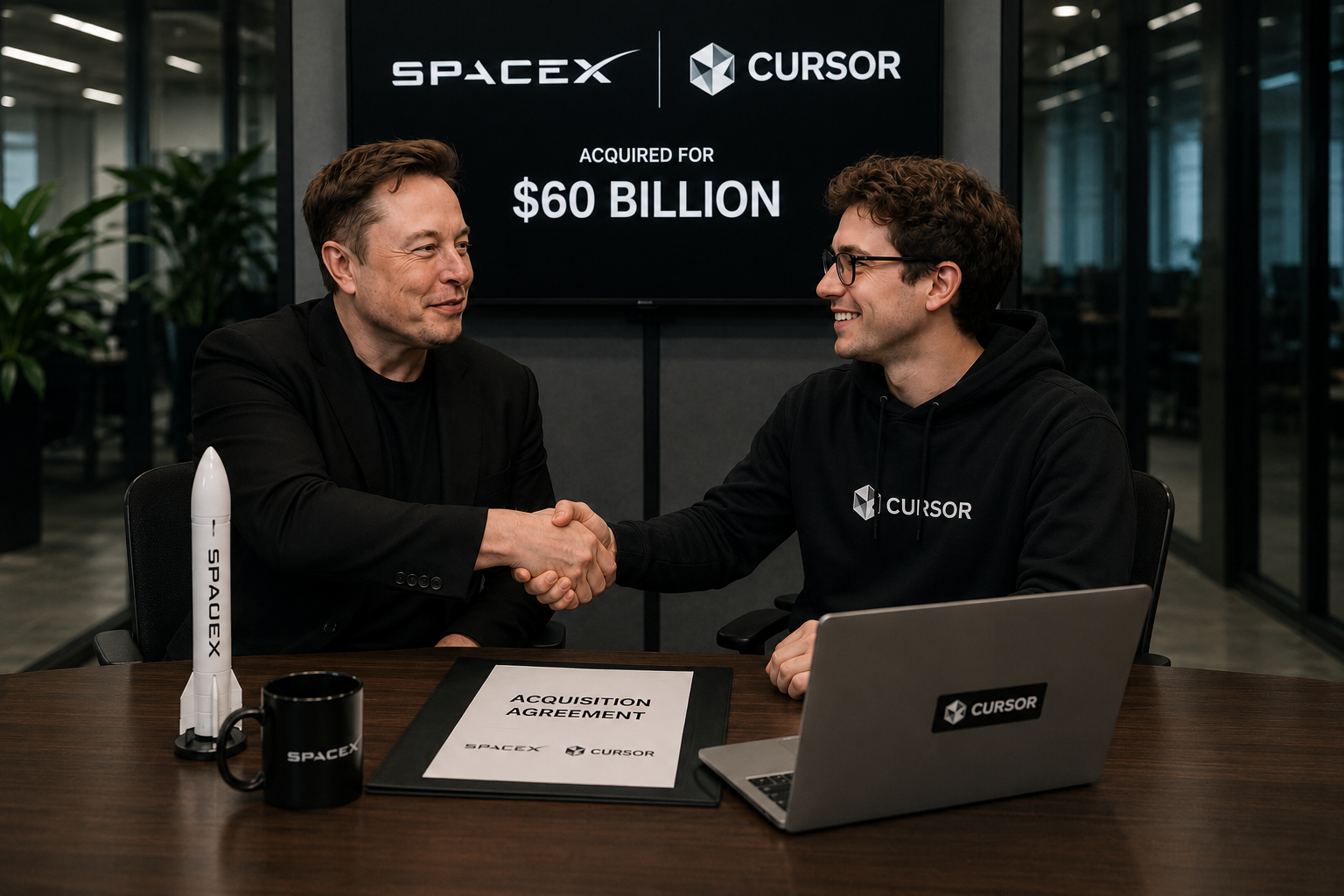
SpaceX built its reputation on rockets and satellites. In 2026, it made one of the biggest bets in the history of artificial intelligence. Just days after its blockbuster Nasdaq debut, Elon Musk’s company agreed to buy Anysphere, the maker of AI coding assistant Cursor, in an all-stock deal valued at $60 billion. The SpaceX Cursor acquisition was announced in June and became effective in mid-August, according to a regulatory filing.
It ranks among the largest acquisitions of a venture-backed start-up ever, and it says a great deal about where Musk believes the next wave of value will come from.
Why the Deal Matters
AI-assisted coding has become one of the first areas where artificial intelligence is producing serious, recurring business revenue. Companies are paying for tools that help their engineers write, test and fix software faster, and Cursor has been one of the clear leaders.
For SpaceX, which merged with Musk’s AI company xAI earlier in 2026, buying Cursor offers an immediate foothold in that market. Rather than building a competing product from scratch, it acquired one of the most popular coding platforms in the world, along with its team and customers.
How Cursor Became So Valuable
Cursor was founded in 2022 by a group of young MIT graduates, including chief executive Michael Truell, Aman Sanger and Sualeh Asif. Its AI-powered code editor launched in 2023 and quickly became a favourite among developers, helping to define what is now often called “vibe coding”: describing what you want in plain language and letting AI handle much of the writing.
Growth was extraordinary. Reports ahead of the deal put Cursor’s annualised business revenue at around $2.6 billion. The company had raised about $3.3 billion from investors including Nvidia, Google, Accel, Thrive Capital and Andreessen Horowitz, and was valued at close to $30 billion after a funding round in late 2025. The SpaceX deal roughly doubled that figure.
How the $60 Billion Deal Was Structured
The acquisition was paid entirely in SpaceX stock, made possible by the company’s recent listing. Reports say SpaceX had secured an option earlier in the year to either buy Cursor for $60 billion or pay $10 billion for a working partnership. Once the IPO was complete, it chose the full acquisition.
Cursor now operates as a wholly owned subsidiary. Its co-founders, who each held a stake of around 4.5%, became billionaires several times over as a result.
How AI Coding Is Changing Software Development
AI coding tools do much more than autocomplete. They can read an entire codebase, suggest changes across many files, explain unfamiliar code, write tests and fix bugs. In many companies, developers now spend more time reviewing and directing AI-generated code than typing it themselves.
The productivity gains are significant, which is why businesses are willing to pay. That revenue potential is a big part of why Cursor commanded such a high price.
What SpaceX Gains
The most obvious benefit is a stronger position in AI. SpaceX and Cursor had already been training a coding-focused model together, which they released mid-year, and the combined company has since rolled out further AI products. Musk told staff in an August meeting that the company must succeed in software and predicted that AI revenue would soon outgrow the rest of SpaceX’s business.
There are also internal benefits. SpaceX and Starlink run enormous amounts of software, from rocket guidance to satellite networks. Better AI coding tools could help its own engineers move faster.
Competition Across the AI Industry
The deal raises the stakes in an already intense race. OpenAI, Anthropic, Google, Microsoft and others are all investing heavily in AI tools for developers, and coding has become one of the most hotly contested markets in the industry.
By owning Cursor outright, SpaceX gains a large, loyal user base and a product that developers already like. Rivals will be watching closely to see whether that base stays loyal under new ownership.
Investor Reaction
Markets responded positively at first. SpaceX shares rose after the announcement, lifting the company’s market value to well above $2.5 trillion, according to reports at the time. Investors appeared to welcome a clear, revenue-generating AI business inside a company best known for space.
Still, the price is steep. Paying around 23 times Cursor’s reported revenue assumes that rapid growth will continue for years.
The Challenges Ahead
Big technology acquisitions are notoriously hard to get right. SpaceX will need to keep Cursor’s engineers motivated, preserve the product’s independence and avoid alienating customers who may be wary of Musk’s other businesses. Developers who use competing AI models inside Cursor will also be watching whether the platform stays open.
Integration with xAI’s models adds another layer of complexity. And as with any deal of this size, the true test will be whether the expected revenue growth materialises.
What It Could Mean for the Future of AI
The SpaceX Cursor acquisition shows how central AI has become to the strategies of the world’s largest companies. It also shows how quickly value is being created in this space: a start-up founded in 2022 was worth $60 billion within four years.
Whether the bet pays off will take time to judge. But it has already reshaped the AI coding market and signalled that Musk intends SpaceX to be as much an AI company as a rocket company.
FAQ
What is the SpaceX Cursor acquisition?
SpaceX agreed in June 2026 to acquire Anysphere, the company behind AI coding assistant Cursor, in an all-stock deal valued at $60 billion. The acquisition became effective in August 2026.
Why did SpaceX buy Cursor?
To strengthen its AI business, which includes xAI, with a leading coding product that already generates billions in annual revenue.
How does Cursor make money?
Mainly through subscriptions from developers and businesses that use its AI-powered code editor to write, review and fix software.
Could the deal reshape the AI industry?
It increases competition in AI coding tools and gives SpaceX a major position in one of AI’s most profitable markets.
What are the biggest risks?
Retaining Cursor’s team and customers, integrating its technology with xAI and justifying the high price through continued growth.