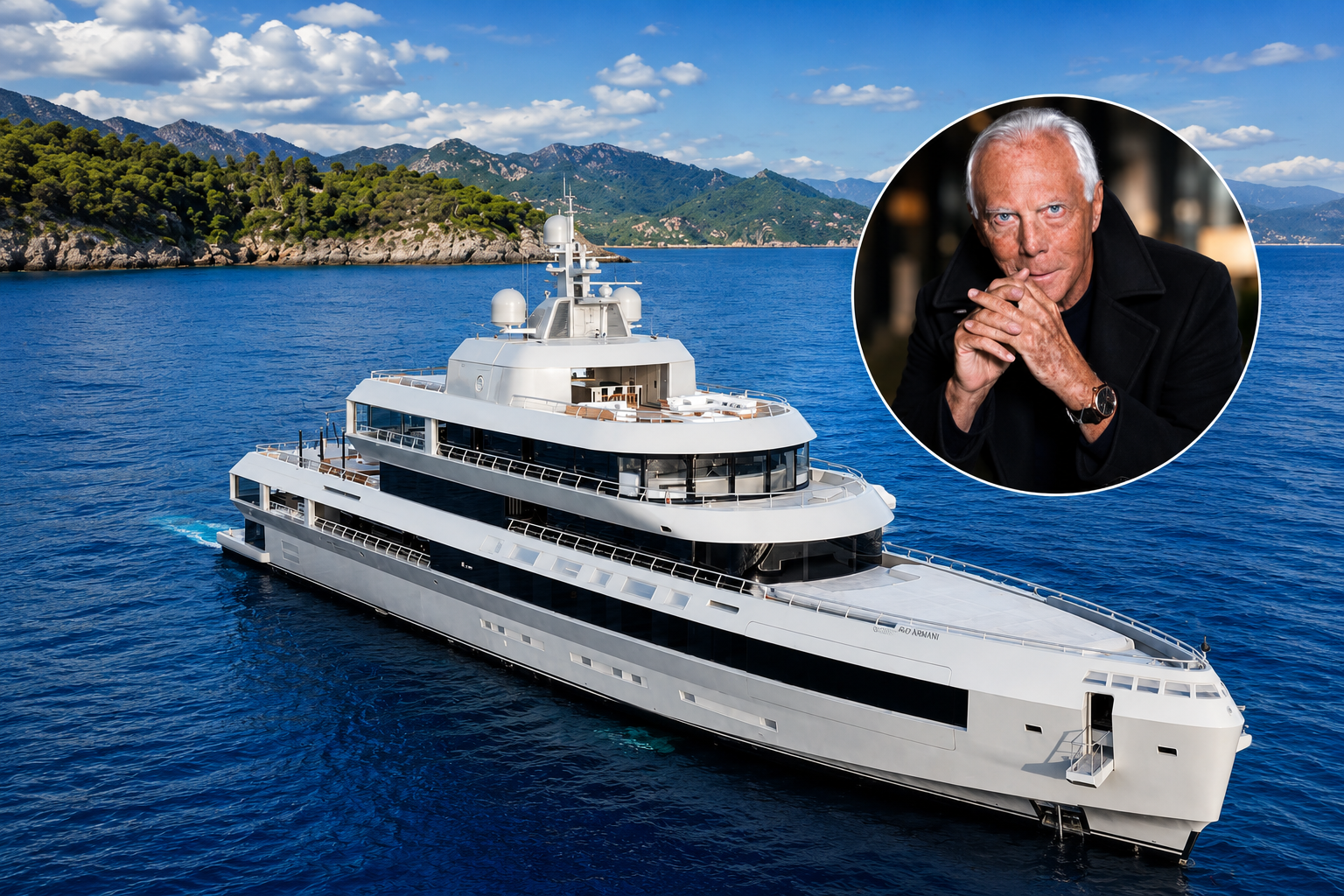
Giorgio Armani spent half a century teaching the world that elegance does not need to shout. Fittingly, one of the last projects he personally oversaw before his death in September 2025 was not a dress or a suit, but a 72-metre superyacht that carries the same quiet confidence as his finest tailoring.
Built by The Italian Sea Group under its Admiral brand and valued by the shipyard at around €155 million (roughly $150 million or more), the Giorgio Armani superyacht is a floating summary of everything the designer stood for: restraint, proportion and an obsession with materials.
The Vision Behind Armani’s Final Yacht
Armani’s influence reached far beyond the catwalk. Over the decades he designed hotels, homes, furniture through Armani/Casa and even yacht interiors. The sea was personal to him too; for years he cruised the Mediterranean aboard his own dark green superyacht, Main.
The Admiral 72 brought those worlds together. Developed in collaboration with The Italian Sea Group, it was conceived as a complete Armani environment, from the shape of the decks to the texture of the cabinetry. Rather than adding ornament, the design aims to create calm.
Why a $150 Million Yacht Draws Global Attention
Superyachts in this bracket are among the rarest objects in the luxury world. Each one takes years to design and build, involves hundreds of specialists and is tailored to the tastes of a single owner. Value comes not just from size, but from custom engineering, handcrafted interiors and the name attached to the project.
In this case, the name is the story. As the final yacht shaped under Armani’s personal guidance, it carries a significance that no other vessel can replicate.
Exterior Design: Speaking Through Restraint
From the outside, the yacht is defined by clean, uninterrupted lines. Flush decks with no visible steps create long, open surfaces, while floor-to-ceiling windows framed in satin aluminium blur the line between inside and outside.
Restraint like this is harder than it looks. With fewer decorative elements, every proportion, joint and curve becomes more noticeable. The result is a profile that looks composed rather than flashy, very much in keeping with Armani’s approach to clothing.
Inside the Armani Superyacht
The interiors were created by Armani/Casa under the designer’s direct supervision. The material palette is rich but controlled: black marble, ivory onyx and walnut, accented with touches of gold and platinum leaf.
The yacht accommodates up to 14 guests in seven suites. The owner’s deck alone covers around 180 square metres, with a private lounge that converts into a cinema. Elsewhere, a 93-square-metre aft deck, a wellness area with massage room, a gym, an open-air cinema on the sun deck and a helipad round out the amenities.
Engineering Hidden Beneath the Luxury
Behind the calm interiors is the serious engineering every modern superyacht demands. Stabilisation systems keep the boat steady at anchor and underway, while soundproofing and vibration isolation keep engines and generators from disturbing guests. Climate control, water treatment and power systems all have to run quietly and reliably for weeks at a time.
The best yachts hide all of this completely. Guests only notice the absence of noise and motion, which is exactly the point.
How Custom Superyachts Are Built
A yacht of this size typically takes several years from first sketches to delivery. Naval architects, engineers and interior designers work in parallel, refining everything from hull shape and deck layouts to furniture details. The hull and superstructure are built and joined, systems are installed, and then the slow work of fitting out interiors begins.
Every choice, from the stone in the bathrooms to the stitching on the sofas, has to meet marine standards for weight, safety and durability. That is part of why bespoke yachts are so expensive.
A New Owner and a New Name
Before delivery, the yacht was marketed under the name Geco. In December 2025, its sale was confirmed in an off-market deal to the Del Vecchio family, major shareholders in eyewear giant EssilorLuxottica. The new owners renamed it No Rush, a name that suits the yacht’s unhurried character.
What It Says About Modern Luxury
The Armani yacht reflects a wider shift in high-end taste. Many of today’s wealthiest buyers prefer subtle design and exceptional materials over conspicuous display. Comfort, privacy and craftsmanship matter more than size alone.
In that sense, the yacht is a perfect expression of “quiet luxury”, a phrase that could almost have been invented to describe Armani’s career.
Armani’s Legacy Beyond Fashion
Giorgio Armani built a global empire from Milan, redefining menswear in the 1970s and 80s with unstructured jackets and soft tailoring, then expanding into couture, fragrance, hotels and home design. He remained deeply involved in his company until the end.
The Admiral 72 shows that his design language was never limited to clothes. It was a way of seeing the world, and it translated naturally to architecture, interiors and the sea.
The Future of Bespoke Yacht Design
Collaborations between fashion houses and shipyards have become more common, and this project will likely inspire more. Buyers increasingly want yachts that feel like an extension of a personal or brand identity, not just a large boat. Armani’s final yacht sets a high bar for how to do that with taste.
FAQ
What makes the Giorgio Armani superyacht unique?
It was the last yacht project Giorgio Armani personally oversaw, combining The Italian Sea Group’s engineering with interiors created by Armani/Casa under his direction.
How much is the Armani superyacht worth?
The shipyard estimated its value at around €155 million, roughly $150 million or more.
Who designed it?
The yacht was developed by The Italian Sea Group under its Admiral brand in collaboration with Giorgio Armani, with interiors by Armani/Casa.
What features does it have?
Seven guest suites for 14 people, a large owner’s deck with a cinema lounge, a wellness area, gym, open-air cinema and helipad.
Who owns the yacht now?
It was sold in late 2025 to the Del Vecchio family and renamed No Rush.