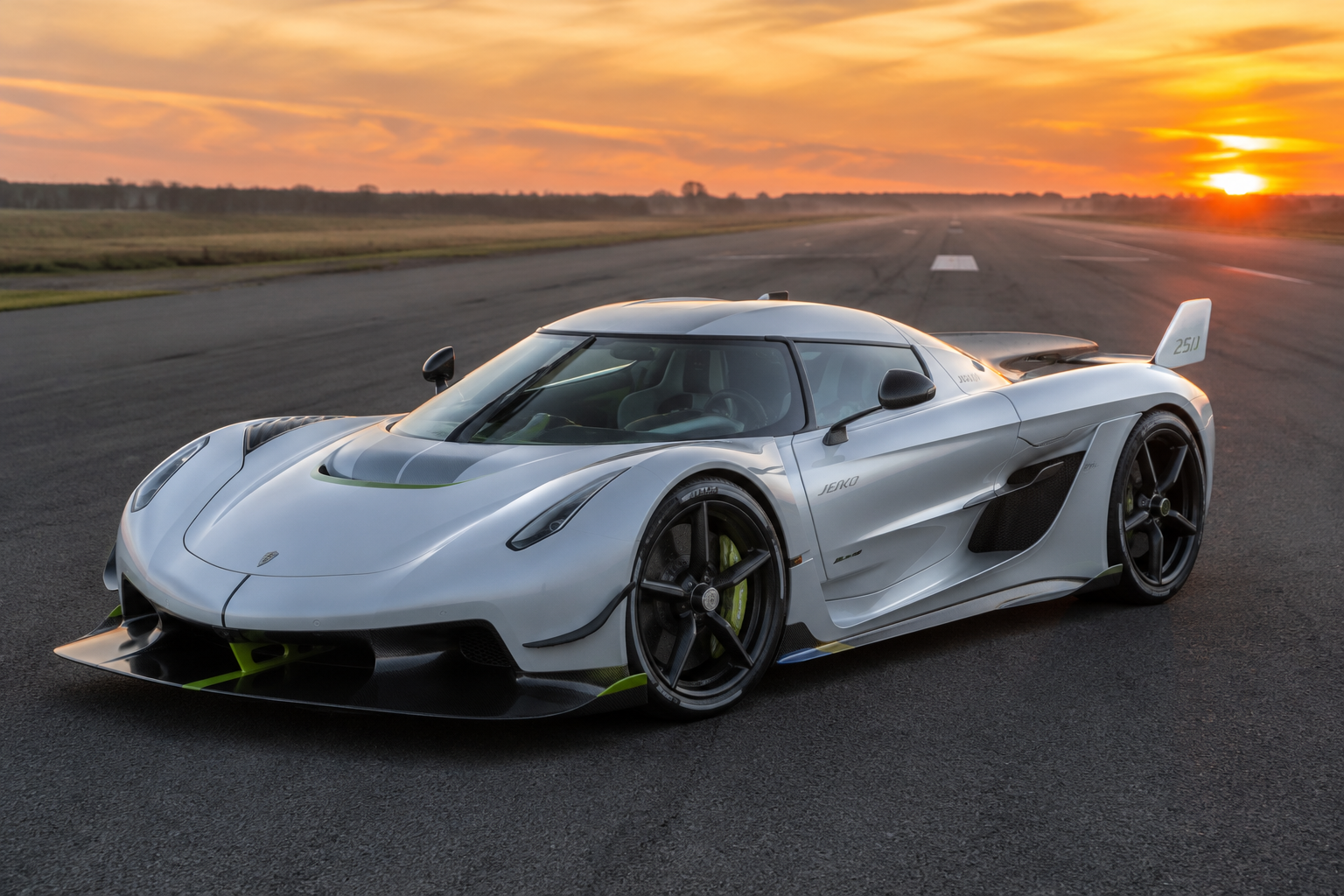
The runway stretches into a pale horizon somewhere in southern Sweden while heat rises gently off the asphalt. Mechanics move quietly around a low silver shape that appears less like a traditional car and more like compressed aerospace engineering. There is no dramatic engine revving yet, only the sound of cooling fans and brief radio conversations between engineers studying airflow, tire temperatures, and telemetry. The fascination surrounding the Koenigsegg Jesko Absolut top speed exists because the car occupies an unusual position in modern automotive history. It has been designed for approximately 330 miles per hour, a number that pushes beyond the limits most production vehicles even attempt to approach, yet no official top-speed verification run has taken place publicly. That absence has only intensified the mythology. The Jesko Absolut represents a machine built almost entirely around one objective: reducing resistance to forward motion until physics itself becomes the primary opponent.
Why Koenigsegg Built the Jesko Absolut
Many hypercars chase lap times, visual drama, or hybrid performance complexity. The Jesko Absolut pursues something more singular and arguably more difficult: maximum speed through aerodynamic efficiency and mechanical stability. Christian von Koenigsegg reportedly described it as the fastest car the company would ever attempt to produce. That statement matters because Koenigsegg rarely approaches engineering casually. The Koenigsegg Jesko Absolut top speed conversation is rooted in a philosophy of relentless optimization where every surface, airflow channel, and drivetrain component serves a specific high-speed purpose. Hypercar engineering, top-speed development, and Swedish performance design define a project focused less on marketing spectacle and more on pushing the edge of production-car possibility.
The Aerodynamics and the Science of Reducing Drag
Extreme speeds, air becomes the greatest mechanical challenge. The Jesko Absolut differs visually from the track-focused Jesko Attack because it removes large aerodynamic elements designed for downforce and replaces them with cleaner body shaping optimized for reduced drag. The rear fins stabilize airflow while the elongated body minimizes turbulence at high velocity. The mechanism reveal becomes important here because achieving 330 mph requires balancing aerodynamic slipperiness with directional stability. A car can reduce drag aggressively, yet if airflow becomes unstable at speed, the vehicle turns dangerous almost immediately. The Koenigsegg Jesko Absolut top speed therefore depends heavily on active aerodynamics, drag coefficient optimization, and high-speed airflow management rather than brute horsepower alone.
The Twin-Turbo V8 and Why It Still Matters in the Hybrid Era
While many manufacturers move toward electrified hypercars, Koenigsegg continues refining the internal combustion engine with almost obsessive intensity. The Jesko Absolut uses a twin-turbocharged V8 capable of producing extraordinary power figures depending on fuel type. Yet raw horsepower alone does not explain the car’s appeal. The engine remains remarkably compact and lightweight relative to its output. The mechanism behind this performance includes flat-plane crank architecture, advanced turbocharging systems, and meticulous thermal management. Within discussions surrounding the Koenigsegg Jesko Absolut top speed, high-performance combustion engines, twin-turbo V8 technology, and lightweight powertrains demonstrate why Koenigsegg still believes combustion engineering has not reached its final chapter.
The Light Speed Transmission and How It Actually Works
One of the Jesko’s most technically ambitious features is its Light Speed Transmission, a gearbox system designed to perform near-instant gear changes without the interruptions associated with conventional dual-clutch systems. Traditional transmissions shift sequentially through ratios. Koenigsegg’s setup allows rapid multi-gear transitions almost instantly using a combination of wet clutches and highly advanced electronic control systems. The mechanism reveal matters because maintaining uninterrupted acceleration becomes increasingly important as aerodynamic resistance grows exponentially at higher speeds. In the wider conversation around the Koenigsegg Jesko Absolut top speed, Light Speed Transmission, multi-clutch gearboxes, and high-speed acceleration engineering explain how the car attempts to preserve momentum deep into velocity ranges most vehicles never approach.
Tires, Stability, and the Real Barrier Beyond 300 MPH
Approximately 330 mph, tires become one of the greatest engineering risks. Rotational forces, heat buildup, and structural deformation reach levels rarely encountered outside aerospace applications. This is one reason why officially testing the Jesko Absolut at full claimed speed remains extraordinarily difficult. Suitable roads or runways are limited, weather conditions must align perfectly, and tire technology itself becomes part of the challenge. The Koenigsegg Jesko Absolut top speed therefore depends on more than engine output or aerodynamics. Hypercar tire engineering, high-speed stability, and vehicle dynamics become decisive factors once speeds exceed the limits of ordinary automotive testing environments.
Why Koenigsegg Has Not Conducted an Official Top-Speed Run
The absence of a verified top-speed record has become part of the car’s identity. Public expectations are enormous, and any official run requires perfect conditions involving road closures, safety teams, engineering validation, and tire certification. There is also strategic restraint involved. Koenigsegg appears less interested in publicity-driven speed theatrics and more focused on delivering a fully engineered capability package. The Koenigsegg Jesko Absolut top speed remains compelling partly because it exists in theoretical territory supported by engineering calculations rather than headline-generating demonstrations. Hypercar testing, speed verification, and engineering validation explain why proving such numbers publicly is vastly more complicated than producing them on paper.
Interior Design, Minimalism at 300 MPH
Despite its extreme capability, the Jesko cabin avoids unnecessary drama. Carbon fiber structures, compact displays, and highly functional controls create an environment focused on visibility and control rather than decorative luxury. Seating positions are low and centered carefully within the chassis to improve feedback during high-speed driving. Yet subtle details still reveal craftsmanship. Exposed weave patterns, precision-machined components, and restrained material choices create an atmosphere closer to aviation engineering than grand touring comfort. In the broader context of the Koenigsegg Jesko Absolut top speed, driver-focused interiors, carbon fiber cabins, and minimalist hypercar design reinforce the idea that every unnecessary element has been removed in service of performance.
How the Jesko Absolut Compares to Bugatti and Other Hypercars
Bugatti traditionally approaches speed through immense power and luxury refinement, creating vehicles that feel stable and composed at extraordinary velocity. Koenigsegg pursues a lighter, more technically aggressive philosophy emphasizing weight reduction, mechanical innovation, and aerodynamic precision. The Jesko Absolut therefore feels less like a grand touring machine and more like an experimental engineering object built for maximum efficiency. Within conversations surrounding the Koenigsegg Jesko Absolut top speed, Bugatti comparisons, record-breaking hypercars, and lightweight performance engineering frame two very different interpretations of modern automotive extremity.
The Meaning of an Untested 330 MPH Claim
The most interesting aspect of the Jesko Absolut may not be whether it eventually reaches 330 mph officially. It may be the fact that manufacturers still pursue numbers this ambitious at all. Hypercars increasingly exist as technological statements rather than practical transportation devices. The Jesko Absolut reflects a belief that engineering ambition itself still carries cultural value even when few owners will ever approach the vehicle’s limits. The deeper implication behind the Koenigsegg Jesko Absolut top speed is that modern automotive prestige now depends as much on theoretical capability and technical audacity as on real-world usability.
FAQ
What is the claimed top speed of the Koenigsegg Jesko Absolut?
Koenigsegg has suggested the Jesko Absolut is theoretically capable of reaching approximately 330 mph under the right conditions.
Has the Jesko Absolut officially reached 330 mph?
No. As of now, no public or officially verified top-speed test has confirmed the car reaching its claimed maximum speed.
What engine does the Jesko Absolut use?
The car uses a highly advanced twin-turbocharged V8 engine paired with Koenigsegg’s Light Speed Transmission system.
Why is the Jesko Absolut different from the Jesko Attack?
The Jesko Absolut is optimized for top speed with reduced aerodynamic drag, while the Jesko Attack focuses more heavily on downforce and track performance.
Why are 300+ mph tests so difficult?
Extreme speeds create major challenges involving tire durability, aerodynamics, road conditions, weather, safety logistics, and engineering validation.