The cabin lights dim softly somewhere over the Arabian Sea while a bottle of still water slides silently into a recessed marble holder beside a full-size bed. Behind a closed partition, two advisers continue reviewing acquisition documents at a conference table under warm indirect lighting. Further forward, a chef plates late-night sashimi in a galley larger than many Manhattan apartments. This is not the atmosphere of a traditional business jet. It feels closer to a private residence moving through the stratosphere at nearly 40,000 feet. The fascination surrounding Airbus ACJ TwoTwenty interior specs comes from this exact contradiction. Airbus has taken the engineering platform of a modern commercial aircraft and reshaped it into something intensely private, a flying environment where owners can sleep properly, host discreet meetings, and move between continents without adjusting themselves to the limitations of conventional aviation cabins. For buyers accustomed to yachts, estates, and fully staffed households, the aircraft offers continuity rather than compromise.
Why Airbus Created the ACJ TwoTwenty
Traditional business jets serve speed and efficiency exceptionally well, yet many ultra-high-net-worth buyers began demanding something closer to residential travel. Airbus recognized a widening gap between executive aviation and true onboard livability. The ACJ TwoTwenty was developed to occupy that space directly, using the Airbus A220 airframe as the foundation for a highly customized private aircraft with significantly more usable cabin volume than many long-range competitors. The Airbus ACJ TwoTwenty interior specs matter because they reveal a different ownership philosophy. Buyers are no longer asking only how fast or how far an aircraft can fly. They are asking how naturally life can continue onboard during fourteen-hour sectors between global residences and financial capitals. Bizliners, VIP airliners, and ultra-long-range private aircraft define a category where architecture becomes just as important as aerodynamics.
First Impressions Inside the Cabin, Space Changes Human Behavior
The first sensation onboard is not luxury. It is relief. Passengers accustomed to crossing oceans inside narrow business jet cabins notice immediately how differently the body reacts to space. The ACJ TwoTwenty offers high ceilings, wide walkways, and distinct zones that allow movement without interruption. Lounge areas feel genuinely separated from dining and sleeping quarters rather than compressed into multifunction layouts. This matters more psychologically than many specification sheets suggest. Fatigue accumulates differently when passengers can walk naturally, hold private conversations without crowding, and shift between environments during long-haul flights. Within discussions about Airbus ACJ TwoTwenty interior specs, wide-cabin comfort, residential aviation design, and passenger wellness become central because the aircraft fundamentally changes how long-distance travel feels over time.
The Master Suite and the Shift Toward Residential Aviation
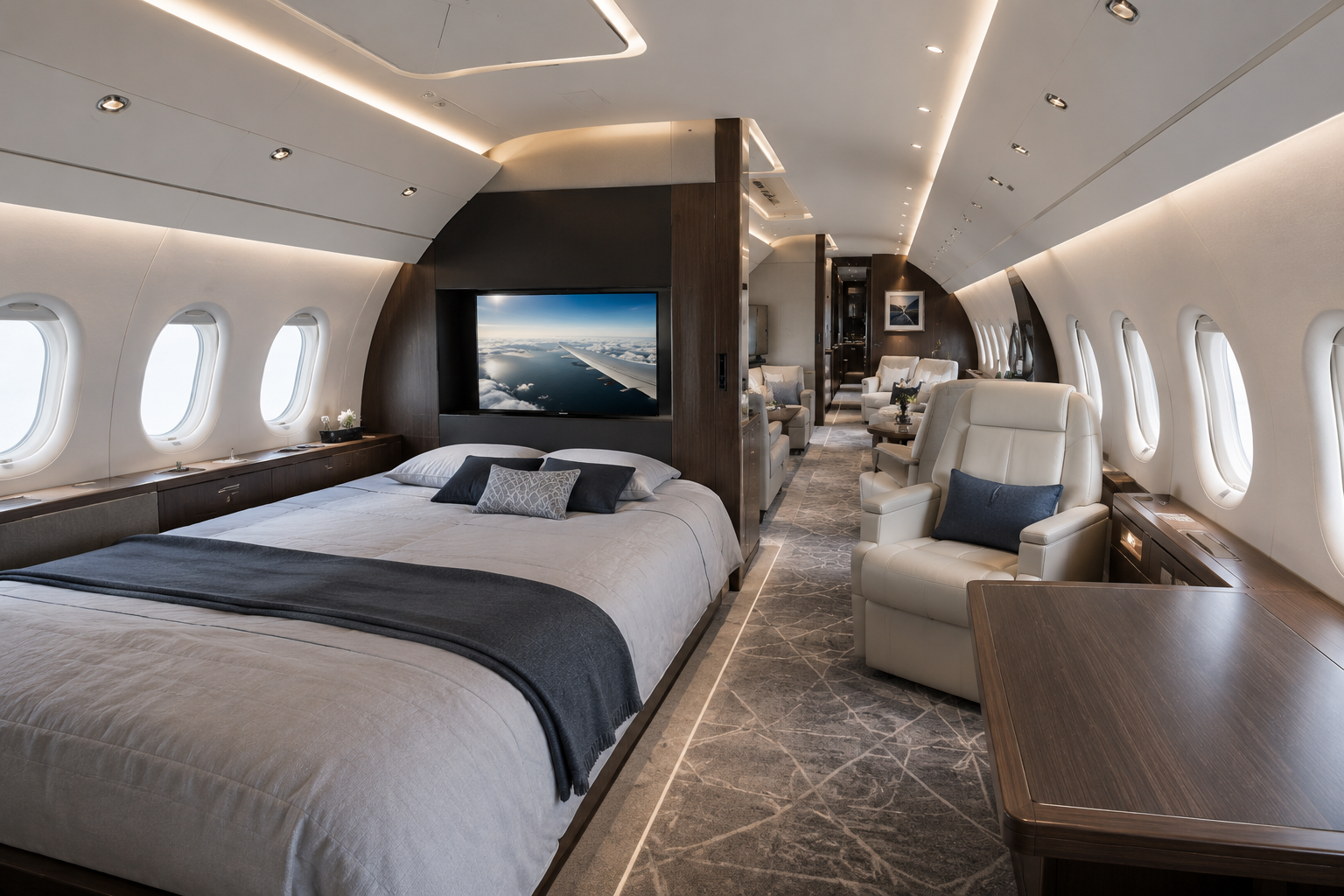
The defining feature onboard is the master suite positioned toward the rear of the aircraft. This is not a reclining seat marketed as a bedroom. It is an actual sleeping environment with a full-size bed, lounge seating, wardrobe storage, and enough spatial separation to create genuine privacy. Some configurations even integrate shower facilities and dedicated dressing areas. The mechanism behind this luxury involves complex weight distribution calculations and highly specialized interior engineering. Every added partition, cabinet, and plumbing system affects aircraft balance and fuel efficiency. The Airbus ACJ TwoTwenty interior specs become especially compelling here because Airbus successfully preserves long-range capability while delivering a cabin experience that feels closer to a private yacht than traditional aviation. Flying master suites, private jet bedrooms, and luxury cabin architecture sit at the center of this transformation.
Cabin Zoning and How the Aircraft Functions Like a Penthouse
One reason family offices and multinational principals are increasingly interested in the ACJ TwoTwenty is its ability to create distinct onboard environments simultaneously. Lounge spaces, dining rooms, private offices, wellness areas, and sleeping quarters can all operate independently without visual or acoustic conflict. The aircraft’s floorplan allows designers to install partitions and furniture arrangements that create natural transitions between spaces. This mechanism matters because zoning changes how passengers use time inflight. Meetings can continue while family members rest privately several zones away. In conversations surrounding Airbus ACJ TwoTwenty interior specs, modular cabin layouts, executive meeting spaces, and multi-zone interiors explain why bizliners are becoming increasingly attractive to owners managing complex global lifestyles.
The Technology Behind the Silence
The aircraft feels unusually calm not because noise disappears naturally at altitude, but because engineers work aggressively to remove vibration and acoustic intrusion from the cabin environment. Advanced insulation layers, optimized airflow systems, and carefully calibrated pressure management create an atmosphere that reduces fatigue over long sectors. Airbus benefits from designing the platform originally for commercial airline efficiency before adapting it for private aviation. The Airbus ACJ TwoTwenty interior specs therefore reveal how engineering invisibility shapes luxury more effectively than decorative excess. Cabin pressurization systems, noise isolation technology, and air quality engineering influence passenger well-being long after landing, particularly for owners moving continuously between time zones and business obligations.
Materials, Finishes, and Why Modern Luxury Became More Restrained
Older VIP aircraft often emphasized polished wood, glossy veneers, and overt visual opulence. The ACJ TwoTwenty reflects a newer design language shaped more by contemporary architecture than traditional aviation interiors. Matte woods, textured stone surfaces, brushed metals, and indirect lighting create a calmer visual rhythm throughout the cabin. Yet these materials are selected through highly technical processes. Weight restrictions, flammability certification, and long-term vibration resistance all influence design choices. The Airbus ACJ TwoTwenty interior specs therefore combine residential warmth with aviation-grade engineering discipline. Bespoke aircraft interiors, custom aviation materials, and minimalist luxury design define a cabin environment built for extended living rather than theatrical display.
Range, Performance, and the Economics of Flying Larger
The ACJ TwoTwenty occupies an unusual position within private aviation because it offers significantly larger living areas without fully entering the scale and operational complexity of larger VIP airliners. Its intercontinental range allows owners to connect major global cities nonstop while carrying relatively few passengers in extraordinary comfort. Operationally, this creates an appealing middle ground. Buyers receive airline-derived reliability and cabin volume without the infrastructure demands associated with much larger aircraft. In the context of Airbus ACJ TwoTwenty interior specs, long-range capability, global mobility, and private aviation efficiency explain why some owners are moving away from traditional flagship business jets toward larger, more residential aircraft categories.
Comparing the ACJ TwoTwenty to Gulfstream and Bombardier Flagships
Compared with long-range business jets from Gulfstream and Bombardier, the ACJ TwoTwenty trades certain advantages in speed and airport flexibility for dramatically increased interior space. Traditional business jets remain exceptionally efficient for smaller executive groups and shorter operational windows. The Airbus counters with lifestyle continuity. Passengers can dine properly, sleep fully flat in private suites, and conduct multi-hour meetings without converting spaces repeatedly. The Airbus ACJ TwoTwenty interior specs reveal a different interpretation of private aviation where the cabin itself becomes the primary selling point rather than pure performance figures. Bizliner comparisons, private aviation strategy, and luxury travel ecosystems frame this evolving ownership mindset.
Why Billionaires Are Treating Aircraft Like Mobile Residences
For many ultra-high-net-worth buyers, aircraft are no longer viewed as transportation alone. They are extensions of homes, offices, and family infrastructure. Owners expect continuity between their residences, yachts, and aircraft rather than adapting themselves to travel environments. The ACJ TwoTwenty reflects this shift clearly. Passengers can maintain routines, privacy, wellness, and productivity during flights that once required compromise. The deeper implication surrounding Airbus ACJ TwoTwenty interior specs is not simply about cabin size. It concerns how private aviation is evolving toward fully integrated living environments designed around the rhythms of global wealth and continuous mobility.
FAQ
What is the Airbus ACJ TwoTwenty?
The Airbus ACJ TwoTwenty is a luxury private aircraft based on the Airbus A220 commercial platform, redesigned with highly customized interiors for ultra-long-range executive travel.
Does the ACJ TwoTwenty have a bedroom?
Yes. Most layouts include a dedicated master suite with a full-size bed, lounge seating, storage areas, and optional shower facilities.
How large is the ACJ TwoTwenty cabin?
The aircraft offers substantially more cabin volume than many traditional long-range business jets, allowing multiple living and working zones onboard.
Who typically buys the Airbus ACJ TwoTwenty?
Buyers usually include billionaires, family offices, heads of state, and multinational executives seeking residential-level comfort during global travel.
Why is the ACJ TwoTwenty different from a normal private jet?
The aircraft combines airline-scale cabin space with private aviation customization, creating a more residential and multi-zone inflight experience than conventional business jets.