
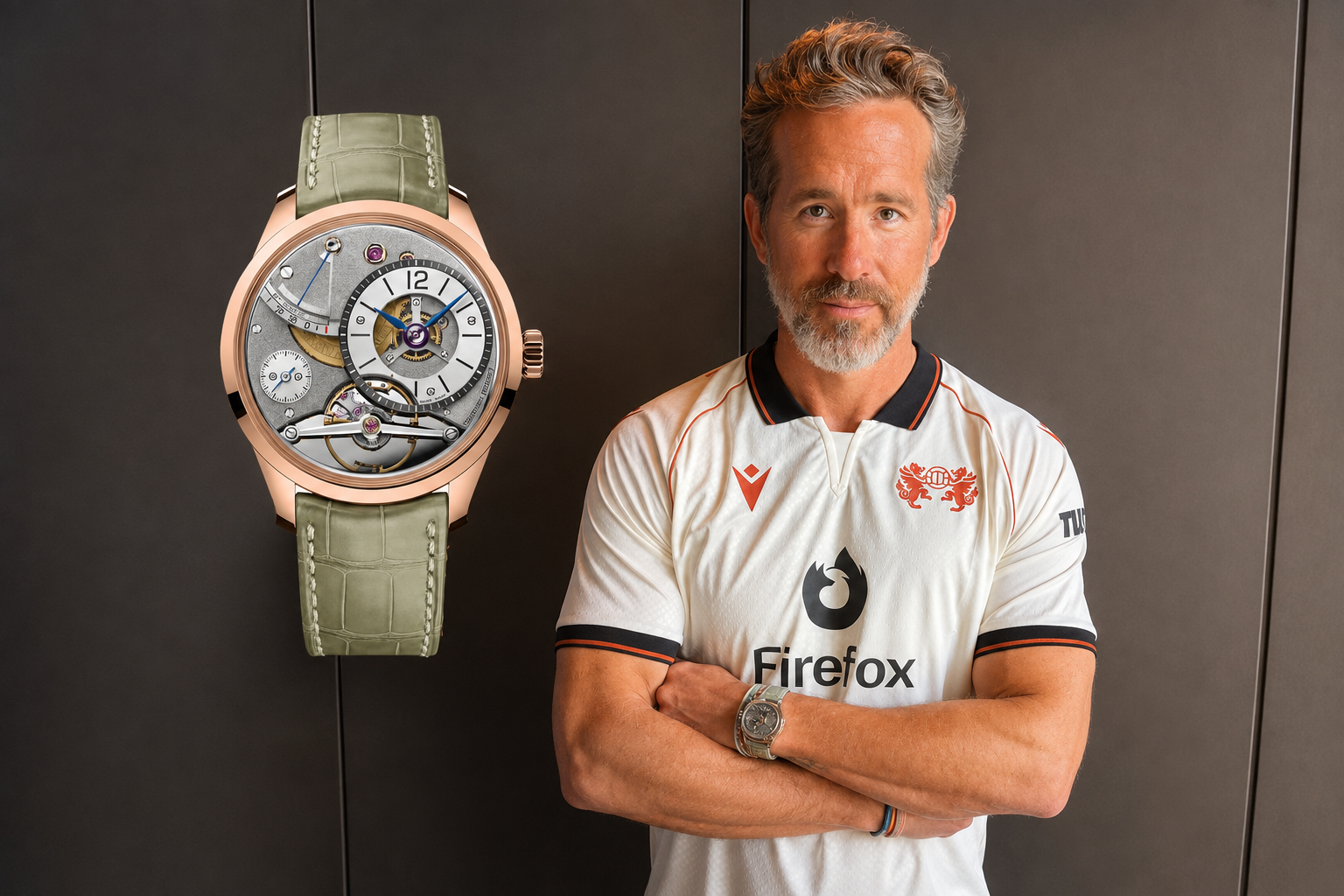
The AVPN Kitchen Spotting
Flour dust hung in the harsh spotlight of the AVPN kitchen station in lower Manhattan. Ryan Reynolds reached across the wooden counter to stretch a ball of Neapolitan dough. As his arm extended, the tailored cuff of his navy button-down slid backward. A photographer’s flash fired. The brief burst of light hit the underside of his left wrist, illuminating a massive, complex mechanical structure. The image hit the horological forums an hour later. The sharp, angled bridges and the oversized balance wheel were instantly recognizable to a select group of collectors. The Ryan Reynolds Greubel Forsey sighting immediately dominated the evening news cycle within the watch community. The setting was deliberately mundane. A multi-millionaire Hollywood star making pizza in a pop-up kitchen. The stark contrast between the working-class environment and the ultra-luxury timepiece created the exact kind of visual friction that generates massive online engagement. The flour on his apron only emphasized the pristine, factory-fresh condition of the titanium case.
The Macro Wrist Shot Details
Cropping the image to isolate the wrist reveals the specific geometry of the Greubel Forsey Balancier Contemporain. The light catches the sharp, internal angles of the titanium bridges. The balance wheel dominates the lower half of the dial, featuring a massive, weighted rim that oscillates at a frequency of 21,600 vibrations per hour. The screws holding the balance wheel are polished to a mirror finish, reflecting the ambient light of the kitchen. The dial lacks any traditional hour markers. Small, rhodium-plated dots indicate the hours, recessed into the frosted gold plate. The hands are sharp, diamond-cut blades, passing over the inclined balance wheel without touching it. The macro photography reveals the microscopic texture of the hand-finished bridges. The Balancier Contemporain occupies a massive amount of visual space on the wrist, despite its relatively modest 39.6 millimeter case diameter. The optical density of the movement forces the eye to focus on the mechanical architecture rather than the time display.
The $220,000 Valuation
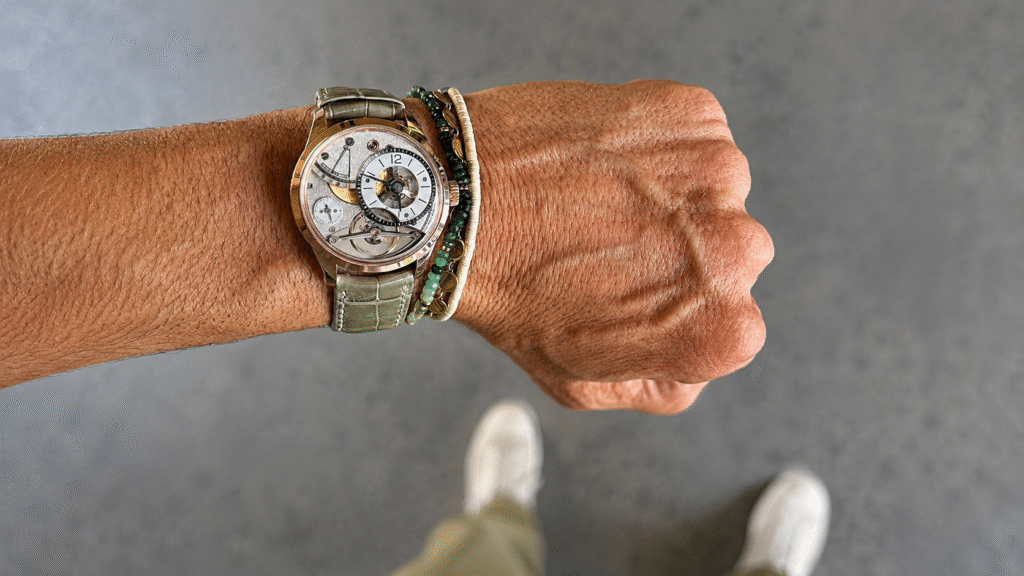
The retail price of the titanium Balancier Contemporain rests at approximately $220,000. The valuation places the watch in the upper echelon of modern independent horology. The price tag rivals the cost of a new Porsche 911 GT3. The capital required to acquire the piece filters the ownership pool to a minuscule demographic. Reynolds purchased the watch through the secondary market or directly from a highly connected authorized dealer. The waiting list for a new Greubel Forsey often spans years. The $220,000 figure reflects the sheer volume of manual labor required to produce a single example. The brand employs a small team of watchmakers who spend hundreds of hours on each movement. The cost of the raw titanium and the gold dial is negligible compared to the cost of the human labor. The $220,000 valuation acts as a barrier to entry, ensuring the watch remains an exclusive asset rather than a mass-produced consumer good.
The Evolution of His Taste
Reynolds has a documented history of wearing high-end, but more commercially available, timepieces. He has been photographed frequently wearing vintage Rolex models and customized Omega Speedmasters. The pivot to a Greubel Forsey signals a distinct evolution in his collecting habits. The transition indicates a shift away from brand recognition and toward mechanical appreciation. A Rolex announces wealth to a broad audience. A Greubel Forsey announces a highly specific, deeply nerdy appreciation for horological engineering to a tiny fraction of the population. The actor has clearly descended into the rabbit hole of independent watchmaking. His choice of the Balancier Contemporain over a more famous tourbillon suggests he sought out a specific, nuanced complication rather than a recognizable status symbol. The independent watchmaking sector relies on collectors like Reynolds making this exact psychological transition from heritage brands to artisanal workshops.
The Greubel Forsey Artistic Provenance
Robert Greubel and Stephen Forsey established their brand on the principle of pushing the boundaries of mechanical timekeeping. They operate out of a specialized atelier in La Chaux-de-Fonds, Switzerland. The founders maintain absolute control over the design and production processes. The brand operates entirely independently of the massive luxury conglomerates like LVMH or Richemont. This independence allows them to produce extremely low-volume, highly complex mechanisms that would never pass a corporate cost-benefit analysis. The Artistic Techniques department within the manufacture handles all the hand-engraving, guilloche work, and finishing. The brand treats each watch as a miniature architectural project. The DNA of the company rests on inclined balance wheels and multi-axis tourbillons, complications designed to solve specific physical problems related to gravity’s effect on the escapement.
The Titanium Case Geometry
The Balancier Contemporain features a 39.6 millimeter case machined from grade 5 titanium. The diameter represents a significant downsizing for Greubel Forsey, a brand historically known for massive 43 to 47 millimeter cases. The titanium alloy provides a stark, grey aesthetic while keeping the watch incredibly light on the wrist. The caseband features a complex, curved geometry that follows the natural shape of the forearm. The lugs are integrated directly into the case middle, flowing seamlessly into the strap. The crown is ridged for grip, featuring the Greubel Forsey logo engraved on the edge. The sapphire crystal sits flush with the bezel, creating a continuous, uninterrupted surface over the dial. The titanium is micro-blasted to a matte finish, eliminating any glare. The grade 5 titanium construction ensures the complex internal movement does not weigh down the wearer’s wrist during daily activities.
The Asymmetrical Dial Architecture
The dial layout of the Balancier Contemporain abandons traditional horological symmetry. The display is split into two distinct zones. The upper half contains the hours and minutes, rendered in a minimalist style with small applied indices. The lower half is dominated entirely by the inclined balance wheel and its massive titanium bridge. A small seconds display sits at the seven o’clock position, balanced visually by the arc of the balance bridge. The asymmetry forces the eye to move dynamically across the dial. The design rejects the static, centered layouts favored by traditional Swiss manufactures. The architecture prioritizes the mechanical elements over the time-telling function. The asymmetrical dial creates visual tension, making the watch feel like a kinetic sculpture rather than a simple instrument. The negative space around the balance wheel allows light to play across the angled bridges, highlighting the hand-finishing.
The 30-Degree Inclined Balance Mechanism
The defining technical feature of the Balancier Contemporain is the 30-degree inclination of the balance wheel. In a standard watch, the balance wheel sits perfectly flat. When the watch is placed in a vertical position on the wrist, gravity pulls downward on the balance spring, causing it to breathe unevenly. This positional error alters the rate of the watch. Greubel Forsey tilts the entire balance wheel and its bridge at a 30-degree angle inside the case. As the watch moves through different vertical positions, the inclined balance wheel experiences a varying vector of gravitational pull. The geometry of the 30-degree tilt ensures that the positive and negative gravitational errors cancel each other out over the course of a day. The inclined plane averages out the positional variations, maintaining a more consistent rate regardless of how the wearer positions their arm. This mechanical solution requires a completely redesigned gear train to accommodate the angled axis of rotation.
The Black Polished Steel Finishing
The finishing on the Balancier Contemporain represents hundreds of hours of manual labor. The steel screws visible on the balance bridge are finished in a technique called black polishing. A watchmaker presses the screw head against a tin plate coated with diamond paste. The watchmaker moves the screw in a figure-eight pattern, checking the surface under a microscope after every few strokes. The process creates a perfectly flat, mirror-like surface that appears black when viewed in direct light. A single microscopic scratch forces the watchmaker to start the process over. The titanium bridges feature hand-beveled edges, polished to a bright shine. The internal angles of the bridges require a special, flat-grained wooden tool to access the tight corners. The black polished steel components catch the light like tiny mirrors, creating a constantly shifting visual effect as the wrist moves.
The Manual Winding Caliber
The movement powering the Balancier Contemporain is a manually wound caliber developed entirely in-house. The mainspring barrel stores enough energy to provide a 72-hour power reserve. Winding the watch requires turning the crown roughly sixty times to reach full tension. The gear train features wheels with highly specific tooth profiles designed to transfer energy with minimal friction. The bridges holding the gear train are machined from solid titanium, chosen for its rigidity and lightweight properties. The movement beats at a frequency of 21,600 vibrations per hour, producing a distinct, rapid ticking sound that can be heard when the watch is held close to the ear. The manual winding caliber lacks an automatic rotor, allowing the wearer an unobstructed view of the mechanical architecture on the reverse side of the watch. The sapphire caseback reveals the parallel bridges and the hand-engraved serial number.
The Frosted Gold Dial Texture
The hour and minute display sits on a small dial plate made of 18k white gold. The surface of the gold features a frosted texture, achieved through a highly specialized finishing technique. A watchmaker takes a small wire brush or a diamond-tipped burin and aggressively abrades the surface of the gold. The process creates a microscopic, granular texture that diffuses light. The frosted gold absorbs ambient light rather than reflecting it, creating a soft, matte appearance that contrasts sharply with the mirror-polished steel components surrounding it. The texture ensures the hour markers and the hands stand out with absolute clarity. The frosted gold dial requires a steady, highly controlled hand. If the watchmaker applies too much pressure, the burin will cut entirely through the thin gold plate. The resulting texture gives the dial an organic, almost celestial appearance.
The Rubberized Calfskin Strap
Greubel Forsey pairs the Balancier Contemporain with a strap made from calfskin leather treated with a rubberized coating. The leather base provides the comfort and breathability of a natural material. The rubber coating protects the leather from moisture, sweat, and the accidental splashes of pizza sauce encountered at an event like the AVPN pop-up. The surface of the strap features a subtle, embossed texture that mimics the weave of a fabric. The strap tapers slightly from the 24 millimeter lug width down to a 20 millimeter buckle width. The edges of the strap are hand-painted and burnished to a high gloss, preventing the internal fibers from fraying. The rubberized calfskin combination represents a practical luxury choice, offering the tactile pleasure of leather with the durability of a synthetic material. The strap attaches to the case using custom titanium spring bars.
The Celebrity Watch Economy
A-list actors wearing ultra-luxury timepieces generates millions of dollars in free advertising for the boutique brands. The spotting of Reynolds wearing the Greubel Forsey acts as a viral marketing campaign. Horological enthusiasts immediately share the image across social media platforms, dissecting the reference number and the specific dial configuration. The brand does not need to pay for a magazine spread or a sponsored post. The organic nature of the sighting lends credibility to the product. A paid advertisement feels corporate. A grainy photograph of a celebrity in a casual environment feels authentic. The celebrity watch economy operates on a subtle hierarchy. Wearing a Rolex or an Audemars Piguet is expected for a star of Reynolds’ net worth. Wearing an indie brand like Greubel Forsey elevates the actor’s status within the collector community, signaling a level of connoisseurship that transcends standard Hollywood luxury. The celebrity watch economy thrives on these unexpected, high-impact visual moments.
The Non-Endorsement Dynamic
Greubel Forsey does not use traditional brand ambassadors. The company avoids paying celebrities to wear their products. Reynolds acquired the Balancier Contemporain through his own capital and his own taste. This non-endorsement dynamic dramatically increases the perceived value of the sighting. When a star wears a watch for a paid contract, the public recognizes the transaction. The watch becomes a prop. When a star wears a watch of their own volition, the watch becomes an extension of their personal identity. The choice validates the brand’s engineering and aesthetic choices to the broader market. Reynolds wore the watch because he wanted to wear it, knowing full well that a tiny fraction of the audience would recognize the exact reference. The non-endorsement strategy requires immense patience from the brand. They must wait for the right client to purchase the watch and subsequently be photographed in a compelling environment.
The 100-Piece Production Limit
Greubel Forsey restricts the production of the Balancier Contemporain in titanium to exactly 100 pieces. This artificial scarcity guarantees the long-term value of the asset. The limited production run means a new buyer cannot simply walk into a boutique and purchase one. The waiting list operates on a strict first-come, first-served basis, managed directly by the brand’s sales team. The 100-piece limit also dictates the pace of the manufacturing process. The watchmakers at the atelier can focus intensely on a small batch of movements, ensuring the finishing standards remain consistently high. Mass production introduces variance and error. Limited production allows for continuous, microscopic quality control. The 100-piece production limit transforms the watch from a consumer good into a collectible asset. The scarcity drives the secondary market premiums higher, rewarding the initial buyer with immediate equity the moment the watch leaves the boutique.
The Secondary Market Premium
The Secondary Market Premium
The sighting of a major celebrity wearing a specific reference number triggers an immediate reaction in the secondary market. Dealers and collectors adjust their asking prices within hours of the photograph surfacing. The Balancier Contemporain already trades above its retail price due to the 100-piece production limit. The Reynolds sighting adds a premium on top of the existing premium. Collectors who were on the fence about purchasing the reference suddenly rush to secure one, fearing the increased visibility will dry up the already scarce supply. The watch becomes a “celebrity-associated” piece. The provenance of the specific watch Reynolds wore is irrelevant. The entire reference number benefits from the halo effect. The secondary market premium reflects the intangible value of cultural relevance. A watch that is culturally relevant commands a higher price than a watch that is merely mechanically complex.
The AVPN Juxtaposition
The AVPN pizza-making event provided the perfect visual backdrop for the sighting. The environment was gritty, hot, and covered in flour. The attendees wore casual clothing, focusing on the manual labor of stretching dough and managing wood-fired ovens. Reynolds stood at a stainless steel counter, wearing a simple button-down shirt. The grease and the flour represented the absolute antithesis of the pristine, dust-free environment required to assemble a Greubel Forsey movement. This visual juxtaposition creates a compelling narrative. The $220,000 watch sits on the wrist of a man performing a working-class task. The image strips away the pretension usually associated with ultra-luxury horology. The watch looks like a tool, a rugged instrument built to survive a chaotic kitchen environment. The AVPN event context humanizes the object, making it feel accessible despite the astronomical price tag.
The Stealth Wealth of Titanium
The choice of a titanium case over a gold case aligns perfectly with the current trends in high-end collecting. Gold cases broadcast wealth through color and reflection. Titanium cases whisper wealth through weight and texture. The matte grey finish of the Balancier Contemporain absorbs light, making the watch practically invisible from a distance. Only a close inspection reveals the complex mechanical architecture hidden beneath the sapphire crystal. Reynolds’ decision to wear the titanium version instead of a gold version signals a desire for discretion. The watch does not demand attention. It rewards attention. The stealth wealth aesthetic relies on the viewer possessing the specific knowledge required to identify the object. To the uninformed observer, the watch is simply a large, grey object on the wrist. To the informed observer, it is a masterpiece of independent horology worth more than a luxury automobile.
Rejecting Traditional Symmetry
The dial layout of the Balancier Contemporain actively rejects the centuries-old tradition of symmetrical watch design. Grand complications from Patek Philippe or Vacheron Constantin typically center the time display, balancing the sub-dials around a central axis. Greubel Forsey pushes the time display to the upper edge of the dial, sacrificing traditional balance to highlight the inclined balance wheel. The large, empty space surrounding the balance bridge is an intentional design choice. It acts as a stage, forcing the viewer to focus entirely on the oscillating mass. The rejection of symmetry is a hallmark of independent watchmaking. Small, artisanal brands use asymmetry to differentiate themselves from the rigid, corporate design languages of the established manufactures. The asymmetrical design philosophy treats the watch dial as a three-dimensional sculpture rather than a flat, two-dimensional canvas.
The Inclined Balance Hierarchy
In the pantheon of horological complications, the inclined balance wheel occupies a specific, highly respected niche. It is mechanically simpler than a tourbillon, yet it addresses the exact same problem of gravitational error. A tourbillon rotates the entire escapement in a cage, averaging out positional errors through continuous rotation. The inclined balance wheel solves the problem through static geometry, tilting the escapement to a calculated angle that minimizes the effects of gravity in the most common vertical positions. Purists often argue the inclined balance is a more elegant, mechanically honest solution than the visually flashy tourbillon. The inclined balance wheel hierarchy places the Balancier Contemporain above standard time-only watches, but below the multi-axis tourbillons that Greubel Forsey produces at much higher price points. It represents the entry point into the brand’s core mechanical philosophy.
The Watchmaker’s Micro-Signatures
A close inspection of the Balancier Contemporain reveals tiny, almost invisible details that serve as the watchmaker’s signature. The main plate features a subtle, hand-engraved pattern that catches the light at extreme angles. The edges of the titanium bridges are polished to a shine that contrasts with the matte, micro-blasted top surfaces. The tiny screws holding the dial markers in place are perfectly aligned, their slotted heads pointing in exactly the same direction. The ruby jewels set into the gear train are seated in polished gold chatons, raised slightly above the surface of the bridge. These micro-signatures are invisible to a casual observer. They exist solely for the enjoyment of the owner and the watchmaker who assembled the movement. The watchmaker’s signature represents hundreds of hours of meticulous, repetitive handwork that cannot be replicated by a machine.
The Optical Illusion of the Bridges
The titanium bridges on the dial side of the Balancier Contemporain are machined to create a specific optical illusion. The edges of the bridges are beveled and polished, creating bright lines of reflected light. The interior surfaces of the bridges are matte blasted, absorbing light. The contrast between the bright edges and the dark interiors gives the bridges a three-dimensional, floating appearance. The curved shape of the main bridge guides the eye directly toward the balance wheel, acting as a visual funnel. The bridge seems to arc over the movement, protecting the balance wheel like a canopy. This optical manipulation requires precise control of the surface finishes during the machining and hand-finishing processes. The optical illusion adds immense depth to a dial that is physically only a few millimeters thick. The visual complexity keeps the owner discovering new angles and reflections years after the initial purchase.
The 39.6 Millimeter Wrist Presence
The 39.6 millimeter case diameter represents a significant shift in the luxury watch market. For years, the trend favored massive, oversized cases. Greubel Forsey recognized the demand for smaller, more ergonomic watches and downsized the Balancier platform accordingly. The reduced diameter allows the watch to sit comfortably on a wider variety of wrist sizes. The thickness of the case remains substantial due to the angled internal mechanism, but the reduced footprint prevents the watch from overwhelming the forearm. The lug-to-lug measurement is incredibly short, allowing the case to hug the wrist without protruding over the edges. The 39.6 millimeter sizing makes the watch highly versatile. It can be worn discreetly under a shirt cuff during a business meeting, or displayed prominently on the wrist during a casual event. The sizing broadens the appeal of the highly complicated movement.
The Mechanical Permanence
The AVPN event will end. The dough will be baked, served, and eaten. The flour will be swept off the wooden counters. Reynolds will remove the watch before going to sleep. The celebrity spotting will fade from the horological forums by the end of the week, replaced by the next actor wearing the next hyper-complication. The titanium case will remain exactly as it was at the factory. The 30-degree inclined balance wheel will continue to oscillate, averaging out the gravitational errors of the real world. The watch exists entirely independent of the celebrity who wears it. The machine does not care about the flash of the camera or the price tag attached to its reference number. The mechanical permanence of the Greubel Forsey outlasts the fleeting nature of internet fame. The balance wheel will keep swinging long after the digital pixels of the photograph degrade. The true value sits in the silent, continuous operation of the gear train.
FAQ
Why did Ryan Reynolds choose a Greubel Forsey over a more famous brand?
Ryan Reynolds choosing a Greubel Forsey Balancier Contemporain signals a deep dive into the niche world of independent horology. Mainstream luxury brands like Rolex, Audemars Piguet, or Patek Philippe offer high recognition and immediate status signaling to a broad audience. Greubel Forsey offers virtually zero mainstream recognition. The value of the watch lies entirely in its mechanical complexity, its hand-finishing, and its scarcity. By wearing the Balancier Contemporain, Reynolds demonstrates a preference for mechanical authenticity over brand marketing. He has moved past the entry-level luxury markers and is engaging with watches as mechanical art pieces. The choice indicates he is consulting with serious collectors or dealers who curate based on horological significance rather than celebrity endorsement deals.
How does the inclined balance wheel in the Balancier Contemporain actually work?
The inclined balance wheel addresses the physical effects of gravity on the escapement. In a standard flat balance wheel, gravity pulls straight down on the balance spring when the watch is in a vertical position. This downward pull causes the spring to expand and contract unevenly, leading to timing errors. The Balancier Contemporain tilts the entire balance wheel and its bridge at a 30-degree angle. As the wrist moves through different vertical positions, this fixed 30-degree tilt changes the angle at which gravity interacts with the balance spring. The specific geometry of the tilt ensures that the timing errors caused by gravity in one vertical position are canceled out by the errors in another vertical position over the course of a day, resulting in a more accurate rate.
What is the typical secondary market premium for the titanium Balancier Contemporain?
The Greubel Forsey Balancier Contemporain in titanium trades significantly above its original retail price of $220,000. Due to the strict 100-piece production limit, the supply is vastly outstripped by the demand from high-net-worth collectors. A standard secondary market premium for this specific reference typically ranges from 30 to 50 percent above retail, depending on the condition and the inclusion of the original box and papers. High-visibility celebrity sightings, like the Ryan Reynolds photographs, can cause immediate, temporary spikes in the asking prices as dealers anticipate a surge in demand. The limited production run guarantees that the watch will remain a highly liquid asset on the secondary market for the foreseeable future.
Why does Greubel Forsey use an asymmetrical dial design?
The asymmetrical dial design prioritizes the mechanical architecture over traditional timekeeping aesthetics. Traditional watchmaking relies on symmetry, centering the hours and minutes and balancing sub-dials around a central axis. Greubel Forsey positions the time display at the top edge of the dial to dedicate the maximum amount of physical space to the inclined balance wheel. The large, empty area surrounding the balance bridge acts as a stage, drawing the eye directly to the oscillating mass. This design philosophy treats the watch as a three-dimensional mechanical sculpture. The asymmetry is a deliberate rejection of corporate watch design, serving as a visual signature that immediately identifies the piece as an independent, artisanal creation.
Is the titanium case of the Balancier Contemporain better than a gold case?
The choice between titanium and gold depends entirely on the wearer’s priorities. A gold case adds significant intrinsic material value and broadcasts wealth through its color and weight. The titanium case of the Balancier Contemporain prioritizes ergonomics and stealth. Titanium is incredibly light, making the complex, thick watch comfortable for daily wear. The matte grey micro-blasted finish absorbs light, making the watch visually subtle and discreet. In the high-end collecting community, titanium is often preferred for highly complicated watches because it shifts the focus away from the material value of the case and directs it entirely toward the mechanical complexity and the hand-finishing of the movement. Titanium aligns with the modern “stealth wealth” aesthetic.