
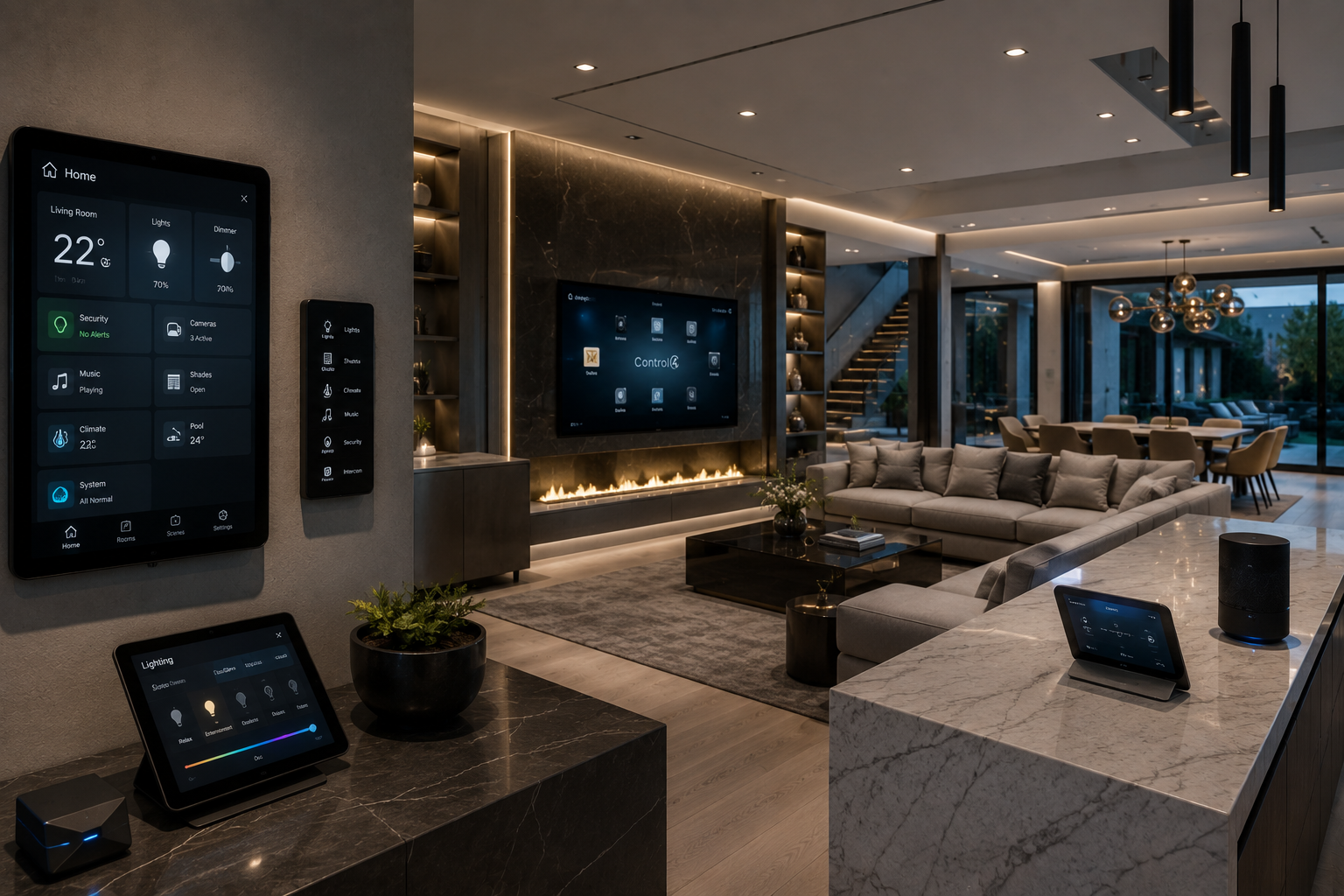
The house wakes before the owner does. At 6:12 a.m., blackout glass slowly clears to reveal a muted ocean horizon while hidden speakers introduce low instrumental audio calibrated to match natural circadian rhythms. Climate systems adjust room temperature by less than a degree. Coffee begins brewing behind a concealed kitchen panel. Downstairs, biometric security systems silently register the arrival of a driver through encrypted perimeter sensors integrated beneath the driveway stonework. Nothing announces itself as technology. That is the point. The most advanced billionaire smart home setup 2026 systems are designed to disappear entirely into architecture, creating residences that anticipate behavior without feeling mechanical or intrusive. For ultra-high-net-worth homeowners, smart homes are no longer about novelty or gadget culture. They are becoming deeply integrated living environments where privacy, wellness, security, automation, and operational continuity merge into one invisible digital infrastructure operating quietly behind stone, glass, and custom millwork.
Why Billionaires Are Spending $150,000 on Home Intelligence Systems
The highest level of residential design, convenience alone no longer justifies major technology investment. Billionaires increasingly treat smart home systems as operational infrastructure similar to private aviation or family office software. The objective is continuity. Owners want homes that maintain security, wellness, energy efficiency, and environmental control without requiring visible interaction. The modern billionaire smart home setup 2026 reflects a shift away from app-driven novelty toward integrated intelligence woven directly into architecture. Luxury home automation, AI-powered residences, and integrated smart ecosystems now define elite residential design where technology becomes valuable precisely because it remains almost invisible to the occupants themselves.
Lighting Systems That Mimic Human Biology
The lighting inside elite smart homes no longer functions purely for visibility or aesthetics. Advanced systems now track circadian rhythms, adjusting color temperature and brightness throughout the day to support energy levels, focus, and sleep quality. Morning light gradually increases blue spectrum exposure while evening environments transition toward warmer tones that reduce neurological stimulation. The mechanism behind this involves centralized lighting processors connected to occupancy sensors, astronomical timing systems, and behavioral learning software. Within the world of billionaire smart home setup 2026, circadian lighting, wellness architecture, and human-centric home design reveal how luxury technology increasingly focuses on physiology rather than spectacle.
AI Assistants That Quietly Learn Household Behavior
The newest generation of home AI systems operates less like voice assistants and more like behavioral infrastructure. Instead of waiting for commands, these systems analyze movement patterns, room usage, environmental preferences, and scheduling habits to automate daily transitions quietly in the background. Temperature, lighting, music, shading, and security profiles adjust dynamically depending on time, occupancy, and behavioral history. The mechanism reveal matters because the system’s intelligence depends heavily on continuous data mapping within the residence. The strongest billionaire smart home setup 2026 environments create seamless experiences precisely because owners interact with interfaces less frequently over time. Predictive home automation, AI residential systems, and behavior-based smart environments define this new phase of luxury technology.
Invisible Security Systems Built Into the Architecture
Security technology inside ultra-high-end homes has evolved dramatically beyond visible cameras and alarm panels. Perimeter analytics, facial recognition systems, underground motion sensors, thermal imaging, and encrypted communications networks now operate almost entirely out of sight. Entry systems often combine biometric authentication with behavioral analysis capable of identifying irregular movement patterns around the property. The mechanism behind these systems focuses heavily on layered redundancy. Multiple technologies overlap so that no single point of failure compromises the residence. In the ecosystem of billionaire smart home setup 2026, private residential security, smart perimeter defense, and biometric access systems reveal how luxury homeowners increasingly prioritize discretion over visible intimidation.
Climate Control and the New Definition of Comfort
Traditional HVAC systems maintained temperature. Modern luxury climate systems manage atmospheric quality itself. Air purification, humidity stabilization, allergen filtering, and scent distribution are increasingly integrated into centralized environmental control platforms. Some residences divide airflow into hyper-specific zones calibrated differently for sleep, entertaining, wellness, or wine storage environments. The deeper mechanism involves advanced sensors constantly monitoring particulate levels, carbon dioxide concentration, and thermal balance throughout the home. The billionaire smart home setup 2026 trend demonstrates how comfort is becoming more scientific and less decorative. Smart climate systems, air quality engineering, and wellness-focused interiors now shape the residential experience more profoundly than visible design elements alone.
Entertainment Rooms That Function Like Private Cinemas
Home entertainment systems at this level resemble boutique screening venues rather than upgraded living rooms. Acoustic wall treatments, hidden projection systems, custom seating geometry, and isolated sound chambers create highly controlled viewing environments. Yet the most impressive detail often remains invisible. Audio calibration systems analyze room dimensions and material behavior digitally to optimize sound distribution automatically. The best billionaire smart home setup 2026 entertainment spaces avoid visual clutter entirely, concealing speakers, displays, and equipment behind architectural surfaces. Private cinema rooms, immersive home audio, and luxury media architecture now operate at a standard once reserved exclusively for professional entertainment venues.
Smart Kitchens and the Automation of Hospitality
Luxury kitchens are becoming increasingly integrated with inventory management systems, appliance coordination software, and hospitality workflows designed around both private chefs and family use. Refrigeration systems track ingredient freshness, cooking environments synchronize automatically with ventilation systems, and concealed storage compartments open through gesture or proximity sensors. The mechanism reveal becomes particularly interesting here because elite kitchens now function partly like professional culinary spaces hidden inside residential architecture. In the context of billionaire smart home setup 2026, automated luxury kitchens, hospitality technology, and smart culinary environments show how domestic life is quietly absorbing operational standards from private aviation and five-star hospitality.
Wellness Technology Hidden Inside Bedrooms and Bathrooms
Bedrooms and wellness spaces are becoming some of the most technologically advanced areas inside luxury homes. Smart mattresses monitor sleep quality, bathrooms adjust water temperature and lighting automatically, and wellness mirrors analyze posture, skin condition, and biometric indicators through embedded sensors. Some residences integrate oxygen therapy rooms, infrared recovery systems, and meditation chambers connected to environmental soundscapes. The strongest billionaire smart home setup 2026 designs avoid making these systems feel clinical or futuristic. Instead, technology dissolves into materials like stone, wood, and textured fabrics. Luxury wellness tech, smart recovery spaces, and biometric residential systems increasingly shape the future of high-end living.
The Infrastructure Most Guests Never Notice
The true cost of a luxury smart home rarely sits in visible hardware. It exists behind walls, beneath floors, and inside hidden server rooms controlling power distribution, encrypted networking, battery backup systems, and automation processors. Elite homes increasingly operate on enterprise-grade digital infrastructure capable of maintaining full operational continuity during outages or cyber threats. Fiber networks, redundant routers, and isolated data environments are becoming standard for owners who conduct business globally from private residences. The billionaire smart home setup 2026 conversation ultimately revolves around infrastructure sophistication rather than gadget accumulation. Residential data systems, private digital networks, and hidden automation infrastructure reveal how modern luxury homes increasingly resemble highly secure technology ecosystems.
Why Smart Luxury Is Becoming Less Visible
The most important shift happening inside luxury technology is aesthetic restraint. Wealthy homeowners no longer want visible screens, exposed equipment, or futuristic visual clutter dominating residential architecture. The strongest smart homes feel calm, tactile, and almost analog despite containing extraordinary computational complexity beneath the surface. The deeper implication surrounding the billionaire smart home setup 2026 trend is that luxury itself may be evolving away from visible technology entirely. The smartest room in the house increasingly looks like the least technological one.
FAQ
What is included in a billionaire smart home setup in 2026?
Typical systems include AI automation, biometric security, circadian lighting, climate control, private cinema rooms, wellness technology, and enterprise-grade networking infrastructure.
Why do luxury smart homes cost over $150,000?
Costs rise because of custom integration, hidden infrastructure, enterprise security systems, premium automation platforms, and architectural installation requirements.
Are billionaire smart homes controlled entirely by AI?
Many systems now use predictive AI automation, although owners still maintain manual control and customized privacy settings when needed.
What is the biggest trend in luxury smart homes?
The strongest trend is invisible technology, where automation systems disappear into architecture rather than drawing attention visually.
Do smart luxury homes improve wellness?
Yes. Advanced systems can optimize lighting, air quality, sleep environments, climate conditions, and recovery spaces to support physical and mental well-being.