Rain settles softly across the bonnet outside a private residence in Mayfair while the charging cable disconnects with a muted mechanical click. A few meters away sits a Ghost finished in deep graphite metallic, its V12 still warm after crossing London in near silence. Inside both cabins, the atmosphere feels Rolls-Royce unmistakably. Thick lambswool carpets absorb footsteps, polished veneers reflect low amber lighting, and the outside world becomes distant almost immediately after the doors close. Yet beneath that familiar calm sits one of the most important transitions the marque has faced in decades. The debate surrounding Rolls-Royce Spectre vs Ghost electric is not really about technology alone. It is about whether the defining qualities of a Rolls-Royce, silence, effortlessness, and mechanical dignity, survive the move into electrification without losing the emotional gravity that long-term owners expect from the brand.
Why the Spectre Matters More Than a Typical Luxury EV
Most electric vehicles arrive with promises of speed, software, and environmental positioning. The Spectre enters the market carrying something more fragile: heritage. Rolls-Royce owners rarely buy cars to experiment with trends. They buy continuity, craftsmanship, and a familiar relationship with comfort. The significance of the Rolls-Royce Spectre vs Ghost electric comparison lies in whether the Spectre preserves that continuity while changing the mechanical heart of the vehicle completely. The transition to electric propulsion actually aligns naturally with many traditional Rolls-Royce values. Electric drivetrains deliver immediate torque, near-total silence, and smooth power delivery without vibration. Electric luxury cars, ultra-luxury EVs, and Rolls-Royce heritage shape a conversation where engineering philosophy matters more than environmental headlines.
Exterior Presence, Formal Elegance vs Futuristic Restraint
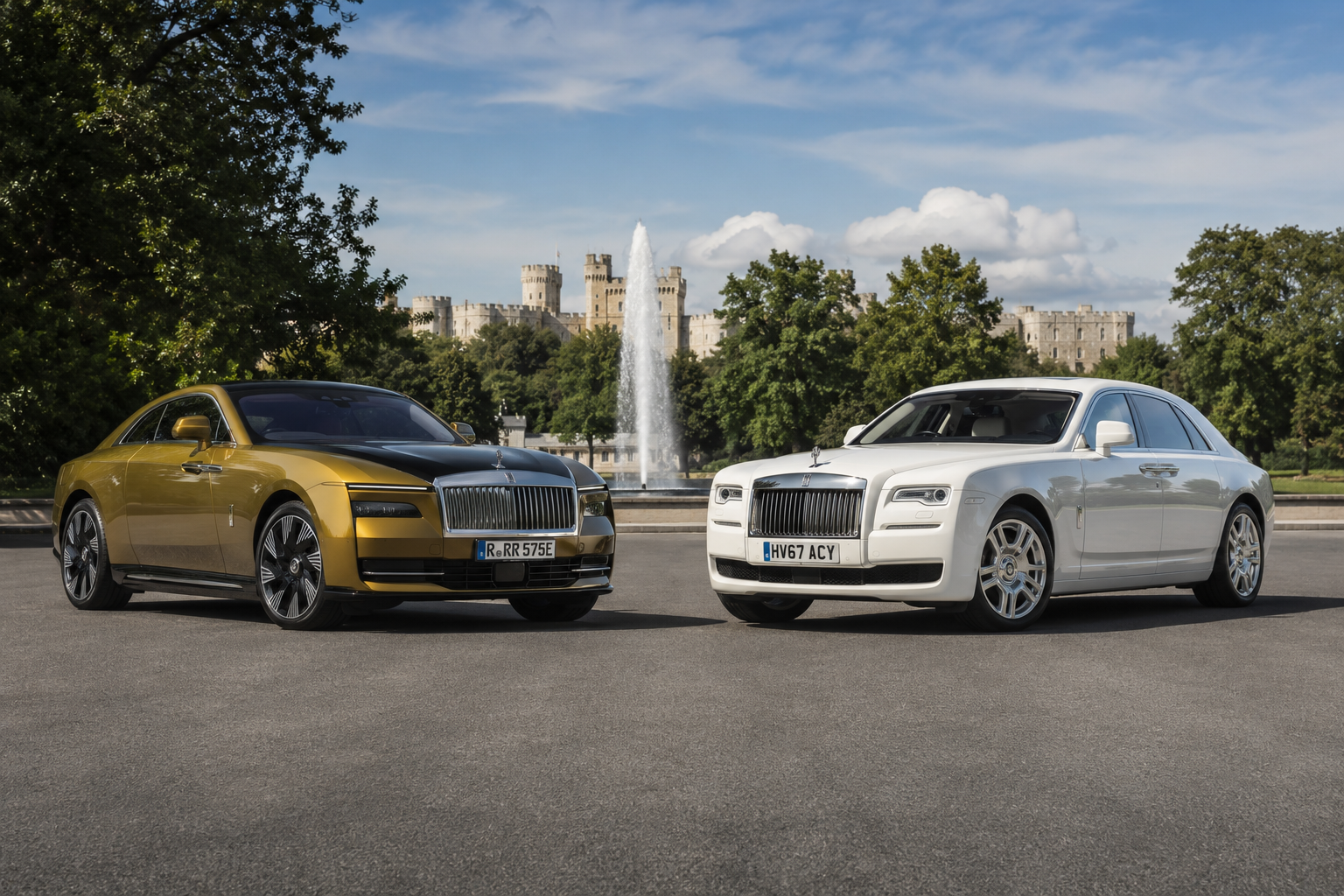
Seen together, the Ghost and Spectre communicate authority differently. The Ghost carries a more formal sedan profile with proportions that feel deeply rooted in classic chauffeur-driven design. The Spectre, meanwhile, introduces a lower roofline and cleaner surfacing that subtly shifts the brand toward a grand touring silhouette. What stands out in person is not aggression, but control. The illuminated grille, carefully weighted door movement, and uninterrupted body panels create an impression of extraordinary precision rather than overt drama. In the Rolls-Royce Spectre vs Ghost electric comparison, design language, coachbuilt aesthetics, and aerodynamic refinement reveal how the company is modernizing without abandoning visual dignity.
Cabin Atmosphere and the Difference Between Silence and Stillness
Both interiors deliver the familiar Rolls-Royce sensation of separation from the outside environment, yet they achieve it differently. The Ghost relies on extensive sound insulation and the smooth character of its V12 engine. The Spectre removes combustion almost entirely from the experience, replacing it with a kind of engineered stillness that feels unusually calm even by luxury standards. The mechanism behind this matters. Electric drivetrains eliminate many frequencies traditionally masked by engine noise, forcing engineers to redesign insulation, suspension calibration, and cabin acoustics from the ground up. Within the Rolls-Royce Spectre vs Ghost electric discussion, cabin isolation, starlight headliners, and bespoke interiors become central to understanding how Rolls-Royce defines comfort in the EV era.
Driving Experience, Electric Torque vs V12 Authority
The Ghost delivers acceleration with immense composure. Power builds in long, uninterrupted waves that feel almost detached from effort. The Spectre approaches performance differently. Instant electric torque creates a more immediate response, especially in urban environments where silent acceleration feels almost surreal given the vehicle’s size and weight. Yet Rolls-Royce intentionally avoids exaggerated aggression. Throttle mapping remains progressive, steering inputs stay relaxed, and suspension tuning prioritizes glide rather than sharpness. In the context of Rolls-Royce Spectre vs Ghost electric, electric torque delivery, V12 refinement, and ride comfort reveal two distinct interpretations of effortless movement.
Ride Quality and the Mechanism Behind the Magic Carpet Effect
The famous “magic carpet ride” remains central to both cars, though the engineering beneath each platform differs significantly. The Ghost uses advanced air suspension combined with predictive systems that scan road surfaces ahead and adjust damping in real time. The Spectre adds battery weight low within the chassis, improving balance while requiring extensive recalibration to maintain softness without excessive body movement. Engineers reportedly adjusted thousands of parameters during development to preserve traditional ride characteristics. The Rolls-Royce Spectre vs Ghost electric comparison becomes especially interesting here because the EV architecture actually enhances certain aspects of composure while introducing new engineering challenges. Adaptive suspension, electric chassis tuning, and ride isolation define the ownership experience more than acceleration figures ever could.
Range, Charging, and the Reality of Ultra-Luxury EV Ownership
Range matters differently at this level of ownership. Most Spectre buyers already maintain multiple vehicles and access to private charging infrastructure at residences, offices, and estates. Charging therefore becomes less about public convenience and more about seamless integration into existing routines. The Ghost, with its V12 and rapid refueling capability, still holds advantages for spontaneous long-distance touring without planning. Within the Rolls-Royce Spectre vs Ghost electric conversation, luxury EV charging, private infrastructure, and grand touring practicality shape whether the Spectre feels liberating or restrictive depending on the owner’s lifestyle.
Craftsmanship, Bespoke Culture, and the Human Element
Rolls-Royce has always sold personalization as much as transportation. Hand-finished veneers, embroidered monograms, custom paint formulations, and highly specific commissions remain central to both vehicles. The Spectre does not abandon this culture. Instead, it expands it into a more technologically integrated environment with illuminated fascia panels and digital architecture blended into traditional materials. The key detail is restraint. Technology never dominates the cabin visually. In the Rolls-Royce Spectre vs Ghost electric comparison, bespoke commissioning, craftsmanship, and hand-built interiors continue to define the emotional value of ownership.
Which Car Better Fits Different Types of Rolls-Royce Owners
Long-term Rolls-Royce clients often divide into two broad groups. Some value tradition, long-distance comfort, and the emotional familiarity of a twelve-cylinder engine. Others prioritize silence, innovation, and urban usability while still demanding uncompromised luxury. The Ghost remains deeply appealing to owners who associate Rolls-Royce with formal grand touring and mechanical continuity. The Spectre suits buyers comfortable with technological transition who appreciate the serenity electric propulsion naturally provides. The Rolls-Royce Spectre vs Ghost electric decision ultimately depends less on specifications and more on personal philosophy. Luxury car ownership, chauffeur-driven sedans, and electric grand tourers frame two very different interpretations of modern prestige.
The Future of Rolls-Royce Beyond the Combustion Era
The Spectre feels less like a departure and more like the beginning of a slow architectural shift within the brand. Electric propulsion removes noise and vibration in ways Rolls-Royce engineers have pursued for generations through increasingly complex mechanical solutions. What changes now is the emotional reference point. Younger buyers may grow up associating complete silence with luxury rather than large displacement engines. The deeper implication behind the Rolls-Royce Spectre vs Ghost electric debate extends beyond these two cars. It concerns whether the future of automotive luxury will be defined by mechanical character or by the absence of mechanical intrusion altogether.
FAQ
Is the Rolls-Royce Spectre fully electric?
Yes. The Spectre is Rolls-Royce’s first fully electric production vehicle and represents the brand’s transition toward an all-electric future.
Which is quieter, the Spectre or the Ghost?
The Spectre is generally quieter because it eliminates combustion engine noise entirely, though both vehicles are engineered for exceptional cabin isolation.
Does the Spectre still feel like a traditional Rolls-Royce?
Yes. Despite its electric platform, the Spectre maintains Rolls-Royce priorities such as ride comfort, craftsmanship, and effortless performance.
Which is better for long-distance travel, the Spectre or Ghost?
The Ghost currently offers greater convenience for spontaneous long-distance touring because refueling remains faster and more widely accessible than charging.
Is the Rolls-Royce Spectre worth buying over the Ghost?
The answer depends on ownership priorities. Buyers seeking innovation and near-total silence may prefer the Spectre, while traditionalists may still favor the V12-powered Ghost.