
A Fence Line at Dusk
The wind carried dust across the scrubland near the border enclave. A small herd moved slowly toward a perimeter fence, their wool catching the fading light. At first glance, nothing felt unusual. Border officers have watched livestock cross terrain for generations.
Then one of the sheep hesitated.
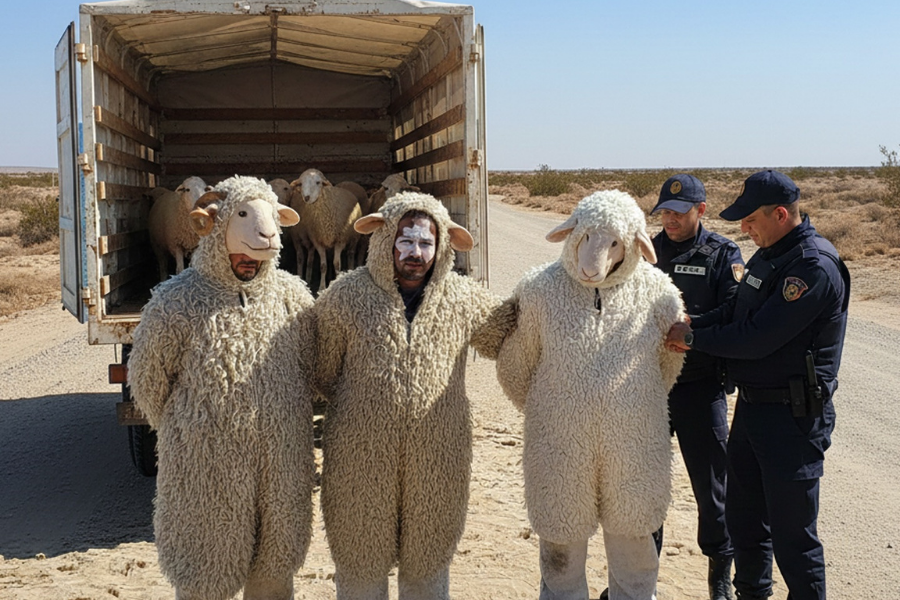
The outline did not match the gait. The back was too rigid. The rhythm felt rehearsed. Minutes later, three men were detained. They had concealed themselves beneath improvised sheep disguises in an attempt to reach Spanish territory.
The episode now referred to as the Algeria Spain Disguised as Sheep Arrest moved quickly across global headlines. It read like satire. Yet it unfolded within one of Europe’s most complex migration corridors, where geography, policy, and desperation intersect daily.
This outline explores the incident, the mechanisms of border control in the region, and the broader implications beneath the viral surface.
Algeria Spain Disguised as Sheep Arrest: What Happened at the Border
The Attempt
According to local security sources, three adult men attempted to approach a fenced border area concealed under sheep skins and crude wool coverings. The plan appears simple in concept. Blend into livestock movement. Cross during low visibility. Avoid detection through visual mimicry.
The terrain between parts of North Africa and Spanish enclaves such as Ceuta and Melilla includes fencing systems, surveillance cameras, motion sensors, and patrol units. Livestock frequently moves in surrounding agricultural zones. That familiarity likely informed the disguise strategy.
However, border monitoring systems operate on layered protocols. Officers rely on pattern recognition, thermal imaging, and coordinated patrol timing. Human movement produces different heat signatures than animals. Body mass distribution differs. Walking cadence rarely convinces trained observers for long.
The men were detained before reaching Spanish territory. Authorities charged them under applicable immigration and border violation statutes.
How Border Security Actually Works
The viral quality of the Algeria Spain Disguised as Sheep Arrest obscures a technical reality. Modern border control does not depend solely on sight.
First layer, physical barriers. Multi tier fencing structures incorporate anti climb materials and reinforced lower panels.
Second layer, surveillance. Thermal cameras detect heat differentials at night. Humans emit consistent infrared signatures. Even when concealed, core temperature remains measurable.
Third layer, patrol integration. Officers coordinate movement based on predictive patterns. Data analytics map common crossing attempts by season and time.
This layered system reduces reliance on visual identification alone. Disguises may alter silhouette. They rarely neutralize temperature contrast or irregular stride length.
The Viral Aftermath
The story spread rapidly across social media channels, framed alternately as absurd, inventive, or desperate. Memes circulated within hours. Yet within security circles, the reaction was procedural. An attempt occurred. Detection functioned. Arrest followed.
The spectacle risks overshadowing context. Border crossings along North Africa’s Mediterranean corridor involve economic hardship, regional instability, and restricted legal pathways. The sheep disguise, while unconventional, reflects the creativity that emerges when conventional routes close.
Beyond the Headline: Migration Pressure, Geography, and Risk
Geographic Reality
The proximity between North Africa and southern Europe shapes migration strategy. The Strait of Gibraltar narrows to approximately 14 kilometers at its tightest point. Spanish territories on African soil complicate jurisdictional lines.
These enclaves function as European Union borders on African land. Crossing into them can trigger asylum processes under EU frameworks. That legal nuance increases their strategic importance.
Risk Calculation
Irregular migration attempts follow a calculus of risk versus opportunity. Some choose sea crossings in fragile vessels. Others attempt fence scaling during coordinated rushes. A disguise, even one as unusual as livestock mimicry, reflects a search for lower visibility options.
Each method carries hazard. Maritime crossings involve weather volatility and overcrowding. Land approaches involve injury risk from fencing and confrontation with security forces.
Law Enforcement Response
Authorities balance enforcement obligations with humanitarian protocols. Detentions involve identification checks, health screenings, and legal processing. International law frameworks influence treatment standards.
The Algeria Spain Disguised as Sheep Arrest therefore fits within a broader matrix of migration management rather than existing as a standalone oddity.
Media Amplification and Public Perception
Unusual details accelerate distribution. The image of adult men disguised as sheep carries inherent narrative tension. Visual absurdity collides with serious policy debate.
For world news readers and current affairs audiences, such stories invite two parallel reactions. Amusement at ingenuity. Reflection on the conditions that produce it.
Viral reach does not eliminate structural complexity. It compresses it.
Mechanism Reveal: Why Disguises Fail Under Thermal Surveillance
To understand the rapid detection in this case, consider thermal imaging mechanics. Infrared cameras capture radiation emitted as heat. Animals and humans both emit infrared energy. Yet distribution patterns differ.
Sheep exhibit heat concentration along torso mass with cooler extremities due to wool insulation. Human bodies generate symmetrical heat around the core, shoulders, and head. Even under layered coverings, thermal outlines often remain discernible.
Additionally, motion algorithms flag irregular movement within defined zones. A herd moves with natural variance. A disguised individual may maintain tension in posture, altering motion rhythm.
Border systems increasingly integrate machine learning software trained on thousands of recorded movement sequences. Deviation triggers alert protocols. The sheep disguise confronted not only human observation but pattern recognition software.
Cultural Memory and the Lifecycle of a Viral Crime Story
Stories like the Algeria Spain Disguised as Sheep Arrest enter a familiar arc.
Stage one, shock and humor.
Stage two, analysis of motive.
Stage three, gradual fade as the news cycle shifts.
Yet certain elements endure. The phrase becomes shorthand for inventive border crossing attempts. It may reappear in policy discussions or academic papers examining irregular migration creativity.
For audiences who follow unusual crime stories, the case joins a catalog of unexpected strategies. For policymakers, it reinforces surveillance investment. For sociologists, it becomes a data point in adaptive behavior under constraint.
The Permanence Test
Night returns to the border as it always does. Patrol vehicles continue their routes. Fences remain under constant observation. Migration pressure does not dissolve because one attempt failed.
The sheep disguises will likely sit in evidence storage for a period before disposal. The fence line remains. The route remains.
A single headline travels globally within hours. The conditions beneath it persist far longer.