
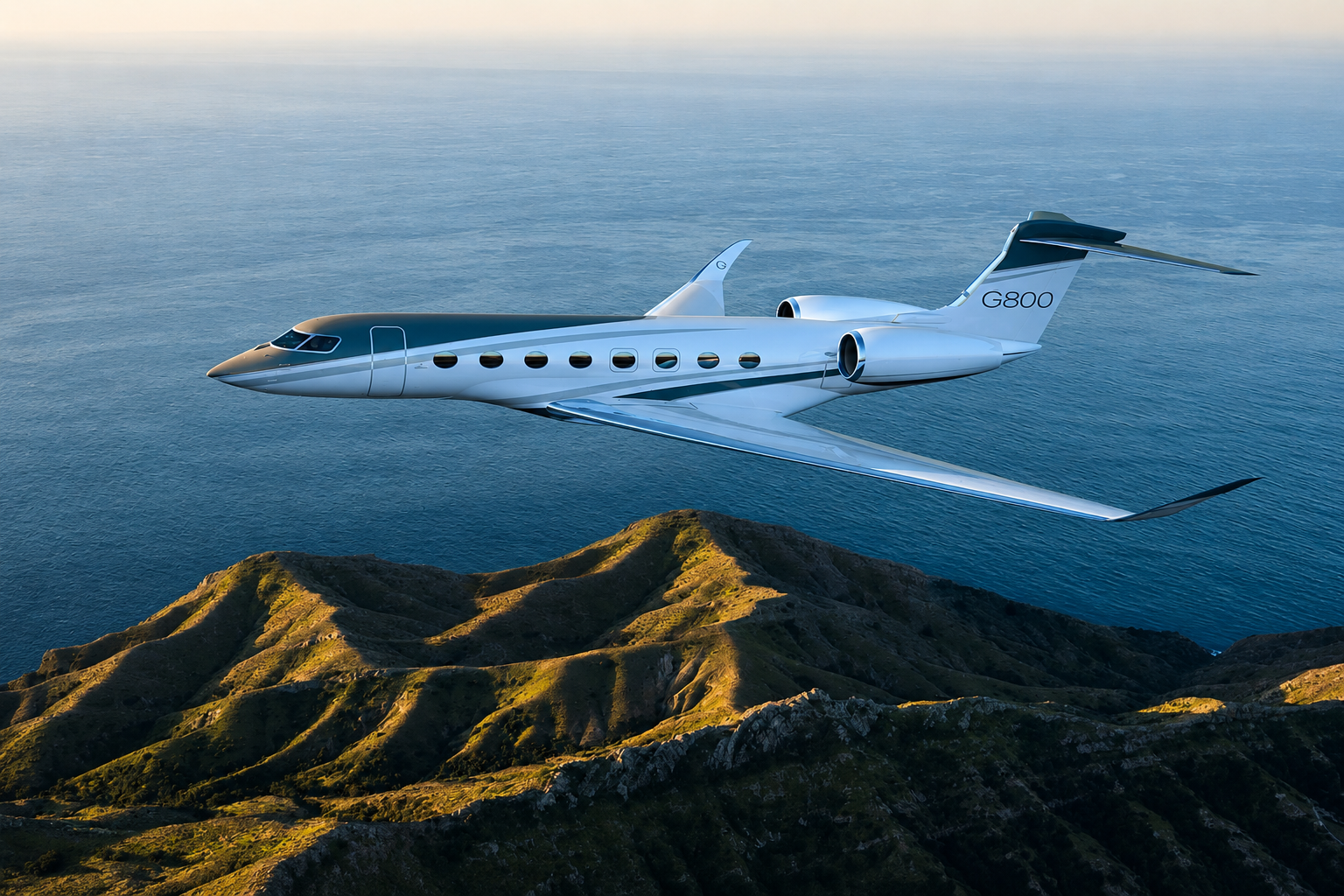
The cabin door closes on a rain-swept apron in Geneva. One aircraft waits with the restrained confidence of a Canadian flagship, the other with the unmistakable curvature of Savannah’s most ambitious design language. Inside both jets, the atmosphere is familiar to owners who measure travel in uninterrupted time rather than miles. Bedrooms convert quietly, lighting adjusts to circadian rhythms, and crews prepare for flights that connect New York to Hong Kong without compromise. This comparison of Bombardier Global 8000 vs Gulfstream G800 examines the two aircraft redefining the top tier of business aviation. Both promise extraordinary range, speed, and cabin refinement, yet they appeal to different ownership philosophies. For buyers considering an aircraft as a strategic asset and a private residence in motion, the distinction lies in details such as altitude, operating profile, and how each manufacturer translates engineering into lived experience.
Why This Rivalry Matters at the Very Top of Private Aviation
This level, aircraft are selected with the same scrutiny applied to yachts and residences. Owners are not comparing simple specifications. They are evaluating how a jet fits a broader lifestyle that includes global businesses, family travel, and the need for discretion. The Bombardier Global 8000 vs Gulfstream G800 debate matters because these two aircraft represent the clearest expression of what ultra-long-range aviation has become. One emphasizes remarkable speed and a low cabin altitude, while the other pairs range with a cabin architecture refined through decades of Gulfstream development. Purchase decisions often involve pilots, family offices, tax advisers, and maintenance specialists. The aircraft becomes part of an operational ecosystem rather than an isolated acquisition. Private jet ownership, family offices, and aviation strategy shape the conversation as much as the headline numbers.
Exterior Presence and First Impressions on the Ramp
Seen side by side, both jets communicate authority without excess. The Global 8000 carries the long, balanced proportions of Bombardier’s flagship platform, while the G800 presents Gulfstream’s signature oval windows and sculpted wing design. These are details seasoned owners notice immediately. Ramp presence matters because it reflects engineering priorities. Gulfstream’s high-speed wing and distinctive winglets suggest aerodynamic efficiency. Bombardier’s clean profile hints at the performance gains derived from its evolved Global platform. Boarding either aircraft feels less like entering transportation and more like stepping into a controlled environment designed around privacy and continuity. In the Bombardier Global 8000 vs Gulfstream G800 comparison, exterior design, aerodynamics, and brand identity contribute to a first impression that extends well beyond aesthetics.
Range and Speed: Which Aircraft Reaches Farther and Faster
For owners flying between financial centers and remote residences, range is operational freedom. The Gulfstream G800 offers exceptional nonstop capability that connects many of the world’s most demanding city pairs. Bombardier counters with the Global 8000, engineered to combine ultra-long range with one of the fastest cruise profiles in business aviation. Speed matters because small time savings compound across a year of intercontinental travel. Mechanically, this advantage comes from aerodynamic refinement, engine efficiency, and flight planning that optimizes performance at altitude. In the Bombardier Global 8000 vs Gulfstream G800 decision, ultra-long-range capability, high-speed cruise, and nonstop global travel are central to ownership value. The right choice depends on whether the buyer prioritizes marginally longer reach, higher cruise performance, or the operating philosophy of the manufacturer.
Cabin Design and the Experience of Living Aloft
The true comparison begins once the door closes. Bombardier’s four-zone layout emphasizes distinct living areas, allowing owners to move from meeting space to dining area to a private suite with minimal interruption. Gulfstream responds with an exceptionally bright cabin shaped by large panoramic windows and a design language focused on openness. Materials, acoustics, and lighting are curated with the precision of a high-end residence. The most revealing detail is how each manufacturer approaches flow. Bombardier favors architectural separation, while Gulfstream creates a more continuous environment. Within the Bombardier Global 8000 vs Gulfstream G800 analysis, cabin comfort, interior design, and private suites become decisive for owners who spend dozens of nights each year onboard.
Cabin Altitude, Noise, and the Physiology of Arrival
Experienced travelers know that performance after landing matters as much as comfort in flight. Both aircraft are engineered to reduce fatigue through low cabin altitude, advanced pressurization, and sophisticated sound insulation. Gulfstream has built much of its reputation around passenger wellness, while Bombardier has pushed aggressively to create one of the healthiest cabin environments in the segment. The mechanism is highly technical. Stronger fuselage structures allow the cabin to maintain lower effective altitude, which reduces the physiological strain associated with long-haul travel. In the Bombardier Global 8000 vs Gulfstream G800 comparison, cabin altitude, wellness technology, and noise reduction influence how owners step directly from the aircraft into boardrooms, estates, or diplomatic meetings with minimal recovery time.
Cockpit Technology and Pilot Preference
Behind the passenger cabin, both manufacturers deliver flight decks designed to reduce workload and enhance situational awareness. Advanced avionics, head-up displays, and predictive safety systems support crews operating in complex international environments. Pilots often develop strong preferences based on interface logic and how each aircraft behaves during long missions. Gulfstream’s cockpit benefits from a mature ecosystem and extensive operator familiarity. Bombardier combines proven systems with performance upgrades that extend the capabilities of its flagship platform. In the Bombardier Global 8000 vs Gulfstream G800 evaluation, avionics, pilot experience, and operational confidence matter because the ownership experience depends heavily on the efficiency and confidence of the flight crew.
Operating Costs, Residual Value, and Ownership Economics
Acquisition is only the beginning. Buyers at this level study maintenance programs, crew costs, insurance, fuel burn, and long-term resale performance. Family offices often model ten-year ownership scenarios to understand total capital exposure. Gulfstream benefits from a deeply established global support network and a strong reputation in the secondary market. Bombardier has strengthened its service infrastructure and continues to build momentum with the Global platform. The Bombardier Global 8000 vs Gulfstream G800 decision frequently comes down to operating costs, residual value, and manufacturer support rather than cabin finishes alone. A well-supported aircraft can protect both availability and asset value over time, which is why ownership economics receive as much attention as performance.
Which Aircraft Best Fits Different Types of Owners
Some owners value the fastest possible connection between continents and appreciate Bombardier’s ambitious performance envelope. Others prefer Gulfstream’s longstanding reputation, cabin ambiance, and entrenched global operator community. Entrepreneurs flying intensively between business centers may prioritize speed and mission flexibility. Families focused on comfort and proven brand familiarity may gravitate toward Gulfstream. The Bombardier Global 8000 vs Gulfstream G800 comparison is ultimately personal. Mission profile, ownership style, and brand loyalty shape the final decision more than any single specification. Both aircraft occupy the highest tier of private aviation, yet each delivers a distinct interpretation of what a flagship business jet should be.
Final Verdict, The Future of Ultra-Long-Range Flight
The Global 8000 and G800 represent two highly refined answers to the same question: how should private aviation serve owners whose lives unfold across continents. One leans toward remarkable performance and architectural zoning. The other offers a deeply established ownership ecosystem and a cabin environment many travelers know intimately. Both aircraft will influence purchasing decisions for years because they redefine what nonstop travel can feel like when time, privacy, and capability are treated as essential. The more enduring point extends beyond this rivalry. At the highest level, a private jet is not simply transportation. It is a mobile operating environment where decisions are made, families travel, and global lives remain uninterrupted at 51,000 feet.
FAQ
Which is better, Bombardier Global 8000 or Gulfstream G800?
The better choice depends on mission priorities, including range, speed, cabin layout, support network, and ownership economics.
Which jet has longer range, the Global 8000 or G800?
Both aircraft are designed for ultra-long-range missions and can connect major global city pairs nonstop with exceptional flexibility.
What is the main difference between Bombardier Global 8000 vs Gulfstream G800?
The main differences involve cabin design philosophy, manufacturer support ecosystems, and performance characteristics such as cruise speed and cabin altitude.
Which aircraft offers a more comfortable cabin?
Both provide world-class comfort, though preferences vary between Bombardier’s zoned layout and Gulfstream’s open, light-filled interior design.
Is the Global 8000 or G800 a better investment?
Long-term value depends on maintenance support, market demand, utilization, and the owner’s specific operational requirements.