A Display Case That Should Have Been Empty
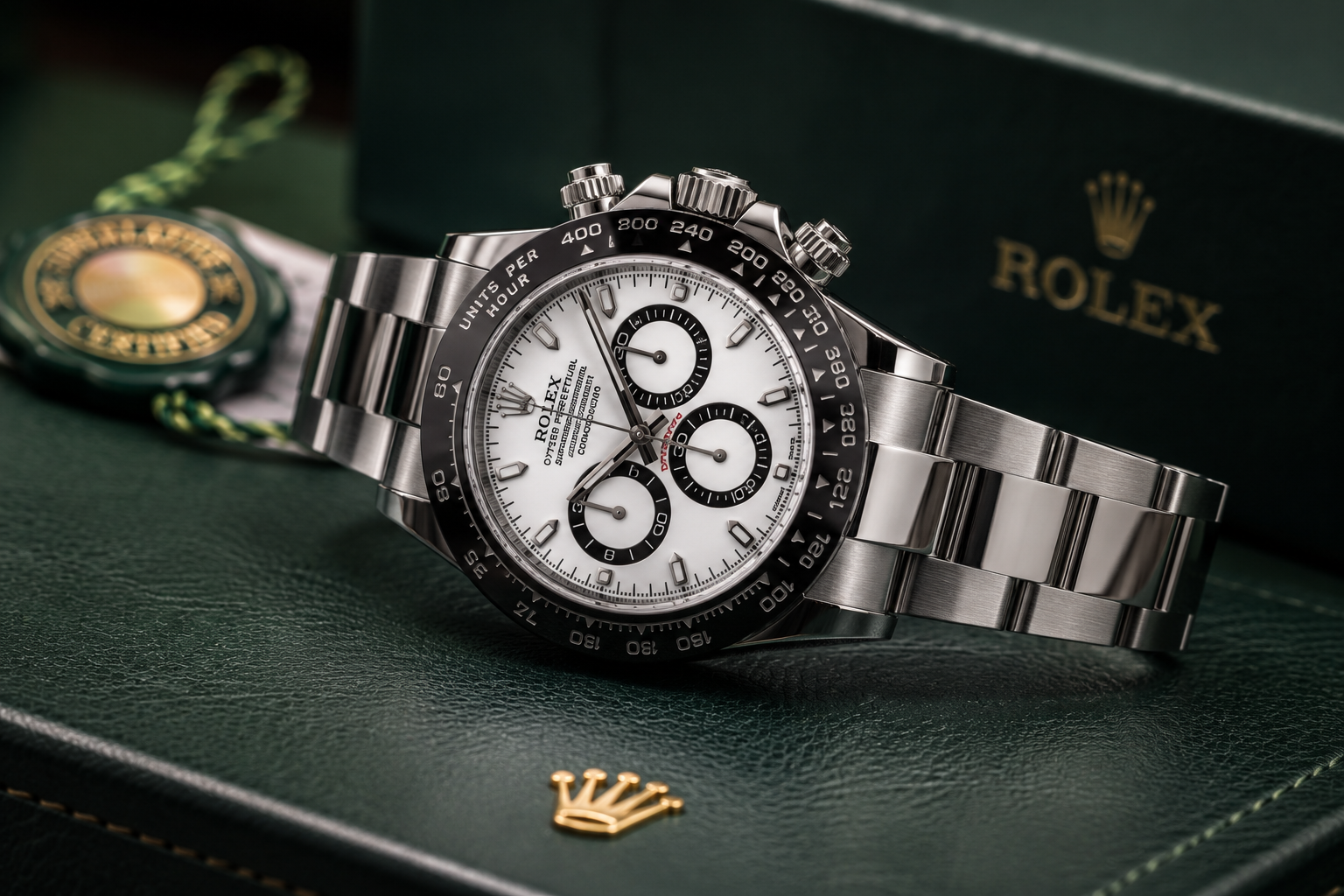
The dealer opens a safe and places a stainless steel Daytona on a tray. Within seconds, every conversation in the room shifts toward the watch. Nobody asks about its chronograph function. Nobody mentions lap times. The crowd studies the dial, reference number, condition, and provenance. The irony is impossible to ignore. The Rolex Daytona was originally built for a world that no longer depends on mechanical wristwatches to measure speed. Smartphones, digital timing systems, and advanced telemetry rendered its original purpose largely obsolete decades ago. Yet the watch has never been more desirable. Understanding the Rolex Daytona history investment value story requires looking beyond watchmaking. The Daytona’s rise reveals how scarcity, culture, storytelling, design, and human psychology can transform a practical object into one of the most sought-after luxury assets in the world. Its journey may be one of the most fascinating transformations in modern collecting.
The Daytona Was Never Supposed to Become a Luxury Icon
When Rolex introduced the Daytona, the objective was straightforward. The watch served drivers, racers, and enthusiasts who required a mechanical timing instrument capable of measuring elapsed time with precision. The design reflected function. The tachymeter scale allowed speed calculations. The chronograph pushers controlled timing events. Every element supported a specific purpose. Early market reception was far from extraordinary. In fact, some references struggled to attract buyers. Dealers occasionally discounted inventory. Demand remained inconsistent. Looking back from today’s perspective, it is difficult to imagine a period when Daytona models sat unsold in display cases. Yet that reality forms a crucial part of the watch’s story. Its eventual success was neither immediate nor inevitable.
The Racing World That Gave the Daytona Its Identity
The Daytona’s connection to motorsport remains central to its identity even though most owners will never use the watch for competitive timing. Rolex understood the power of association long before luxury marketing became a science. The watch became linked to endurance racing, speed, and technical excellence through strategic partnerships and cultural positioning. The name itself carries significance. Daytona evokes a specific environment where engineering, competition, and performance converge. This connection created a narrative framework that extended beyond the product. Owners were not simply buying a chronograph. They were participating in a broader story about achievement, precision, and aspiration.
Why Early Daytona Models Were Surprisingly Difficult to Sell
One of the most revealing chapters in the Rolex Daytona history investment value journey involves the watch’s early commercial challenges. During certain periods, buyers preferred other Rolex models offering greater practicality and broader appeal. The Daytona occupied a niche position within the catalog. Its specialized functionality limited mainstream demand. Some references remained in dealer inventories for extended periods. This phase demonstrates an important principle within collecting. The objects that eventually become legendary often begin their lives without widespread recognition. Scarcity alone does not create value. Meaning emerges gradually through culture, timing, and changing perceptions.
The Paul Newman Effect That Changed Everything
Few individuals have influenced a product’s reputation as profoundly as Paul Newman influenced the Daytona. His association with a particular dial configuration transformed collector interest and eventually reshaped the market. The significance extends beyond celebrity ownership. Newman represented authenticity. He wore the watch rather than collecting it as an investment. The image felt natural rather than constructed. Over time, collectors began viewing specific references through a different lens. Demand increased. Scholarship expanded. Auction results attracted global attention. A niche variation evolved into one of the most recognized collector categories in watchmaking history. This shift illustrates how cultural significance can dramatically alter perceived value.
Mechanism Reveal: How Scarcity Actually Works in the Daytona Market
The most misunderstood aspect of Daytona demand involves scarcity. Many observers assume scarcity exists simply because Rolex produces limited quantities. The reality is more nuanced. Demand consistently exceeds supply because the Daytona occupies a unique position at the intersection of brand prestige, design consistency, cultural relevance, and collector enthusiasm. Historical references add another layer through rarity, provenance, and condition sensitivity. The mechanism operates across multiple generations simultaneously. Vintage collectors pursue early references. Modern buyers seek current production models. Investors monitor market trends. Enthusiasts admire the watch’s history. These overlapping audiences create sustained demand that extends beyond any single collecting trend.
The Design That Refused to Become Outdated
Many luxury products struggle to maintain relevance across changing tastes. The Daytona succeeded because its core design remains remarkably disciplined. The dial layout feels balanced. The proportions remain elegant. Functional elements contribute to visual identity rather than clutter. Rolex resisted dramatic reinvention, choosing instead to refine the watch gradually over time. This consistency allowed multiple generations to recognize the Daytona instantly. The design became familiar without becoming stale. Collectors often value continuity because it reinforces long-term confidence. The Daytona’s visual stability contributed significantly to its enduring appeal.
From Tool Watch to Status Symbol
At some point, the Daytona ceased being purchased primarily for its intended purpose. The transformation happened gradually rather than suddenly. As demand increased and waiting lists expanded, ownership itself became a signal. The watch communicated access, patience, and participation within a highly competitive market. Yet unlike many status symbols, the Daytona retained credibility among enthusiasts. Its reputation remained grounded in genuine horological and historical significance. This combination proved exceptionally powerful. The watch could satisfy both collectors and aspirational buyers simultaneously, creating a demand profile few products achieve.
Rolex Daytona History Investment Value: Why Collectors Study It So Closely
The phrase Rolex Daytona history investment value appears frequently because the model has become a case study in collectible luxury. Collectors examine historical auction results, reference variations, production periods, dial configurations, and ownership histories with remarkable attention to detail. Yet the strongest lesson may not involve financial performance. Instead, it involves understanding how cultural importance accumulates over time. The Daytona demonstrates that value often emerges from a combination of storytelling, scarcity, design excellence, and emotional resonance rather than purely technical characteristics.
The Auction Market and the Creation of Modern Legends
Auction houses played a significant role in elevating the Daytona’s profile. High-profile sales attracted media attention and introduced the watch to broader audiences. Record-breaking results created headlines. Collectors began researching references more deeply. The market developed increasing sophistication. Provenance gained importance. Historical context became essential. These developments transformed the Daytona from a desirable watch into a globally recognized collectible category. The auction world did not create demand, but it amplified awareness and accelerated the watch’s cultural significance.
What Modern Buyers Are Actually Purchasing
Contemporary Daytona buyers rarely purchase the watch because they need a chronograph. Most own multiple devices capable of timing events more accurately. Instead, they acquire a combination of heritage, craftsmanship, scarcity, design, and cultural significance. The watch functions as an object carrying multiple layers of meaning. It connects owners to motorsport history, Rolex’s broader legacy, and decades of collector enthusiasm. Understanding this reality helps explain why practical obsolescence never diminished demand. The Daytona evolved beyond its original utility.
The Future of the Daytona in a Digital World
As technology continues advancing, the Daytona’s original function becomes even less necessary. Yet that trend may strengthen rather than weaken its appeal. Luxury increasingly revolves around experiences, stories, and emotional connections rather than practical necessity. Mechanical watches occupy a space where craftsmanship matters precisely because technology has made them unnecessary. The Daytona embodies this shift perfectly. Its relevance now depends on culture rather than utility. That distinction may prove crucial to its long-term future.
The Lesson Was Never About Timing
The most fascinating aspect of the Rolex Daytona story is that the watch achieved its greatest success after losing the need for its original purpose. The Rolex Daytona history investment value narrative reveals how objects acquire meaning beyond functionality. A racing chronograph became a cultural artifact. A slow-selling reference became a collector obsession. A tool watch evolved into a global symbol of access and desirability. Long after technology rendered mechanical timing obsolete, the Daytona continued gaining relevance. That transformation offers a broader lesson about luxury itself. The products that endure often succeed because of the stories people attach to them, not the tasks they were originally designed to perform.
FAQ
Why is the Rolex Daytona so valuable today?
The Daytona combines historical significance, limited availability, strong collector demand, iconic design, and cultural relevance, creating sustained interest across multiple generations of buyers.
What is the importance of Paul Newman to Daytona history?
Paul Newman became closely associated with a specific Daytona dial variation, helping transform a niche reference into one of the most celebrated and valuable categories in watch collecting.
Was the Rolex Daytona always popular?
No. Early Daytona models experienced periods of relatively weak demand, and some references remained unsold for extended periods before collector interest grew significantly.
Is the Rolex Daytona considered a good investment?
Many collectors view the Daytona as one of the most important luxury watch references due to its strong historical significance, enduring demand, and established position within the collector market.
Why is the Daytona called a tool watch?
The Daytona was originally designed as a chronograph for motorsport use, featuring timing functions and a tachymeter scale intended to assist drivers and racing enthusiasts.