
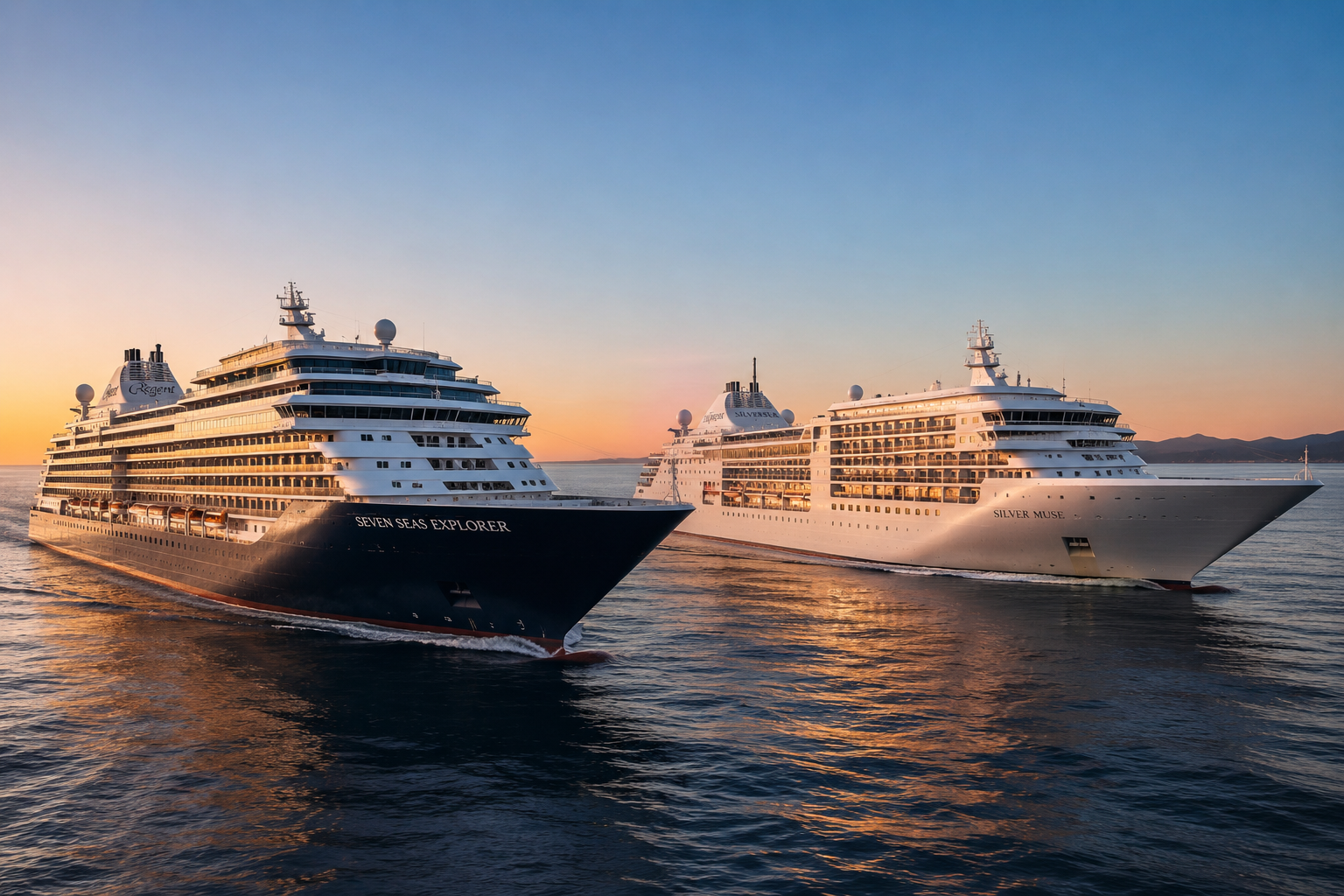
The suite doors close softly while the coastline of Monte Carlo slips past the balcony in near silence. A butler places handwritten dinner confirmations beside a chilled bottle of vintage champagne as tenders move quietly below toward the marina lights. Across the harbor, another ultra-luxury vessel prepares for departure with equal precision, polished teak glowing under muted deck lighting while crew members reset lounge furniture down to exact angles. The debate surrounding Regent Seven Seas vs Silversea luxury cruise experiences begins here, in the details invisible to ordinary travelers yet immediately obvious to seasoned luxury clients. Both cruise lines promise exceptional service, expansive suites, destination-rich itineraries, and near-total operational polish. Yet they approach ultra-luxury hospitality differently. One leans toward spacious abundance and seamless inclusivity. The other emphasizes intimacy, expedition sophistication, and highly personalized service rhythms. For travelers accustomed to private aviation, yacht charters, and resort-level discretion, the distinction matters more than brochure language ever suggests.
Why Ultra-Luxury Cruising Has Become a Billionaire Alternative to Yachting
Private yachting offers complete control, yet even wealthy travelers increasingly appreciate the operational simplicity of ultra-luxury cruising. Elite cruise lines now deliver many of the same experiences without requiring owners to manage crew logistics, maintenance infrastructure, or seasonal repositioning. The strongest Regent Seven Seas vs Silversea luxury cruise comparisons emerge because both brands occupy a rare segment where service ratios, suite sizes, and destination access rival private hospitality standards. Ultra-luxury cruises, private-style travel, and all-inclusive expedition cruising have evolved far beyond traditional cruise stereotypes, attracting travelers who value comfort, cultural access, and operational ease simultaneously.
First Impressions, Regent’s Grand Scale vs Silversea’s Quiet Intimacy
Walking onto a Regent ship often feels like entering a floating luxury hotel. Public areas are expansive, suite corridors wide, and design language intentionally polished without becoming theatrical. Silversea creates a different emotional atmosphere. Spaces feel more intimate, quieter, and slightly more residential in scale. Crew interactions also shift subtly. Regent tends toward seamless professional formality while Silversea often feels more conversational and personally adaptive. Within the larger Regent Seven Seas vs Silversea luxury cruise conversation, ship atmosphere, luxury hospitality design, and guest-to-space ratios reveal two distinct philosophies surrounding high-end travel at sea.
Suite Design and the Difference Between Comfort and Residence
Both cruise lines offer suites that exceed many luxury hotel rooms in quality, yet the experiences differ meaningfully in execution. Regent emphasizes spaciousness, oversized marble bathrooms, and highly polished contemporary interiors designed to feel immediately impressive. Silversea often leans toward softer textures, warmer palettes, and layouts that prioritize privacy and intimacy over visual scale. The mechanism behind these differences reflects broader operational philosophies. Regent builds environments optimized for visible comfort and effortless movement while Silversea prioritizes emotional calm and residential rhythm. The strongest Regent Seven Seas vs Silversea luxury cruise comparisons therefore focus heavily on luxury suites, butler service, and private veranda living because this is where travelers spend most of their time onboard.
Dining Experiences and How Culinary Culture Shapes Each Brand
Food defines luxury travel more deeply than marketing departments often admit. Regent approaches dining with broad variety and highly polished execution across multiple specialty venues. Silversea tends to focus more heavily on regional integration and personalized flexibility, particularly on expedition and longer itineraries. This becomes important here because elite cruise dining relies heavily on logistics. Ingredient sourcing, provisioning schedules, galley coordination, and staffing ratios determine whether restaurants feel genuinely refined or merely expensive. In the context of Regent Seven Seas vs Silversea luxury cruise, fine dining at sea, destination-inspired cuisine, and private dining experiences explain how culinary identity shapes overall guest perception.
Service Standards and the Invisible Labor of Luxury
True luxury hospitality depends on anticipation rather than reaction. Both cruise lines operate at exceptionally high service levels, yet their rhythms differ subtly. Regent often delivers highly structured efficiency where requests disappear almost instantly into operational systems. Silversea tends to create a more relationship-driven atmosphere where crew members adapt continuously to guest preferences over longer voyages. The strongest Regent Seven Seas vs Silversea luxury cruise evaluations emerge through small moments, remembering preferred wine temperatures, adjusting cabin environments quietly, or altering excursion timing without formal requests. Luxury cruise service, butler culture, and hospitality precision define experiences that most passengers notice emotionally long before they analyze them intellectually.
Itineraries, Expedition Access, and Destination Philosophy
Regent excels in classic luxury itineraries connecting major cultural and coastal destinations with extensive onboard comfort. Silversea has built particularly strong credibility within expedition cruising, including polar regions and remote destinations requiring specialized operational capability. Expedition vessels carry reinforced hulls, advanced navigation systems, and expedition teams capable of delivering highly curated off-ship experiences. The mechanism behind this distinction involves fleet structure and destination philosophy. Within the broader Regent Seven Seas vs Silversea luxury cruise discussion, expedition cruising, global itineraries, and destination immersion reveal which brand better aligns with different travel personalities.
Wellness, Privacy, and the Psychology of Long Voyages
Long luxury voyages demand more than visual beauty. Travelers increasingly prioritize wellness infrastructure capable of supporting sleep quality, physical recovery, and emotional calm over extended periods at sea. Regent often emphasizes expansive spa facilities and polished relaxation spaces integrated into larger ship environments. Silversea’s smaller-scale ships create naturally quieter atmospheres with less passenger density overall. The Regent Seven Seas vs Silversea luxury cruise comparison therefore extends into psychology as much as amenities. Luxury wellness travel, private sea travel, and slow mobility experiences shape how guests experience time itself during multi-week itineraries.
Who Regent Appeals To vs Who Chooses Silversea
Regent often attracts travelers seeking maximum inclusivity, spacious accommodations, and highly polished luxury without operational friction. Silversea appeals strongly to travelers who prioritize expedition access, quieter onboard culture, and highly adaptive personalized service. Neither approach is objectively superior. The distinction resembles the difference between staying at a grand luxury hotel and retreating to an exceptionally private boutique property. Within the world of Regent Seven Seas vs Silversea luxury cruise, luxury traveler preferences, high-net-worth travel behavior, and private-style cruising reveal how personality shapes purchasing decisions far more than specification sheets alone.
The Economics of Ultra-Luxury Cruising
First glance, ultra-luxury cruising appears expensive relative to conventional travel. Yet many affluent travelers increasingly view these voyages as operationally efficient alternatives to managing yachts, private villas, and constantly shifting logistics independently. Included dining, premium beverages, butler service, excursions, and highly curated itineraries reduce planning friction substantially. The Regent Seven Seas vs Silversea luxury cruise debate therefore extends into value perception. All-inclusive luxury travel, private hospitality economics, and high-end cruise infrastructure reveal why this segment continues expanding among travelers who already possess access to almost every other form of luxury mobility.
Which Cruise Line Earns the Trillionaire Seal?
The answer depends entirely on what the traveler values most. Regent Seven Seas delivers expansive comfort, polished operational consistency, and highly visible luxury execution. Silversea offers intimacy, expedition sophistication, and a quieter style of personalized service that often feels less performative and more deeply embedded into the voyage itself. The deeper implication surrounding the Regent Seven Seas vs Silversea luxury cruise comparison is that ultra-luxury travel is becoming increasingly individualized. The future of elite cruising may belong less to the largest ships or most extravagant suites and more to whichever brand understands how wealthy travelers actually want to feel while moving through the world.
FAQ
Which is more luxurious, Regent Seven Seas or Silversea?
Both offer ultra-luxury experiences, though Regent emphasizes spacious all-inclusive comfort while Silversea focuses more heavily on intimacy and expedition sophistication.
Does Silversea include butler service?
Yes. Silversea provides butler service across many suite categories, particularly on higher-end itineraries and expedition voyages.
Are Regent Seven Seas cruises fully all-inclusive?
Regent is widely known for its highly inclusive pricing structure, often including excursions, premium dining, beverages, and other luxury services.
Which cruise line is better for expedition travel?
Silversea is especially respected for expedition cruising, including polar and remote-destination itineraries supported by specialized expedition vessels.
Why are luxury cruises becoming popular among billionaires?
Ultra-luxury cruises combine private-style service, destination access, wellness, and operational convenience without the complexity of managing private yachts or multiple residences.