
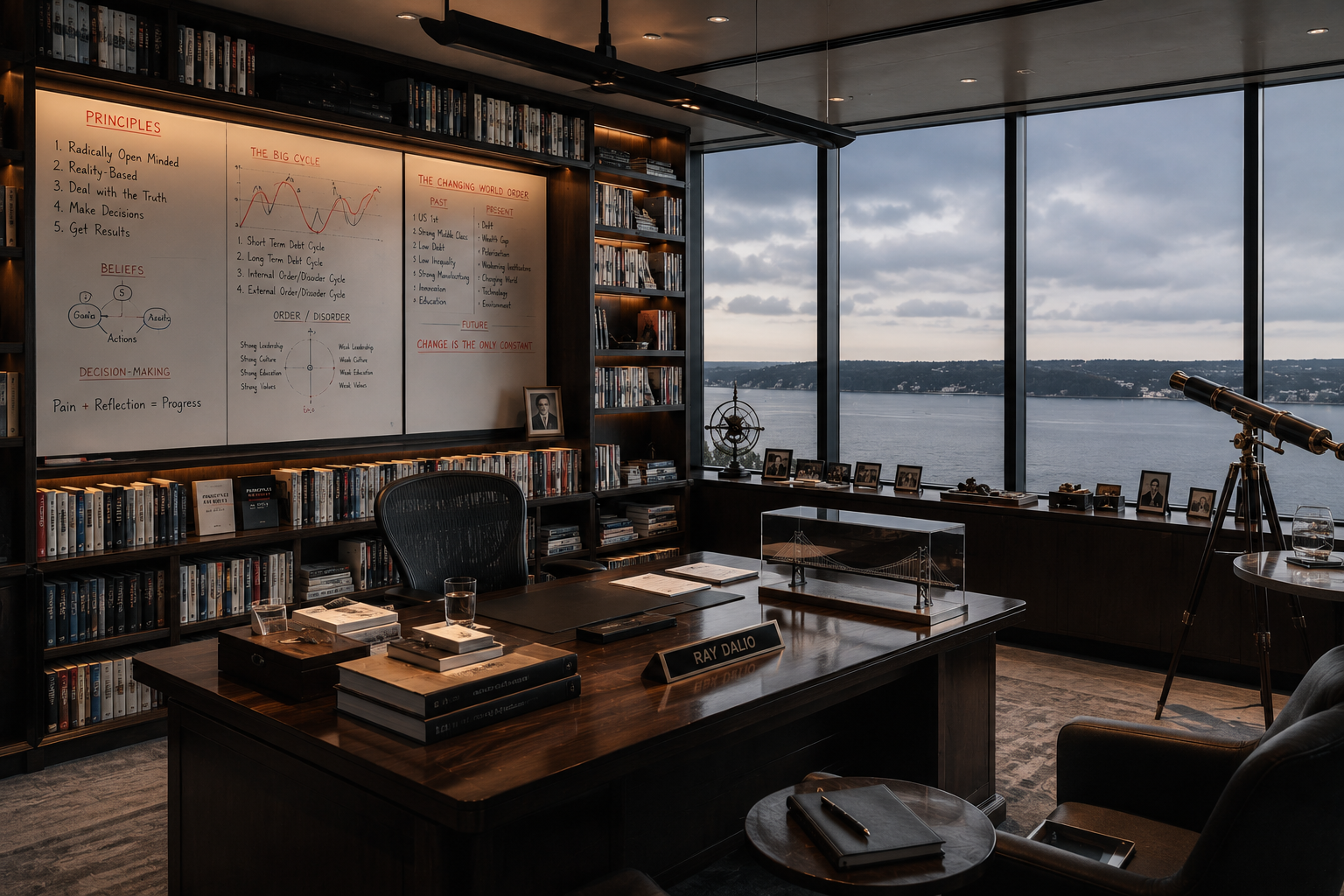
When people imagine a billionaire investor’s office, they often picture wall-to-wall screens and marble floors. Ray Dalio’s approach to his working environment is built around something less visible: a system for thinking clearly. The founder of Bridgewater Associates, one of the world’s largest hedge funds, has spent decades designing not just offices, but the processes, culture and tools that surround investment decisions.
It Starts With Questions, Not Screens
Dalio founded Bridgewater in 1975 out of his two-bedroom apartment in New York. The firm grew into a giant managing well over $100 billion, now based in Westport, Connecticut, but its core idea stayed the same: understand how the economic “machine” works, and make decisions based on principles rather than emotions.
That philosophy shapes his workspace. The environment exists to support careful questioning, debate and learning from mistakes.
Clear Thinking Over Status
Dalio’s writing, especially his bestselling book Principles, emphasises that the best decisions come from confronting reality honestly, including your own weaknesses. An office designed around that idea prioritises open discussion, easy access to information and spaces where ideas can be challenged, rather than displays of status.
How an Elite Investment Office Processes Information
Bridgewater is known for its systematic approach. Instead of relying solely on individual judgement, the firm translates its understanding of markets into rules and models that can be tested against historical data. Researchers study economic history across many countries and centuries, looking for patterns in debt cycles, inflation and growth.
The physical office is designed to support that research culture: quiet spaces for deep analysis, rooms for group debate and technology that makes data accessible across the firm.
Why Environment Shapes Decisions
Behavioural finance shows that stress, distraction and social pressure can lead to poor investment decisions. A well-designed environment reduces noise and encourages reflection. Dalio has long practised Transcendental Meditation and credits it with helping him stay calm and clear-headed.
Radical Transparency
Bridgewater’s culture is famous for “radical transparency”. Many meetings are recorded, employees are encouraged to challenge one another openly regardless of seniority, and feedback tools allow people to rate each other’s thinking in real time. Profiles summarising employees’ strengths and weaknesses, sometimes called “baseball cards”, help match people to the right roles.
The approach is controversial and not for everyone, but it reflects Dalio’s belief that truth-seeking requires honest disagreement.
Technology That Supports Judgement
At Bridgewater, technology is used to capture decision-making rules, analyse data and track how well people’s judgements perform over time. The aim is not to replace human thinking, but to make it more disciplined and accountable.
Process Over Prediction
Dalio often stresses that no one can reliably predict the future. Instead, the goal is to build a portfolio that can perform reasonably well in many different environments. That idea led to Bridgewater’s “All Weather” strategy, which balances assets designed to respond differently to growth and inflation.
Lessons for Entrepreneurs
Business owners do not need a hedge fund budget to learn from Dalio’s approach:
- Write down the principles behind your decisions.
- Create spaces, physical and cultural, where people can disagree openly.
- Review mistakes systematically and learn from them.
- Limit distractions and protect time for deep thinking.
- Use data to test your assumptions.
An Expensive Office Versus an Intelligent One
An expensive office impresses visitors. An intelligent one improves decisions. Dalio’s real infrastructure is the combination of culture, principles and systems behind the walls, not the furniture inside them.
Built Around Intellectual Discipline
Ray Dalio’s personal fortune, estimated in the tens of billions of dollars, was built on a disciplined way of thinking about markets. His workspace, in the broadest sense, is designed to protect that discipline.
FAQ
What defines Ray Dalio’s approach to his work environment?
A focus on principles, radical transparency, systematic research and spaces that support open debate and clear thinking.
Why does workspace design matter for investors?
Because stress, distraction and social pressure can lead to poor decisions. A well-designed environment encourages reflection and discipline.
What technology do elite investment offices use?
Data analysis platforms, research systems, decision-tracking tools and secure communication, used to support human judgement.
How do successful investors reduce emotional decisions?
By following written principles, diversifying, testing ideas against data and reviewing mistakes systematically.
Can entrepreneurs apply these principles?
Yes. Writing down principles, encouraging honest feedback and protecting time for focus work in any business.