Porsche has never been short of special editions, but the Porsche 911 GT3 Artisan Edition is a different kind of limited run. Created by Porsche Exclusive Manufaktur and reserved entirely for Japan, it takes the most purist model in the 911 range and finishes it with details inspired by two traditional Japanese crafts: cut glass and indigo dyeing. Only 30 cars are being built.
For collectors, that combination of a high-revving naturally aspirated GT car, local craftsmanship and tiny production numbers is about as compelling as modern Porsches get.
Why Porsche Built a Japan-Exclusive GT3
Japan is one of Porsche’s most discerning markets. Its buyers are known for exacting standards, meticulous care of their cars and a deep appreciation for objects that reward close inspection. Air-cooled 911s, GT models and rare specification cars are treated almost like museum pieces by many Japanese enthusiasts.
A Japan-exclusive model speaks directly to that culture. Rather than simply painting a GT3 in a special colour, Porsche worked with Japanese artisans so that the car reflects the country it was made for. The result feels less like a marketing exercise and more like a genuine collaboration.
What “Artisan” Means Here
The name refers to the Japanese craft traditions behind the car’s design. Two in particular shaped the details: Edo-style cut glass, known for its fine geometric patterns, and indigo dyeing, a centuries-old technique prized for its deep, layered blues.
Those influences show up in subtle ways throughout the car. Patterns echoing cut glass appear in carbon-fibre aero elements, while indigo-inspired textiles and tones run through the cabin. The aim is not to shout about Japanese heritage, but to let it reveal itself the closer you look.
Exterior Design and Finishing
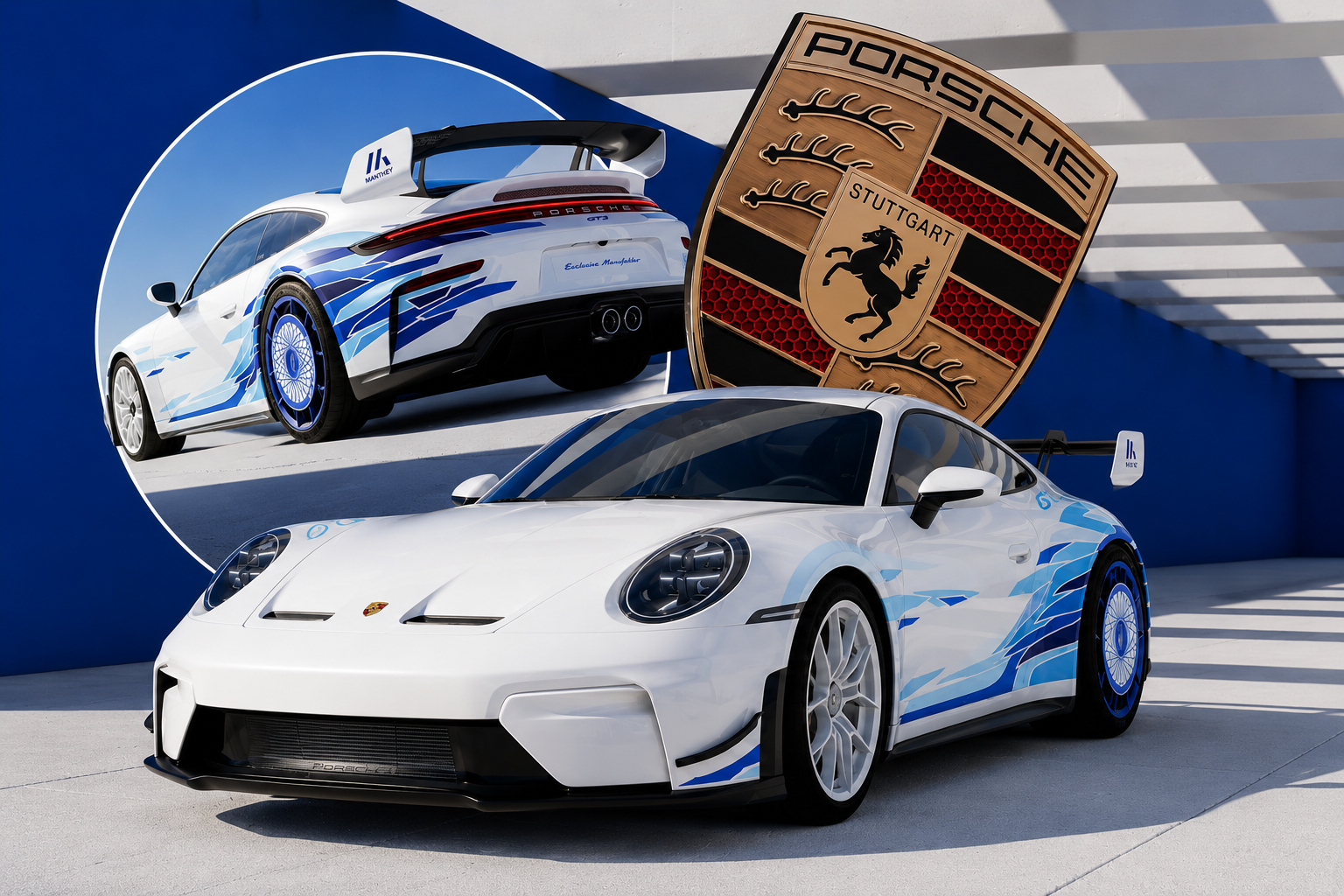
The Artisan Edition starts with white bodywork, set off by Club Blue graphics and light blue accents on the sculpted rear fenders. The graphics fade in a gradient that is meant to suggest airflow and the passage of time, a nod to both motion and craftsmanship.
White front wheels add to the clean, almost porcelain look. At the rear, carbon-fibre aero covers carry a web-like pattern inspired by cut glass. It is a quiet detail that most people would walk past, which is exactly the point.
A Cabin Inspired by Japanese Precision
Inside, the theme continues. Speed Blue and white leather stitching runs through the cabin, while blue and white inserts appear on the dashboard, centre console and door panels. The seats feature an indigo-dyed pattern, giving the interior a texture you will not find in any standard GT3.
Porsche extended the design to the accessories too, with a matching wallet and key pouch. There is even a “Wearable Heritage Collection” of clothing, including a jacket, tops and Puma sneakers, for owners who want the look to continue outside the car.
The Naturally Aspirated Flat-Six
Underneath the craftsmanship, this is still very much a GT3. Power comes from Porsche’s 4.0-litre naturally aspirated flat-six, producing around 510 PS (507 hp) and 450 Nm of torque, and revving all the way to 9,000 rpm.
At a time when most performance cars rely on turbochargers or hybrid systems, an engine like this has become rare. Its instant throttle response and spine-tingling top end are central to why the GT3 is so admired, and why collectors are increasingly drawn to it. In the Artisan Edition, power is sent through Porsche’s seven-speed PDK dual-clutch gearbox.
Manthey Kit and Track Focus
The Artisan Edition comes with the Manthey kit as standard. Developed with Porsche’s long-time racing partner Manthey, it adds four-way adjustable coilover suspension, revised aerodynamics for extra downforce and upgraded brakes designed for track use.
That makes the car more than a beautiful object. It is fully capable of being driven hard on circuit, with aerodynamic and chassis upgrades that sharpen the already precise GT3. Like all GT models, its roots go back to Porsche’s motorsport base in Weissach, where engineers obsess over steering feel, braking stability and balance.
Thirty Cars and the Power of Scarcity
Production is limited to just 30 units, all destined for Japan and all left-hand drive. That is a tiny number even by Porsche special-edition standards.
Scarcity alone does not make a car desirable, but scarcity combined with genuine engineering and a strong story usually does. A GT3 with the Manthey kit, a unique design developed with Japanese artisans and a production run of 30 has all the ingredients of a future collector-grade Porsche.
Pricing and Access
Porsche did not publish an official price at launch. For context, a standard 911 GT3 costs around ¥28.7 million in Japan, and the Artisan Edition, with its bespoke finishes and standard Manthey kit, is expected to sit well above that.
In practice, price is only part of the story. Cars like this are typically allocated to long-standing Porsche clients with a history of buying special models. For most people, the real barrier is not the money but the invitation.
Why Collectors Took Notice
Limited GT models have a strong track record in the collector market. Region-specific versions, in particular, tend to attract attention because they are so hard to find outside their home market. The Artisan Edition ticks several boxes at once: naturally aspirated engine, motorsport-derived hardware, bespoke design and very low numbers.
Japanese ownership culture adds another layer. Cars that have lived in Japan are often in exceptional condition, with careful maintenance and low mileage, which can make them especially appealing years down the line.
Part of a Bigger Strategy
The Artisan Edition fits into a broader pattern at Porsche of creating models for specific markets and clients. Porsche Exclusive Manufaktur and its Sonderwunsch personalisation programme have increasingly been used to tell local stories through design, materials and colour.
These projects strengthen the bond between Porsche and its most loyal customers. They also show how the brand sees luxury today: not as more power or more chrome, but as meaning, craftsmanship and a connection to place.
A Car Built to Outlast the Moment
The Porsche 911 GT3 Artisan Edition is not the fastest or most extreme 911 ever made. What makes it special is the balance it strikes between engineering purity and cultural nuance. It pairs one of the last great naturally aspirated engines with craft traditions that have been refined over centuries.
Thirty owners in Japan will get to experience that combination first-hand. For everyone else, it is a reminder that some of the most memorable cars are defined not by how loudly they announce themselves, but by how much they reveal on closer inspection.
FAQ
What is the Porsche 911 GT3 Artisan Edition?
It is a Japan-exclusive limited edition of the 911 GT3, created by Porsche Exclusive Manufaktur with design details inspired by Japanese cut glass and indigo dyeing. Only 30 units are being built.
Why is the Artisan Edition only available in Japan?
Porsche created it specifically for the Japanese market, which has a strong culture of collecting and caring for rare Porsches, and worked with local artisans to reflect Japanese craft traditions.
What engine does it use?
The 4.0-litre naturally aspirated flat-six from the 911 GT3, producing around 510 PS and revving to 9,000 rpm, paired with a seven-speed PDK gearbox.
Is the Porsche 911 GT3 Artisan Edition a good investment?
No return is guaranteed, but limited, region-specific Porsche GT models have historically attracted strong collector interest, and the Artisan Edition’s 30-unit run and unique story work in its favour.
What makes the Artisan Edition special?
Its combination of GT3 performance, the standard Manthey kit, bespoke Japanese-inspired design inside and out, and extreme rarity.