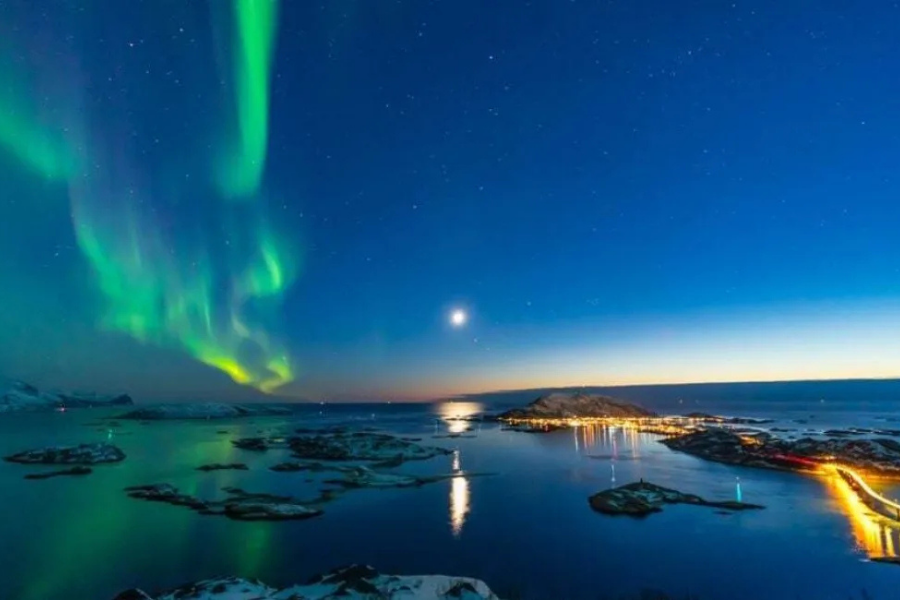
The wind came off the Norwegian Sea in clean, sharp currents, brushing across the ridgeline above Mefjordvær. Boots pressed into frozen gravel. Below, the fjord lay still, black as polished obsidian. Then the sky shifted.
At first, a pale arc stretched low on the horizon. It looked tentative, almost restrained. Within minutes, that restraint dissolved. Green ribbons ignited above the jagged peaks of Senja, bending and coiling in slow motion. The display widened, intensified, and climbed. Light spilled across the water, doubling itself in reflection. Cameras clicked, then stopped. No shutter could keep pace with the movement overhead.
The Northern Lights Over Senja Norway do not perform on schedule, and that unpredictability is part of their authority. Senja, Norway’s second-largest island, sits far enough north to offer consistent auroral visibility, yet remains less trafficked than Tromsø. The result is rare space. Fewer headlights, fewer competing flashes, more silence.
For landscape photographers, this coastline delivers topography that amplifies scale. Knife-edge mountains rise directly from the sea. Snow settles along the ridges, creating contrast against the aurora’s electric green. Travel enthusiasts and Arctic seekers arrive expecting spectacle. What they encounter is something more deliberate. The sky unfolds slowly, then accelerates without warning.
The display that night did not flicker. It surged. Curtains of light rippled from west to east, then fractured into delicate strands that shimmered like pulled silk. Above, stars held their ground as the aurora passed through them.
Proximity matters here. You feel the cold deepen as you wait. You hear only wind and distant water. The island offers no distraction.
Why Northern Lights Over Senja Norway Deliver a Rare Arctic Experience
The Northern Lights Over Senja Norway unfold at the intersection of geography and physics. Senja lies beneath the auroral oval, a shifting ring around the Earth’s magnetic poles where charged solar particles interact with the atmosphere. When solar wind carries electrons toward the planet, they collide with oxygen and nitrogen atoms in the upper atmosphere. Those atoms release energy as visible light. Oxygen at higher altitudes emits green and occasionally red hues. Nitrogen contributes purple and pink tones.
This is the mechanism. What elevates Senja is context.
Unlike urban viewing points, Senja offers deep darkness. Light pollution remains minimal outside small fishing villages. Mountains create natural framing. Fjords provide reflective surfaces. The island’s west-facing coastline gives unobstructed horizons toward open ocean, allowing aurora bands to appear earlier and stretch wider.
Weather conditions here move fast. Atlantic systems sweep across the island, clearing clouds quickly after snowfall. That volatility increases opportunity windows. A sky that appears closed at 9:00 pm can open entirely by 10:30 pm. Seasoned Arctic guides watch wind direction as carefully as solar activity forecasts.
For adventure travelers, Senja combines aurora viewing with terrain worth exploring by day. Frozen waterfalls hang along cliff faces. Coastal roads trace the waterline in long, cinematic curves. Snowshoeing across ridges provides altitude that shifts perspective. From above, you see the aurora’s geometry more clearly, arcs stacking over distant peaks.
Luxury Arctic experience seekers gravitate toward private lodges tucked into coves or perched above fjords. Interiors lean Scandinavian in restraint, wide windows positioned deliberately for night sky visibility. Heated floors combat the cold that seeps through boots after hours outdoors. Staff track auroral forecasts and will knock quietly if activity intensifies after midnight.
Landscape photographers arrive with tripods, wide-angle lenses, and patience. The island rewards composition discipline. A red fishing cabin under a shifting green sky delivers narrative contrast. A lone pier extending into black water adds linear depth. Exposure settings become negotiation. Too long and the aurora blurs into a wash. Too short and the dynamic folds disappear.
The aurora here rarely behaves as a static curtain. It pulses, contracts, then reappears in new formations. Watching it feels less like viewing a light show and more like observing weather made luminous.
There is also a psychological dimension. Senja’s remoteness compresses attention. Without urban interruption, the body calibrates to elemental cues. Cold. Wind. Darkness. When the sky ignites, it feels earned.
Travel enthusiasts and bucket-list explorers often speak of moments that justify distance. The Northern Lights Over Senja Norway qualify without theatrics. They rise above a landscape that does not compete for validation.
As solar cycles intensify over the coming years, auroral frequency may increase. Yet locations that offer this combination of topography, low density, and access will remain limited. Senja sits inside that narrow band.
The lights fade eventually. They always do. The sky returns to black, the mountains remain, and the fjord settles back into stillness. What lingers is not only the image, but the calibration.
The Arctic does not promise permanence. It offers presence. On Senja, under a sky alive with charged particles that began their journey 93 million miles away, that presence feels unusually precise.