Opening Scene, Arrival Before the Crowd
The dock is quiet at this hour. Crew move without conversation, checking lines, calibrating instruments, adjusting details that will not be noticed later. Out on the water, hulls sit low and still, engineered for speed that only reveals itself under pressure. A helicopter circles once, then disappears behind the cliffs.
By mid-morning, this place will look like a social calendar event. Right now, it reads differently. Precision first, spectacle second.
This is the environment where the most expensive sports in the world exist. Not as entertainment, but as controlled ecosystems. Entry is measured. Access is negotiated. Participation carries consequences that extend well beyond the field, the track, or the water.
The Structure of Access in the Most Expensive Sports in the World
Cost alone does not explain these sports. High prices are only the visible layer. The deeper structure is built on restriction.
Ownership is one gate. Membership is another. Then comes the network, the least visible and most decisive factor.
A racing yacht, for example, is not simply purchased. It is designed, tested, crewed, and positioned across seasons. A polo player does not arrive with one horse. They arrive with a system.
What drives cost at this level:
- Asset complexity, machines and animals that require constant calibration
- Private infrastructure, from hangars to coastal estates
- Human capital, engineers, trainers, tacticians
- Mobility, the ability to relocate instantly across continents
- Time insulation, schedules that remove friction from participation
These elements work together to filter entry. Not everyone who can afford the surface cost can sustain the ecosystem behind it.
Ranked: The Most Expensive Sports in the World
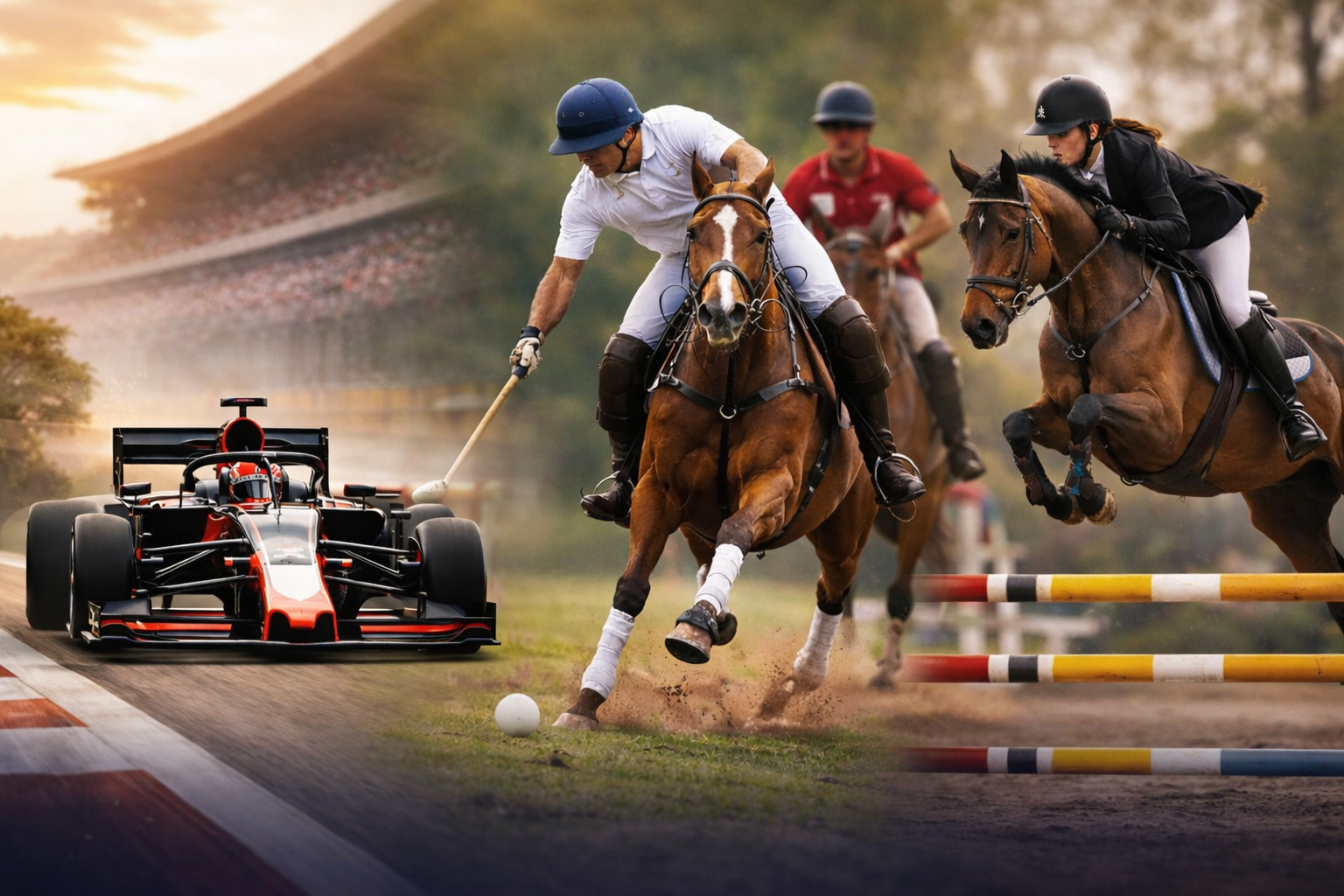
1. Formula 1 Racing, Precision at Scale
Monaco, late afternoon. The harbor fills before the race begins. Conversations happen on decks, not in stands. The cars pass in intervals, but the real movement is happening elsewhere.
Formula 1 sits at the top because it combines sport, technology, and global influence into one structure.
Cost Reality:
- Team operations reach into hundreds of millions annually
- Research divisions mirror aerospace engineering environments
- Sponsorship deals shape entry more than talent alone
How it actually works:
The official budget cap suggests limits. The advantage shifts into data ownership, simulation, and technical alliances. Performance gains are often measured in milliseconds, but those milliseconds are engineered through vast, quiet investments.
2. Superyacht Racing, Control Over Open Water
Wind shifts are subtle. The crew notices before the spectators do. Adjustments are immediate, almost invisible.
Superyacht racing is less about competition in the traditional sense and more about mastery over variables that cannot be controlled fully.
Cost Reality:
- Acquisition ranges from $10 million to over $300 million
- Annual maintenance remains consistent, regardless of usage
- Crew, logistics, and storage operate year-round
Mechanism:
The yacht itself is only the starting point. Competitive advantage comes from design intelligence and tactical navigation, refined across seasons rather than events.
3. Equestrian Sports, Living Assets with Memory
There is a pause before the jump. Not hesitation, something else. Recognition, perhaps. The horse already knows the line.
Equestrian sports operate on a different timeline. Development is slow, deliberate, and expensive.
Cost Reality:
- Elite horses valued from $1 million upward
- Ongoing care includes specialized veterinary teams
- Global competition requires constant transport logistics
Mechanism:
Bloodline influences potential, but training defines outcome. The horse carries memory. Each performance builds on a history that cannot be replicated quickly.
4. Polo, Speed Managed Through Rotation
The game moves faster than it appears from a distance. Horses rotate between chukkas. Decisions happen mid-stride.
Polo compresses equestrian investment into a faster, more demanding format.
Cost Reality:
- Multiple horses required per player
- Dedicated staff for training and care
- Travel between elite clubs across continents
Mechanism:
Endurance is distributed. Success depends on how effectively a player manages horse rotation and pacing, not just skill with the mallet.
5. Aviation Sports, Airspace as Territory
The runway is quiet until it isn’t. Then everything happens at once.
Aviation sports remain less visible, but the cost structure is uncompromising.
Cost Reality:
- Aircraft acquisition and customization
- Continuous maintenance and inspection cycles
- Training that operates at extreme precision levels
Mechanism:
Access is shaped by regulation. Certifications, airspace permissions, and compliance create natural barriers that money alone cannot bypass instantly.
6. America’s Cup Sailing, Engineering in Motion
At speed, the hull lifts. Water resistance disappears. For a moment, it looks unreal.
This level of sailing functions as a design competition disguised as sport.
Cost Reality:
- Research and development budgets dominate spending
- Materials are experimental, often proprietary
- Teams include engineers, analysts, and designers
Mechanism:
Performance gains come from innovation cycles, not repetition. The winning edge is often built months before the race begins.
7. Elite Golf, Access Hidden Behind Tradition
The course is quiet. Conversations stay low. Decisions happen off the fairway as often as on it.
At its highest level, golf becomes a network disguised as a sport.
Cost Reality:
- Membership fees can reach seven figures
- Access is controlled through committees
- Travel between private courses defines participation
Mechanism:
Entry depends on who introduces you, not how well you play. The game is only one layer of the experience.
| Rank | Sport | Estimated Cost Range | Core Asset | Access Barrier | How It Actually Works |
|---|---|---|---|---|---|
| 1 | Formula 1 Racing | $100M to $500M+ annually | F1 car, team infrastructure | Sponsorship, ownership stakes, elite driver pipeline | Performance is driven by data, simulation, and technical alliances, not just driving skill |
| 2 | Superyacht Racing | $10M to $300M+ acquisition + 10% yearly upkeep | Racing yacht | Yacht ownership, elite regatta invitations | Advantage comes from design intelligence and navigation strategy, refined over years |
| 3 | Equestrian Sports | $1M to $20M+ per horse + ongoing care | Elite horses | Bloodline access, training networks, global circuits | Success depends on horse memory, training, and long-term conditioning |
| 4 | Polo | $500K to $5M+ annually | Multiple polo horses | Private clubs, international circuits | Performance relies on horse rotation and stamina management, not just player skill |
| 5 | Aviation Sports | $1M to $10M+ aircraft + high maintenance | Aircraft | Licensing, airspace permissions, certifications | Entry is controlled by regulation and pilot precision, creating natural scarcity |
| 6 | America’s Cup Sailing | $50M to $200M+ campaign budgets | Foiling yachts | Team selection, national representation | Winning depends on engineering innovation and R&D cycles, not repetition |
| 7 | Elite Golf (Private Circuit) | $250K to $1M+ annually | Club memberships, travel | Invitation-only memberships, legacy networks | Access is determined by who introduces you, not performance alone |
The Investment Layer, Where Sport Meets Influence
Participation in these sports often leads to outcomes that are not recorded publicly.
Deals begin in informal settings. Partnerships develop over shared routines. Trust builds through repetition and proximity.
For high-net-worth individuals and investors, these environments offer:
- Access to closed networks
- Brand positioning within elite circles
- Opportunities that emerge outside structured markets
The sport provides context. The value exists in what surrounds it.
Final Note, After the Applause Fades
The event ends, but the infrastructure remains. Equipment returns to storage. Teams reset quietly. Invitations for the next season begin to circulate long before anything is announced.
Nothing here is temporary.
Access, once established, tends to compound.
FAQs
1. What defines the most expensive sports in the world?
They are defined by high entry costs, ongoing maintenance, restricted access, and strong connections to elite global networks.
2. Which sport has the highest ongoing cost?
Formula 1 and yacht racing maintain the highest continuous spending due to technology, staffing, and global logistics.
3. Are these sports accessible to new wealth?
Entry is possible, but it often requires introductions, credibility, and sustained presence, not just capital.
4. Why do wealthy individuals invest in these sports?
Beyond competition, these sports provide network access, influence, and long-term positioning.
5. Is there financial return in participating?
Direct returns are limited, but indirect value through relationships and opportunities can be substantial.