
A Private Room in Geneva
The room is quieter than the main floor. A handful of collectors stand near the glass display, hands folded, phones away. Under soft white light rests a Patek Philippe few will ever see again in public. No flash, no spectacle. Just a discreet murmur when the estimate appears.
This is the air surrounding the Most Expensive Patek Philippe Watches ever sold.
For the audience of The Trillionaire Life, price is not the headline. Access is. Rarity is. The question is simple, who secures the piece when the hammer falls, and why does it matter decades later.
This feature explores the five timepieces that reshaped the top tier of the market. Each represents a convergence of engineering, provenance, and timing. Each altered auction psychology. And each offers insight into how value in ultra high horology is constructed.
The Five Most Expensive Patek Philippe Watches in the World
1. Patek Philippe Grand Complications 6300A-010
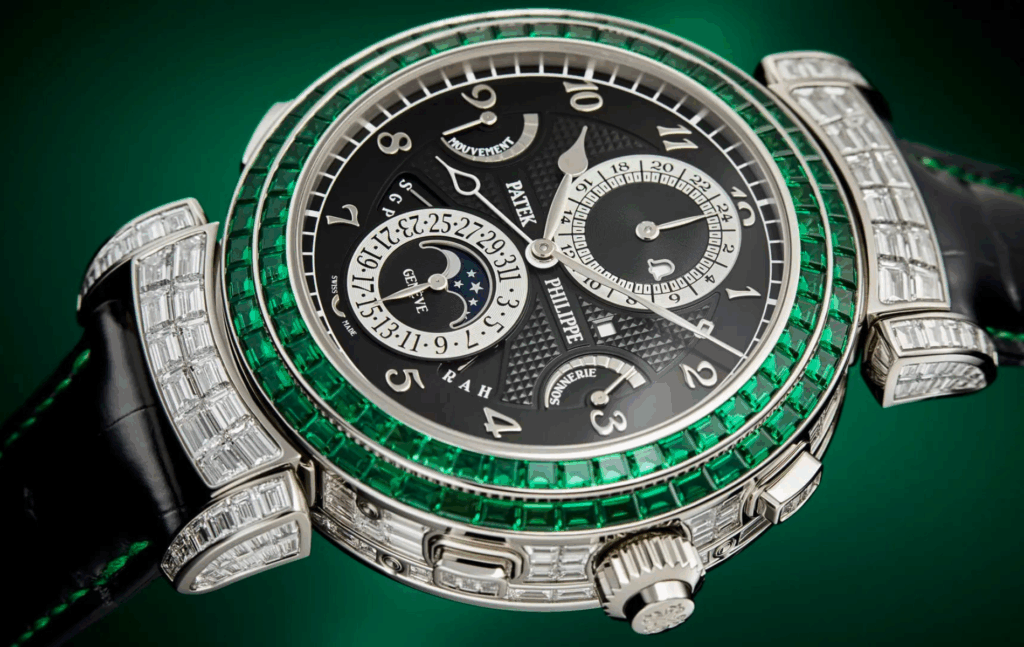
Sold for 31 million dollars at a charity auction in Geneva, this stainless steel Grand Complications reference shifted the ceiling permanently.
Steel is rarely the top metal in haute horlogerie. Here, that decision created tension. Collectors accustomed to platinum suddenly faced a unique steel minute repeater with a perpetual calendar and a second time zone.
How it works: the 6300A houses a reversible case. One dial displays a perpetual calendar with retrograde date. The other reveals a black enamel minute repeater dial. The owner physically rotates the case within its frame. It clicks into place with satisfying resistance, engineered through a patented swivel mechanism.
The watch became a cultural marker. After this sale, estimates across complicated references recalibrated. Serious buyers no longer asked if steel could command supremacy. They asked how rare the steel example was.
2. Patek Philippe Henry Graves Supercomplication
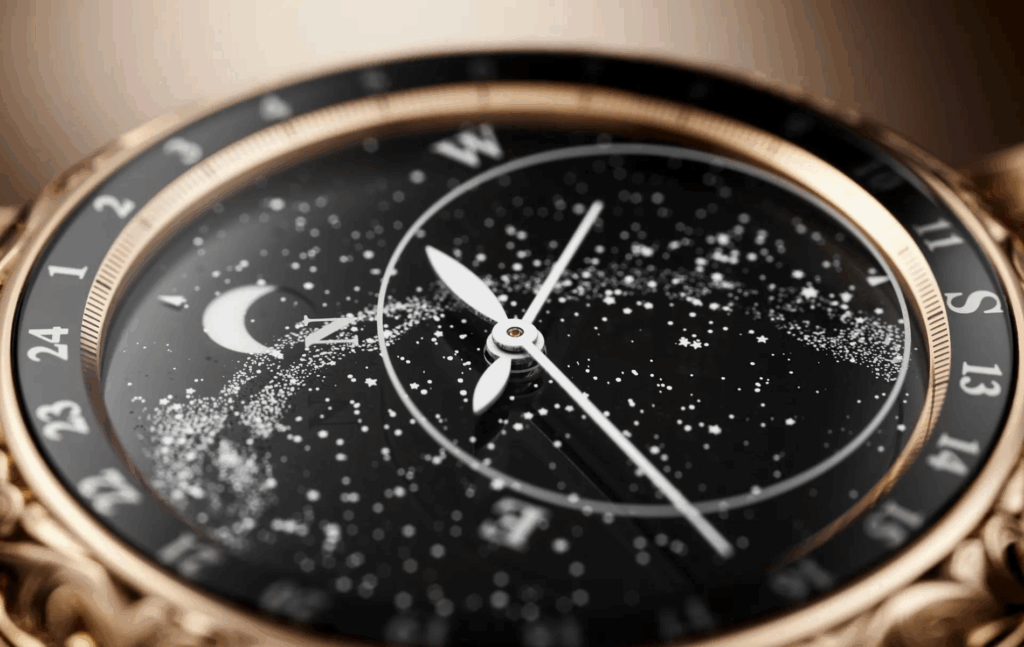
Commissioned by banker Henry Graves Jr., this pocket watch required eight years to complete. It once held the title of the most complicated mechanical watch ever made.
Twenty four complications sit inside. Among them, a celestial chart calibrated to the night sky above Graves’ Fifth Avenue residence. The watch does not display a generic map. It shows his sky.
The mechanism relies on more than 900 individual parts. Every lever interacts in choreography. The minute repeater chimes Westminster tones. The perpetual calendar adjusts automatically, accounting for leap years without correction.
When it crossed the block for over 24 million dollars, collectors understood they were bidding on rivalry history. Graves had commissioned the piece to outdo another titan of his circle. That tension remains embedded in its metal.
3. Patek Philippe Stainless Steel Ref. 1518
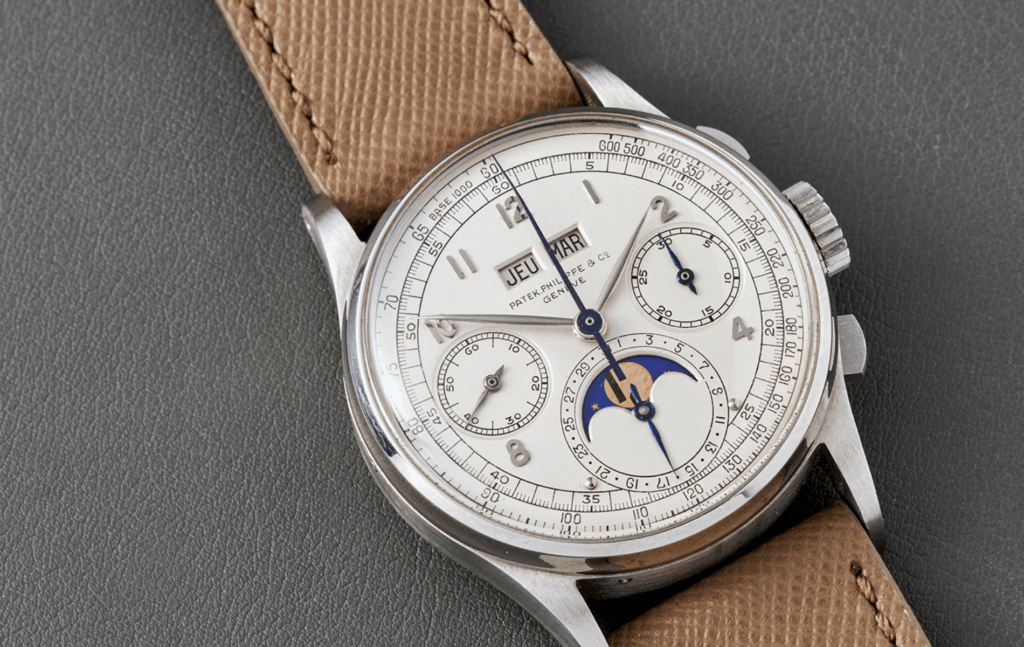
Before modern hype cycles, there was Reference 1518. Introduced in 1941, it was the first perpetual calendar chronograph produced in series.
Most examples were cased in gold. Four were made in stainless steel. That number drives the narrative.
This reference pairs a moonphase aperture with twin chronograph registers and a tachymeter scale. The layout is balanced. Nothing feels crowded. The watch measures 35 millimeters, modest by current tastes, yet it wears with presence because of its thin bezel and stepped lugs.
The steel 1518’s sale above 11 million dollars marked a turning point. Collectors recognized early complicated wristwatches as blue chip assets. The market began tracing serial numbers with forensic intensity.
4. Patek Philippe Ref. 2499

Reference 2499 is frequently described as the successor to 1518, though that feels reductive. It spanned decades of production, evolving subtly across four series.
The most coveted examples feature square pushers and hard enamel signatures. Production numbers remain low across all metals.
Mechanically, the 2499 refined the perpetual calendar chronograph architecture. The movement, based on a Valjoux ébauche heavily reworked in house, integrates calendar disks beneath the dial without sacrificing chronograph precision. Adjustments occur through recessed correctors along the case flank, requiring a stylus and deliberate handling.
High auction results for pristine examples confirmed something seasoned collectors already sensed. Condition and originality have become as important as reference and metal.
5. Patek Philippe Gobbi Milan Heures Universelles Ref. 2523
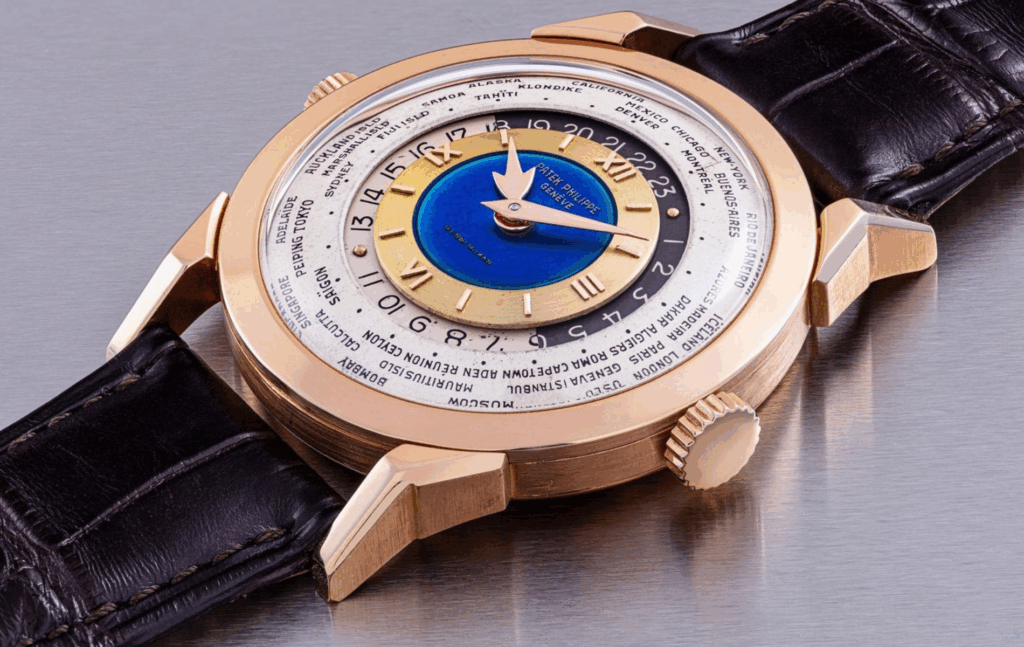
World time watches carry a specific romance. Reference 2523 refined that concept into sculpture.
This double signed example, bearing the signature of Milan retailer Gobbi, achieved well above nine million dollars at auction. Only a handful exist.
The cloisonné enamel dial depicts a map in miniature. Fine gold wires outline continents. Enamel pigments fill the segments and are fired repeatedly at high temperatures. One mistake destroys weeks of labor.
The world time mechanism allows the wearer to adjust local time through a single pusher at 10 o’clock. The hour hand jumps while the 24 hour ring rotates in sync. It is intuitive once understood.
Collectors pursue 2523 for rarity. They keep it for artistry.
Why the Most Expensive Patek Philippe Watches Continue to Climb
The Most Expensive Patek Philippe Watches operate in a distinct ecosystem.
First, production discipline. Patek Philippe limits output across complicated references. Scarcity is structural, not accidental.
Second, lineage. Many of the highest results trace back to singular provenance, a financier, a statesman, a private commission with documented archives. Provenance adds narrative depth without marketing gloss.
Third, mechanical credibility. These watches are not decorative complications stacked for spectacle. The calendar works because a system of cams and levers tracks irregular month lengths. The repeater chimes because gongs are tuned by hand and fixed directly to the case for resonance.
Serious collectors evaluate these mechanisms personally. They examine bridge finishing under magnification. They listen to the repeater tone in a quiet room.
Auction investors view these references as concentrated stores of value. Liquidity at this level is thin, yet demand among ultra high net worth buyers remains resilient.
Meanwhile, secondary references rise in sympathy. When a steel perpetual calendar chronograph breaks records, adjacent models recalibrate upward. The ceiling lifts the floor.
For TTL readers, the deeper question centers on horizon. The most exceptional Patek Philippe pieces rarely reappear quickly. Families hold them for decades. Trusts protect them. Museums court them.
The permanence of these watches does not depend on headlines. It rests on disciplined manufacture, finite supply, and the psychology of ownership at the highest tier.
Long after quarterly indices shift, a minute repeater built a century ago still chimes on command. The steel retains its weight. The calendar advances correctly at midnight.
That continuity, quiet and mechanical, keeps the Most Expensive Patek Philippe Watches at the apex of the collecting world.