
Jane Birkin’s Original Hermès Birkin Bag $10.1 Million
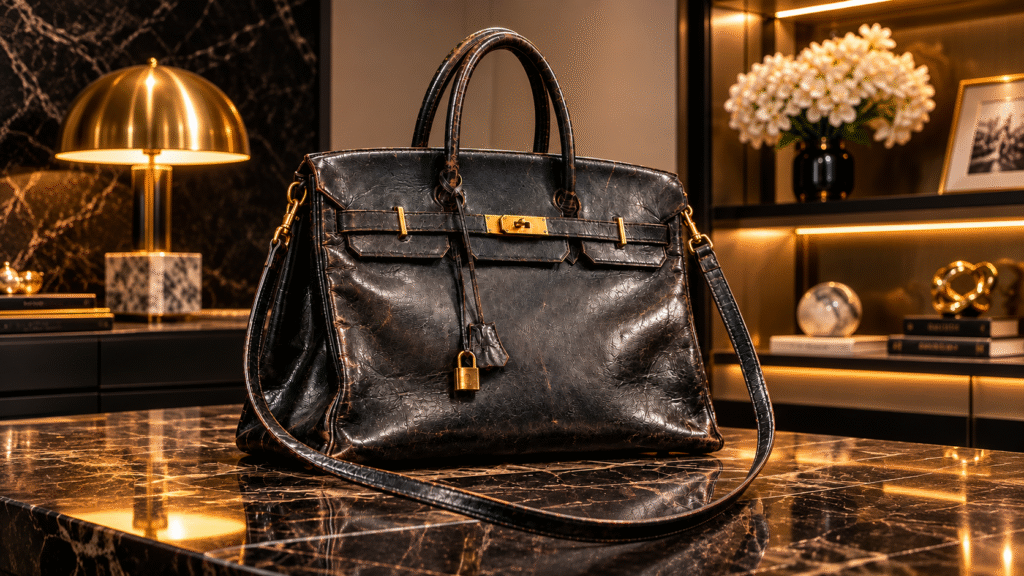
Standing in the private viewing room at Sotheby’s in Paris, the scent of vintage leather and dried perfume anchors the reality of the object. Jane Birkin’s original Hermès Birkin bag sold for $10.1 million, establishing a definitive ceiling for personal accessory valuation. The bag shows severe structural degradation. The tarbine leather displays water staining from a 1984 flight where the actress spilled her belongings. The brass hardware lacks any modern lacquer, exhibiting a deep oxidation pattern that requires decades of human contact to achieve. The mechanism of the valuation relies entirely on provenance forensics. Specialists utilized gas chromatography-mass spectrometry to isolate specific molecular signatures of mid-century Hermès tanning agents. The stitching features the original waxed linen thread, now frayed at the stress points. The buyer acquired a physical artifact of cultural history rather than a functional container. The structural failure of the leather adds immense value. The bag demonstrates the physical reality of use, rejecting the sterile perfection of modern retail goods. The permanence of this sale lies in the fact that a damaged, used object can command a higher price than a pristine, factory-sealed item. The auction shifted the paradigm of luxury valuation. The object is no longer defined by its utility or condition but by the exact biological and historical trace of its original owner.
Codex Leicester $30.8 Million
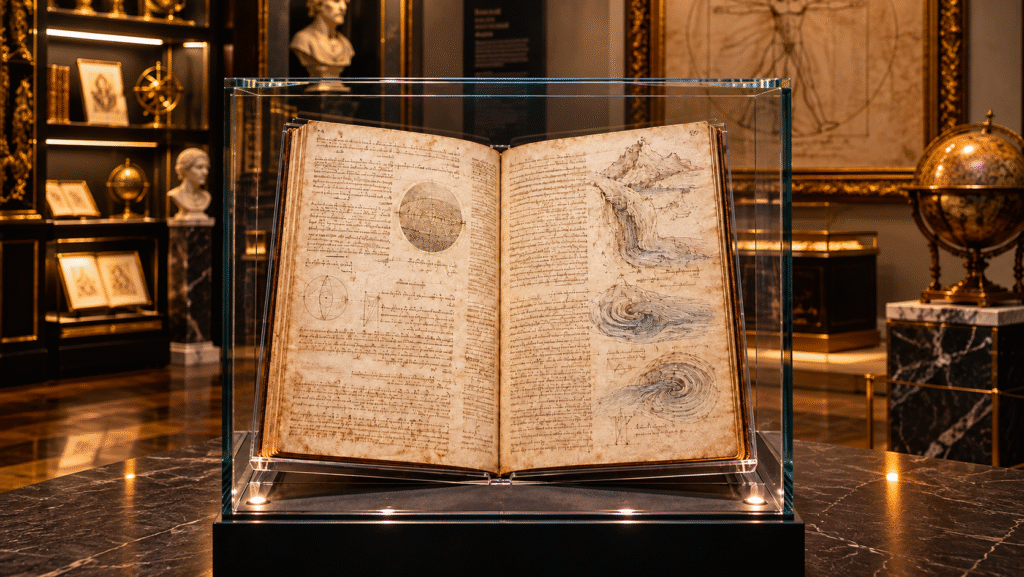
Handling the folios of the Codex Leicester in a subterranean vault requires wearing nitrile gloves. The room temperature drops to 18 degrees Celsius to preserve the 500-year-old linen paper. Bill Gates purchased this Leonardo da Vinci manuscript for $30.8 million, securing a primary record of human cognition. The document contains da Vinci’s scientific observations, written in his distinctive mirror writing. The mechanism of the ink penetration reveals the specific pressure of his left-handed drag across the page. The iron gall ink has chemically bonded with the cellulose fibers. The oxidation process has turned the ink a deep brown. The pages feature watermarks identifying the specific paper mill in Italy. The scientific diagrams detail hydraulics and astronomy. The drawings utilize a specific silverpoint technique where a ground of bone dust and rabbit-skin glue holds the metallic trace. The conservation environment utilizes argon gas to prevent further oxidation. The manuscript functions as a physical record of Renaissance engineering. The sale price reflects the scarcity of original da Vinci scientific output. The permanence of the Codex lies in its material survival. The paper outlasted the political upheavals of five centuries. The survival of the ink demonstrates the structural superiority of ancient metallurgical recipes over modern chemical formulations. The physical document remains a direct conduit to the mechanics of a singular mind.
Patek Philippe Grandmaster Chime $31 Million
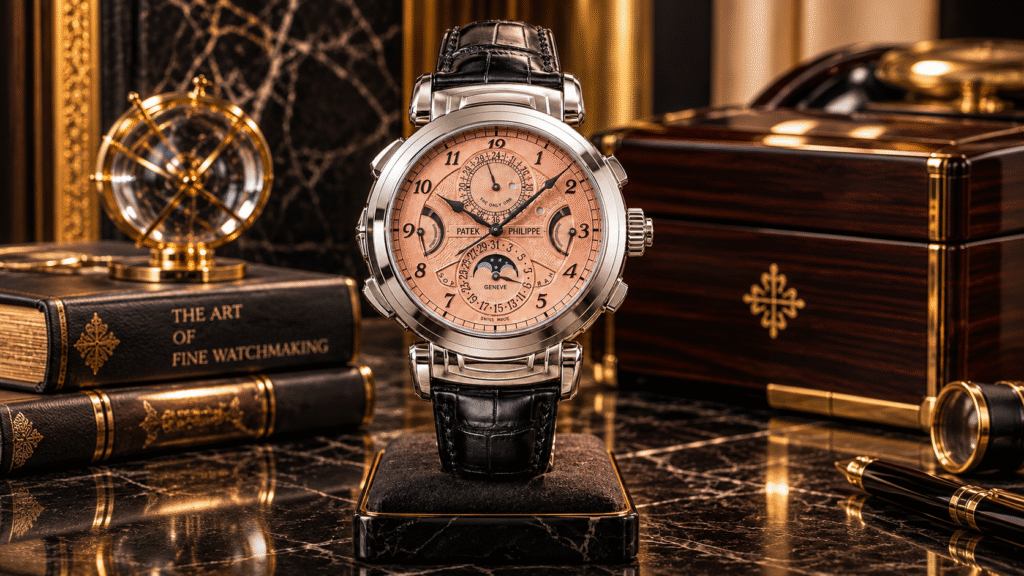
Picking up the Patek Philippe Grandmaster Chime in the Geneva boutique reveals an unexpected mass. The 18-karat gold case weighs heavily in the hand. The watch sold for $31 million, setting a record for a timepiece. The mechanism features 20 distinct complications. The acoustic resonance of the minute repeater requires precise tuning. A technician files the gongs by hand, removing microscopic layers of metal to reach the exact frequency. The filing alters the nodal points of the gong. The sound wave generated is a perfect C-sharp. The watch features a reversible case. The dial rotates on a central axis. The front displays the time. The back displays the calendar functions. The case consists of 214 individual components. The assembly requires six months of manual labor. The tolerance between the moving parts measures 0.05 millimeters. The movement utilizes a bi-axial tourbillon. The tourbillon cage rotates on two axes simultaneously, counteracting the gravitational pull on the oscillator. The watch operates as a mechanical computer. The gears calculate the leap year cycle. The permanence of the Grandmaster Chime lies in the physical isolation of time. The gears will outlast the wearer. The mechanical logic remains absolute. The purchase price secures a functioning micro-mechanical universe, a closed system of perfect geometric harmony that operates independently of digital infrastructure.
Dorothy’s Ruby Slippers $32.5 Million
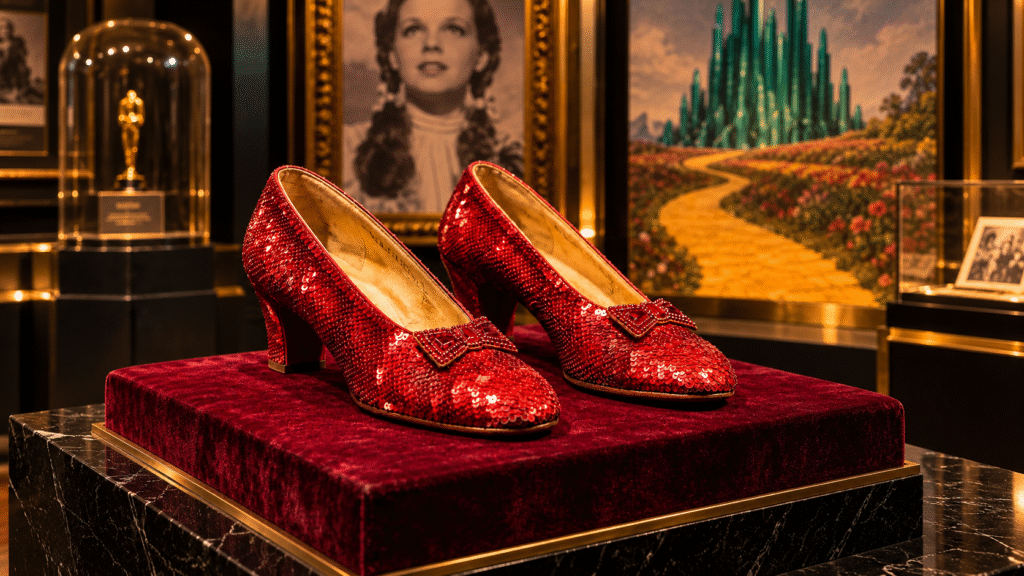
Examining the ruby slippers from the Wizard of Oz in the conservation lab requires specialized lighting. The sequins show advanced material degradation. The pair sold for $32.5 million. The original shoes feature a standard pump design manufactured by the Innes Shoe Company. The red color originates from an aniline dye applied to the silver sequins. The dye exhibits extreme light sensitivity. The mechanism of the degradation involves the breaking of chemical bonds within the dye molecules when exposed to ultraviolet radiation. The sequins lose their saturation. The gelatin on the soles, added to enhance the reflectivity for Technicolor film, is shrinking. The conservation process involves storing the shoes in a completely inert nitrogen environment. The glass beads sewn onto the bows display microscopic fractures. The thread used to attach the sequins is a decayed cotton. The structural integrity of the shoe relies on the internal lining. The sale price reflects the cultural impact of the 1939 film. The slippers function as a physical anchor to the golden age of Hollywood. The permanence of the object is threatened by its own material composition. The synthetic materials degrade faster than natural ones. The preservation requires continuous technological intervention to prevent the total collapse of the sequin structure.
First Printing of the U.S. Constitution $43.2 Million
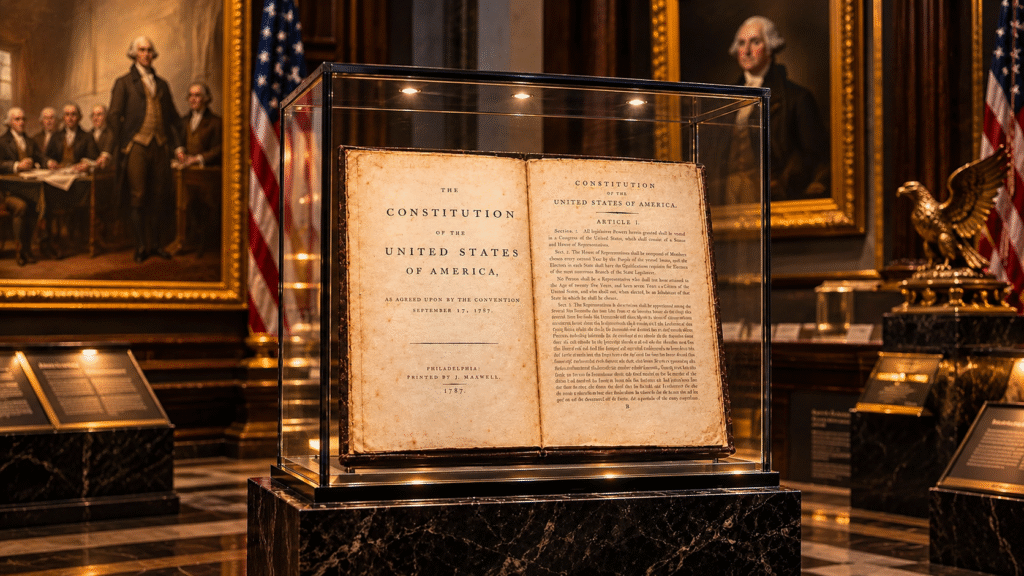
Viewing the first printing of the U.S. Constitution at Sotheby’s reveals the specific texture of 18th-century paper. The document sold for $43.2 million. The paper consists of linen rags. The fibers exhibit a random orientation. The printing utilizes a Caslon font. The specific kerning of the letters shows variations caused by the manual typesetting process. The ink features a high carbon content. The mechanism of the printing involved a hand-pulled press. The operator applied ink to the type using leather balls. The pressure forced the paper into the inked type. The paper shows a distinct watermark. The watermark identifies the paper mill in Pennsylvania. The text includes the original draft. The absence of the Bill of Rights indicates the early printing date. The physical document measures 28 by 23 inches. The margins show minor foxing. The foxing originates from iron impurities in the paper. The sale price reflects the foundational legal text of a global superpower. The permanence of the Constitution lies in its physical survival. The paper outlasted the ink. The text remains legible. The document functions as the physical manifestation of a political philosophy. The acquisition secures the original mechanical reproduction of a legal framework that continues to dictate global geopolitics.
Apex Stegosaurus Fossil $44.6 Million
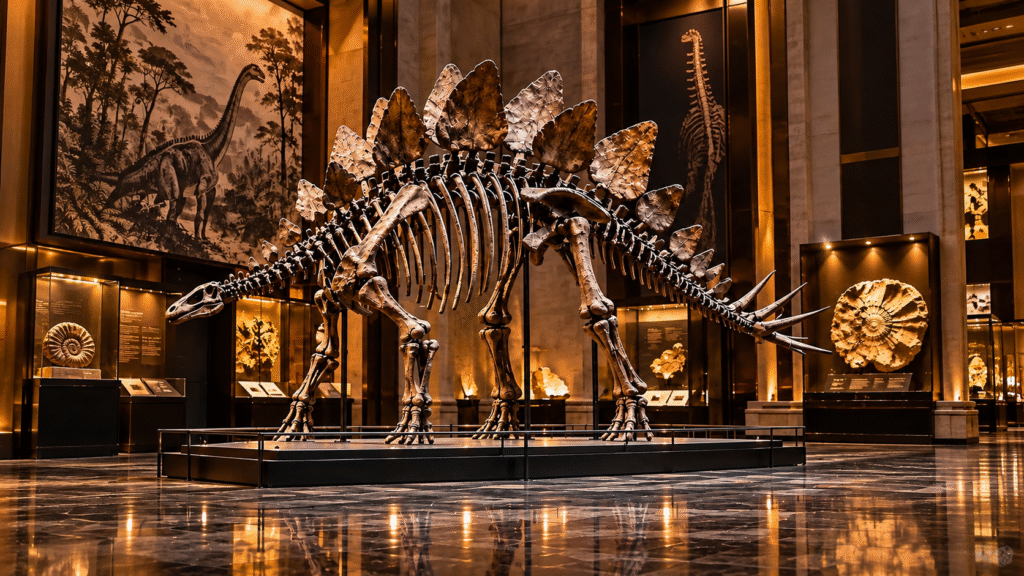
Walking into the private warehouse in Wyoming, the sheer scale of the Apex Stegosaurus skeleton dominates the space. The fossil sold for $44.6 million. The skeleton measures 11 feet tall and 27 feet long. The bones show a dark brown coloration. The coloration originates from the mineralization process. The mechanism of fossilization involves the replacement of bone calcium with silica and iron. The bone structure remains visible. The osteoderms, the plates along the back, feature vascularization pathways. The pathways appear as small holes in the fossilized bone. The skull shows a small brain cavity. The teeth display a unique wear pattern. The wear indicates a diet of tough vegetation. The preservation required extreme geological stability. The absence of tectonic disruption allowed the skeleton to remain articulated. The extraction process utilized diamond-tipped saws. The saws cut through the surrounding sandstone. The fossil was jacketed in plaster. The structural armature built to display the skeleton uses titanium. The metal supports the immense weight of the fossilized bone. The sale price reflects the extreme scarcity of complete dinosaur skeletons. The permanence of the fossil spans 150 million years. The rock outlasted the biological entity. The skeleton represents a physical record of deep time, a structural framework that survived the complete transformation of the Earth’s surface.
Graff Pink Diamond $46.2 Million
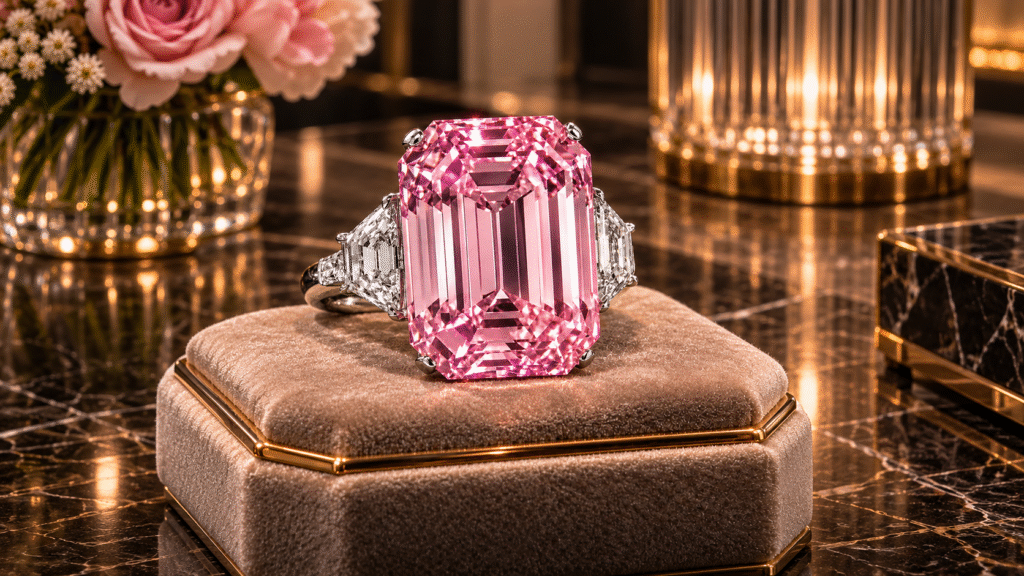
Viewing the Graff Pink diamond in the Geneva vault requires a specific optical setup. The stone sold for $46.2 million. The diamond weighs 23.88 carats. The cut is an emerald shape. The color is a fancy intense pink. The pink color originates from plastic deformation. The mechanism involves the shifting of the crystal lattice under extreme tectonic pressure. The carbon atoms move out of their standard alignment. The light absorption changes. The stone reflects the pink wavelength. The diamond is a type IIa. This classification indicates a complete absence of nitrogen impurities. The clarity is internally flawless. The polishing process utilized a specialized scaif. The technician removed microscopic inclusions. The facet alignment shows absolute symmetry. The specific refractive index of the stone creates a distinct optical brilliance. The diamond sits in a platinum setting. The setting features white diamonds as side stones. The sale price reflects the extreme rarity of large pink diamonds. The permanence of the stone lies in its physical structure. The carbon lattice will outlast the current geological epoch. The diamond represents a fragment of deep-earth geology brought to the surface through volcanic pipes. The acquisition secures a piece of planetary history.
Oppenheimer Blue Diamond $57.5 Million
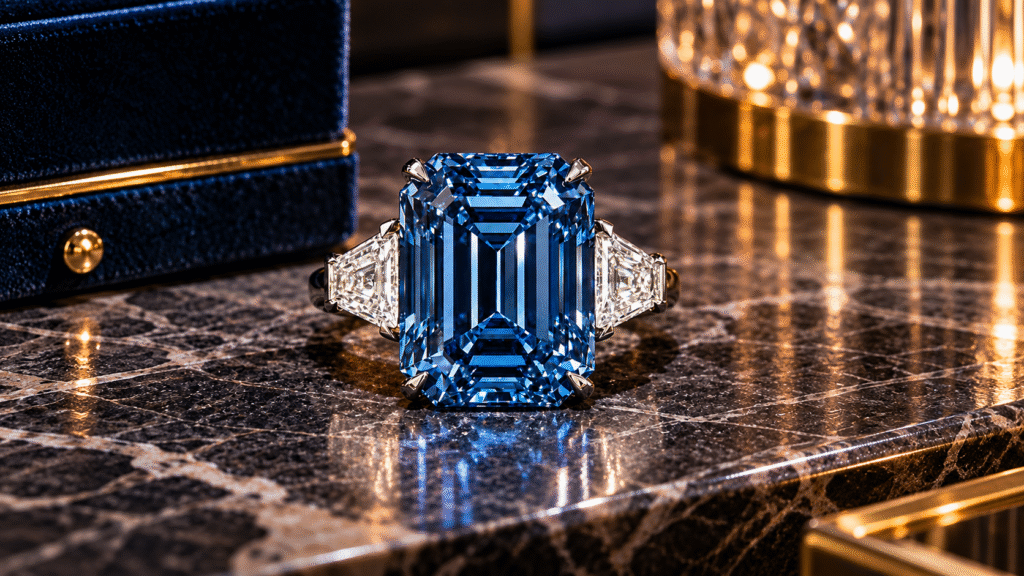
Holding the Oppenheimer Blue diamond under long-wave ultraviolet light reveals a specific phosphorescence. The diamond sold for $57.5 million. The stone weighs 14.62 carats. The cut is an emerald shape. The color is a fancy vivid blue. The blue color originates from boron atoms trapped within the carbon lattice. The mechanism involves the boron atoms absorbing the red end of the light spectrum. The transmitted light is blue. The diamond shows a strong blue fluorescence under UV light. The phosphorescence continues for several seconds after the UV source is removed. The diamond features a type IIb classification. The stone is internally flawless. The facet geometry creates a specific light return. The critical angle calculations dictate the exact depth of the pavilion. The stone is set in a platinum ring. The ring features two trapeze-cut diamonds. The sale price reflects the absolute scarcity of vivid blue diamonds over 10 carats. The permanence of the Oppenheimer Blue lies in its chemical stability. The boron atoms will remain locked within the carbon lattice. The diamond represents the extreme conditions required to forge colored gemstones. The geological history of the stone remains locked within its crystal structure, a physical record of tectonic compression.
CTF Pink Star Diamond $71.2 Million
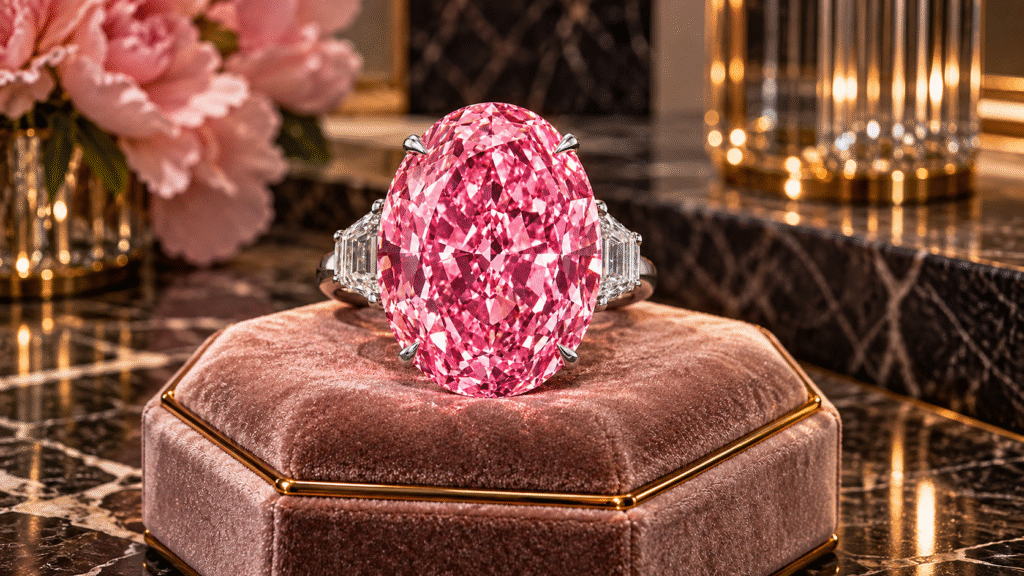
Standing on the auction floor in Hong Kong, the tension preceding the sale of the CTF Pink Star diamond was palpable. The diamond sold for $71.2 million. The stone weighs 59.60 carats. The cut is an oval mixed shape. The color is fancy vivid pink. The clarity is internally flawless. The stone originated from a 132.5-carat rough. The cutting process took two years. The mechanism of the cutting involved a specialized scaif utilizing diamond dust. The technician balanced the weight retention against the light performance. The stone features a type IIa classification. The pink color originates from a plastic deformation of the crystal lattice. The deformation occurred during the tectonic uplift. The light passes through the stone without scattering. The facet alignment shows absolute precision. The diamond shows no fluorescence under UV light. The radio-luminescence testing confirmed the natural origin of the color. The stone sits in a white gold setting. The sale price established a new world record for any diamond. The permanence of the Pink Star lies in its geological history. The crystal structure formed deep within the earth’s mantle. The extreme pressure and temperature forged a perfect carbon lattice. The acquisition secures a physical anomaly of nature.
Jeff Koons’ Rabbit $91.1 Million

Standing in the Christie’s exhibition space, the seamless surface of Jeff Koons’ Rabbit reflects the room. The sculpture sold for $91.1 million. The work is cast in stainless steel. The surface shows zero texture. The mechanism of the fabrication involves a proprietary electro-polishing process. The process removes the amorphous layer of the metal. The technician submerges the sculpture in an electrolytic bath. An electrical current passes through the solution. The metal ions dissolve from the peaks of the surface. The surface becomes completely smooth. The reflection of the viewer appears distorted. The curvature of the ears creates a funhouse mirror effect. The internal structure of the sculpture is hollow. The legs require internal supports to prevent buckling under the weight of the head. The fabrication occurred in a German foundry. The lost-wax casting process created the initial form. The sale price set a record for a living artist. The permanence of the Rabbit lies in its material indifference. The stainless steel resists oxidation. The surface will remain pristine without conservation. The sculpture exists as a permanent reflection of its environment. The acquisition secures an object of absolute physical perfection, a surface that rejects the entropy affecting traditional art materials.
L’Homme au doigt $141.3 Million

Viewing L’Homme au doigt in a private gallery reveals the specific texture of Alberto Giacometti’s bronze. The sculpture sold for $141.3 million. The work depicts a pointing man. The bronze surface shows a rough, hand-modeled texture. The mechanism of the creation involves a lost-wax casting process. Giacometti created the original in plaster. The plaster was coated in a ceramic shell. The shell was heated. The plaster melted. Molten bronze poured into the cavity. The bronze cooled. The ceramic shell was chipped away. The surface retains the thumbprints of the artist. The patina is a dark brown. The patina originates from the chemical application of liver of sulfur and heat. The oxidation layer is sealed with wax. The figure is elongated. The limbs are thin. The structural fragility is an illusion. The bronze core provides immense tensile strength. The base shows the foundry markings. The sale price reflects the significance of Giacometti’s post-war existentialism. The permanence of the bronze lies in its metallurgical stability. The copper and tin alloy will resist corrosion. The sculpture will outlast the physical gestures of the artist. The work captures the physical tension of human isolation, a structural framework rendered in permanent metal.
Three Studies of Lucian Freud $142.4 Million

Examining Three Studies of Lucian Freud by Francis Bacon reveals the specific topography of the oil paint. The triptych sold for $142.4 million. The three canvases show Lucian Freud seated on a wooden chair. The paint is applied thickly. The mechanism of the application involves stiff hog-hair brushes. Bacon dragged the paint across the raw linen canvas. The impasto creates a physical dimension. The paint stands off the canvas. The colors feature a specific palette of fleshy pinks and violent yellows. The raw linen shows through the gaps in the paint. The linen is unprimed. The oil paint bleeds into the fibers. The craquelure on the surface indicates the drying process. The paint dried rapidly. The tension of the stretchers keeps the canvas flat. The frames are gilded. The gold leaf shows a deliberate distressing. The sale price reflects the peak of Bacon’s psychological portraiture. The permanence of the work lies in the chemical stability of the oil. The linseed oil binder will yellow over centuries. The painting captures a specific moment of human interaction. The distortion of the face reflects the internal anxiety of the subject. The acquisition secures a physical record of post-war British artistic intensity.
Mercedes-Benz 300 SLR Uhlenhaut Coupé $143 Million

Sitting in the Mercedes-Benz museum in Stuttgart, the specific smell of the Mercedes-Benz 300 SLR Uhlenhaut Coupé interior leather is overpowering. The car sold for $143 million. The chassis consists of a spaceframe. The mechanism of the spaceframe involves a network of tubular steel welded into triangles. The structure provides immense torsional rigidity. The body panels are hand-beaten aluminum. The aluminum is extremely thin. The doors feature a gullwing design. The hinges are machined from solid steel. The engine is a 3.0-liter straight-eight. The fuel injection system utilizes a mechanical plunger pump. The pump delivers precise amounts of fuel to the intake ports. The engine revs to 8,000 RPM. The acoustic signature is a high-pitched mechanical scream. The brakes are massive drum brakes. The cooling fins dissipate the heat. The interior features a bespoke luggage set. The sale price reflects the extreme scarcity of the prototype. The permanence of the Coupé lies in its mechanical engineering. The tolerances of the engine components remain tight. The car represents the pinnacle of 1950s automotive design. The engineering outlasted the era of its creation. The acquisition secures a functioning piece of industrial history, a machine built for absolute velocity.
Salvator Mundi $450.3 Million
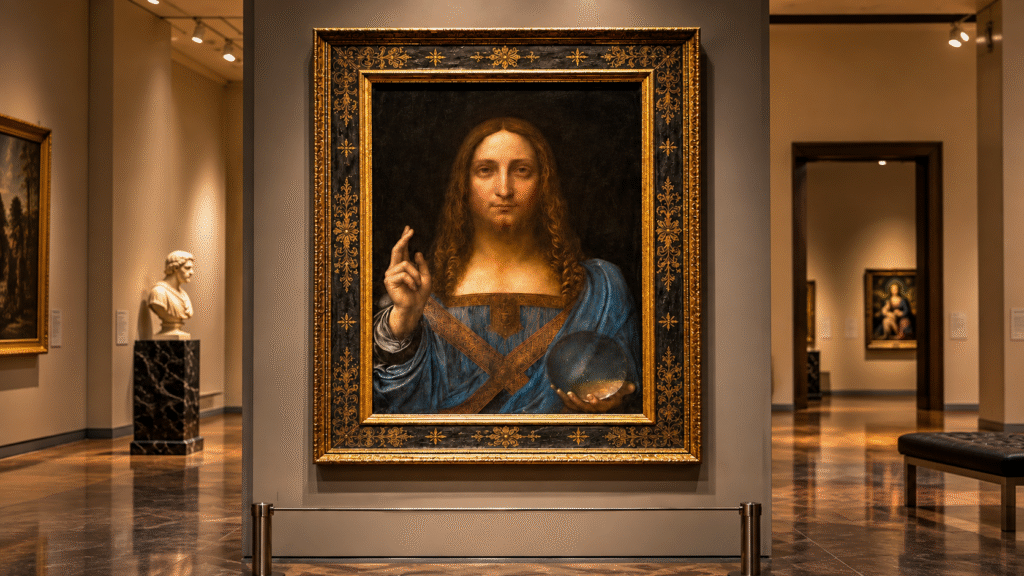
Viewing the Salvator Mundi in a secure freeport requires wearing a surgical mask. The painting sold for $450.3 million. The work is attributed to Leonardo da Vinci. The panel is made of walnut. The mechanism of the paint involves walnut oil as a binder. Leonardo applied the paint in extremely thin layers. The sfumato technique creates a smoky transition between the colors. The face shows no visible brushstrokes. The optical blending occurs in the eye of the viewer. The crystal orb in Christ’s hand shows a specific distortion. The orb lacks optical refraction. Leonardo painted the background with a specific lead-white underpainting. The underpainting creates a luminous depth. The craquelure on the surface is extensive. The painting underwent a severe restoration. The restorer utilized acetone and solvent gels to remove the overpaint. The original paint is heavily abraded. The wood panel shows signs of warping. The sale price reflects the extreme scarcity of an autograph Leonardo. The permanence of the painting is threatened by its material fragility. The walnut panel requires strict climate control. The paint will continue to degrade. The work survives as a ghost of its original state. The acquisition secures a disputed masterpiece, an object whose physical reality is secondary to its attributed historical weight.
FAQ
What are the Most Expensive Items Ever Sold?
The list of the Most Expensive Items Ever Sold includes the Salvator Mundi painting attributed to Leonardo da Vinci at $450.3 million, the Mercedes-Benz 300 SLR Uhlenhaut Coupé at $143 million, and the CTF Pink Star diamond at $71.2 million. Other notable items range from rare fossils and historical documents to iconic pop culture artifacts and luxury watches.
Why did the Salvator Mundi sell for $450 million?
The Salvator Mundi sold for $450.3 million due to its attribution to Leonardo da Vinci. The extreme scarcity of da Vinci’s surviving works drove the valuation. The painting’s provenance, extensive restoration history, and the cultural significance of acquiring a piece attributed to a Renaissance master created a unique market dynamic resulting in the record price.
How is the value of a luxury item determined?
The value of a luxury item is determined by provenance, material scarcity, and historical significance. Forensic authentication processes, such as gas chromatography for leather or trace element mapping for diamonds, establish authenticity. The physical condition and the cultural impact of the item dictate the final market price.
What is the most expensive car ever sold?
The Mercedes-Benz 300 SLR Uhlenhaut Coupé is the most expensive car ever sold, fetching $143 million at auction. The record price reflects the extreme scarcity of the prototype, its advanced spaceframe engineering, and its historical significance as a pinnacle of 1950s automotive design.
How are fragile historical artifacts preserved?
Fragile historical artifacts are preserved using specialized climate control systems. Documents and paintings are stored in argon or nitrogen environments to prevent oxidation. Fossils utilize titanium armatures for structural support. Light-sensitive items like the ruby slippers require completely inert atmospheres and UV-filtered lighting to halt chemical degradation.