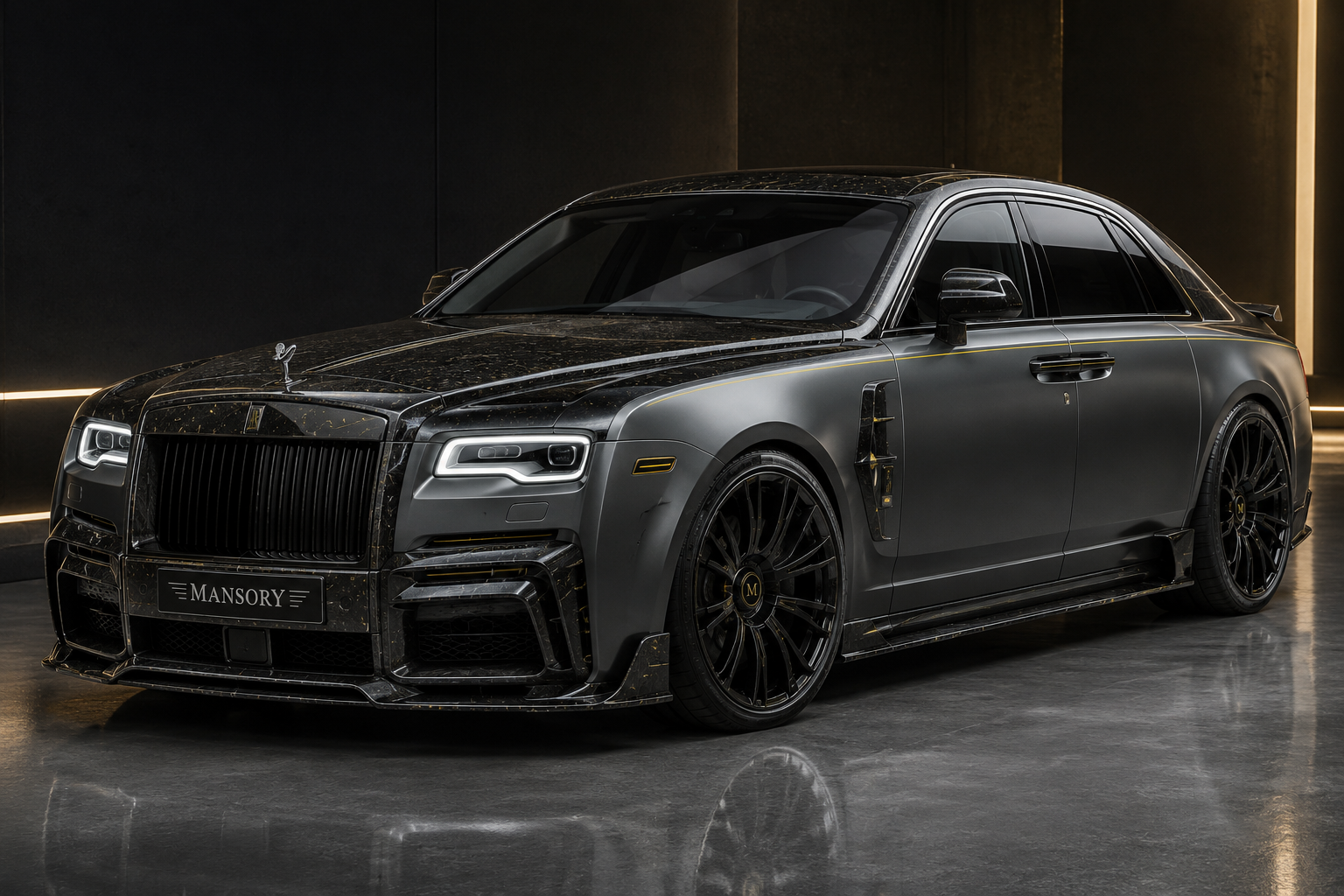
Look closely at a Mansory-modified Rolls-Royce Ghost under showroom lights and the first thing you notice is not the badge. It is the exposed carbon weave on the bonnet, the deeper front lip and the glowing grille. This is a Ghost that has clearly left Goodwood’s script. But before getting into the details, it is worth clearing up a common mix-up around the name Mansory Stallone GTS and the “750 HP Ghost” headlines that often accompany it.
What Is the Mansory Stallone GTS?
Strictly speaking, the Stallone GTS is not a Rolls-Royce at all. Mansory uses the “Stallone” name for its Ferrari 812 programmes, and the Stallone GTS, revealed in 2021, is based on the Ferrari 812 GTS convertible. It raises the V12’s output to around 830 hp and 740 Nm, with a claimed top speed of roughly 345 km/h, alongside carbon bodywork and forged 21- and 22-inch wheels.
Mansory’s Rolls-Royce Ghost conversion is a separate project, built on the second-generation Ghost. Because both cars combine a V12, carbon bodywork and huge power figures, the two are frequently confused online, and figures of around 750 hp are often attached to the Ghost. Mansory’s own published figure for its Ghost package is 720 hp.
Mansory Rolls-Royce Ghost: Specs at a Glance
Based on Mansory’s announced package for the current Ghost:
- Engine: 6.75-litre twin-turbocharged V12
- Power: 720 hp (up from 571 PS in the standard car)
- Torque: 1,020 Nm (up from 850 Nm)
- 0-100 km/h: 4.4 seconds
- Top speed: standard limit, raised on request
- Wheels: 22-inch “V.6” wheels, 9.5J front and 10J rear
- Tyres: 265/35 R22 front, 295/30 R22 rear
- Exhaust: sport system with high-performance catalytic converters
How the Ghost’s V12 Gains So Much Power
The extra output comes from three coordinated changes: a modified engine control unit, new turbochargers and a freer-flowing sport exhaust. The ECU recalibration adjusts boost pressure, fuelling and ignition timing, while the larger turbos move more air. The exhaust reduces back pressure so the engine can breathe more easily.
Doing this on a Rolls-Royce is as much a calibration challenge as a power challenge. The Ghost’s character depends on silky, effortless delivery. Adding hundreds of newton metres without making the car feel abrupt or noisy requires careful tuning of throttle response and gearbox behaviour.
Carbon Bodywork That Changes the Car’s Presence
Mansory is known for carbon fibre, and the Ghost kit uses plenty of it. Changes include a lightweight bonnet with visible carbon structure, a front lip with carbon side flaps, dark carbon sills, carbon air outlets in the front wings and a carbon engine cover.
At the rear, a boot-lid spoiler and roof spoiler are designed to reduce lift on the rear axle, while a new diffuser frames the sport exhaust.
The Reworked Front End
The front is where the conversion most obviously departs from Rolls-Royce’s own design. Mansory adds an illuminated grille, with a selectable colour, LED daytime running lights and a deeper lower section. Combined with black door handles and the carbon details, the car looks lower and more aggressive than the factory Ghost.
Side Profile and Rear
From the side, the 22-inch wheels and carbon sills give the car a more planted stance. The Ghost’s long wheelbase and clean surfaces still dominate, which helps the conversion avoid looking overloaded. At the back, the spoilers and diffuser add visual width and signal the extra performance.
The Exhaust and the Sound of a V12
A standard Ghost is engineered for near silence. Mansory’s sport exhaust lets more of the V12’s character through, adding a deeper note under acceleration while remaining civilised at cruising speeds. For some buyers that is the whole point; for purists, it is the most controversial change.
Wheels, Tyres and Ride
Large wheels look dramatic but affect much more than appearance. Bigger rims and lower-profile tyres can sharpen steering response, but they also increase unsprung mass and can transmit more road imperfections into the cabin. The Ghost’s sophisticated air suspension helps to compensate, but owners should expect a slightly firmer feel than the factory car.
Inside the Cabin
Mansory’s showcase Ghost features fine white leather with contrasting “Mandarin” accents, a sports steering wheel in leather and carbon, carbon inlays and LED lighting integrated into the seats, door panels and dashboard. A leather cool bag is available as an option.
Modifying a Rolls-Royce interior is particularly difficult because the factory cabin is already finished to an exceptionally high standard. Any changes need to match that quality to feel worthwhile.
Real-World Performance
With 720 hp and more than 1,000 Nm, a Mansory Ghost can reach 100 km/h in 4.4 seconds, remarkable for a luxury saloon weighing around 2.5 tonnes. In the real world, the bigger benefit is effortless overtaking and motorway acceleration. Braking and tyre performance become even more important with this much power and mass.
Who Is It For?
Buyers of Mansory cars usually already own standard Rolls-Royces or other luxury vehicles and want something more visibly individual. Mansory has clients worldwide, with particularly strong demand in markets such as the Middle East and Asia, where bold customisation is popular.
Cost and Resale
Mansory does not publish fixed prices for its Ghost package. The total cost combines the price of the donor car, itself well above $300,000, with the conversion, wheels, carbon parts and interior work, which can add a substantial sum depending on specification.
Resale is harder to predict. Collectors often value factory originality, but well-known conversions can find buyers who specifically want the Mansory look.
Factory Ghost vs Mansory Ghost
The factory Ghost prioritises calm, refinement and understated design. Mansory’s version adds power, sound and visual drama. Neither is objectively better; they appeal to very different tastes.
Beyond the Headline Numbers
Whether you call it a Stallone, a 750 HP Ghost or simply a Mansory Rolls-Royce, the real story is how far a luxury car can be pushed while keeping its core character. Mansory’s Ghost shows both the possibilities and the trade-offs of transforming one of the world’s most refined cars.
FAQ
Is the Mansory Stallone GTS a Rolls-Royce?
No. The Stallone GTS is Mansory’s conversion of the Ferrari 812 GTS. Mansory’s Rolls-Royce Ghost conversion is a separate model.
How much horsepower does the Mansory Rolls-Royce Ghost have?
Mansory’s published figure for its Ghost package is 720 hp and 1,020 Nm, compared with 571 PS and 850 Nm for the standard car.
How fast is it?
Mansory quotes 0-100 km/h in 4.4 seconds.
Does it use real carbon fibre?
Yes. The bonnet, front lip, sills, wing vents and engine cover feature carbon fibre.
How much does a Mansory Ghost cost?
Mansory does not publish a fixed price. The total depends on the donor car and the chosen conversion and interior specification.