
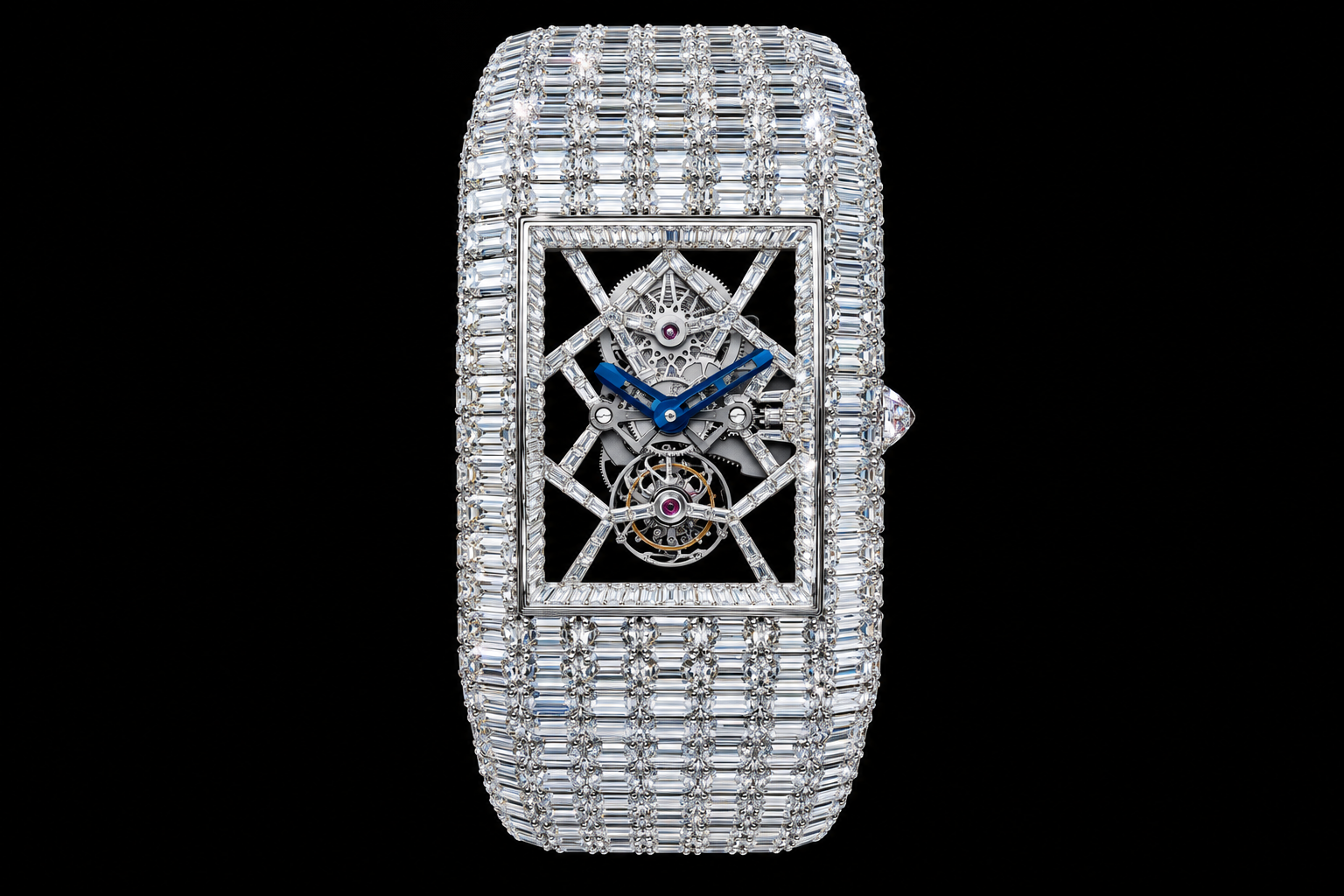
The Geneva Vault and the Tactile Weight of Kinetic Capital
Standing inside the private acoustic testing vault at the Geneva manufacture, the heavy steel door seals shut with a distinct pneumatic hiss. The room isolates all external noise, leaving only the sound of the watchmaker’s breath and the microscopic clicking of the movement. The Jacob & Co. Extraordinary Watches sit on a specialized acoustic damping stand, representing the absolute pinnacle of mechanical engineering and haute horology. The immediate visual weight of the timepieces contradicts the physical density. Picking up a 50-millimeter titanium and rose gold case reveals a specific mass distribution. The center of gravity sits exactly over the movement, balancing perfectly on the index finger. The acquisition of these hyper-specific instruments bypasses the traditional retail ecosystem entirely. The buyers acquire these objects through private allocation, demanding direct relationships with Geneva brokers. The era of discreet stealth wealth concludes here. These pieces favor extreme visual signposting, utilizing the tourbillon as a structural component rather than a mere marketing tool. The mechanical friction of the gear teeth creates a direct physical link between the wearer and the machine. The physical reality of the sapphire crystal and the 18-karat gold anchors the capital to the earth. The valuation stems from the impossibility of automated mass production. A single watchmaker requires six months to assemble the movement. The engineering development requires thousands of hours of design and prototyping. The capital expenditure required to engineer a one-off flying tourbillon exceeds the standard margin of the watch. The economics reject the concept of economy of scale. The price does not decrease as production increases. The production remains strictly limited. The scarcity ensures the watches retain their exclusivity. The visual impact of the timepieces relies on the specific texture of the baguette diamonds and the unique profile of the open-worked movement.
Casino Tourbillon Baguette
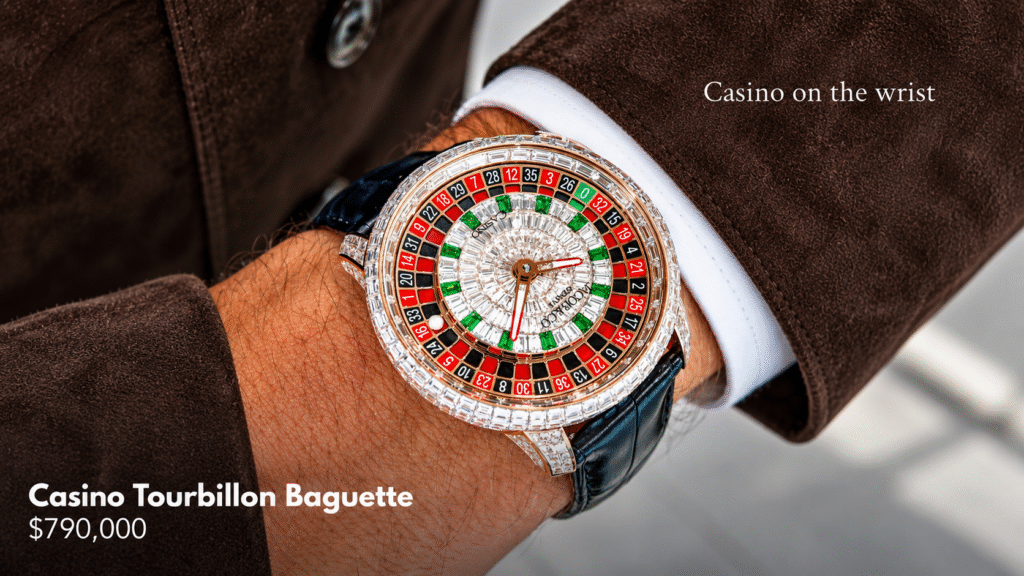
Examining the Casino Tourbillon Baguette under a specialized 10x loupe reveals the intense concentration of capital in a 44-millimeter space. The watch features an 18-karat white gold case completely set with baguette-cut diamonds. The gem setters utilized a specialized invisible setting technique. They cut microscopic grooves into the pavilion of each diamond. The diamonds slide onto a hidden gold rail, locking into place without any visible metal prongs. The mechanism of the watch centers around a functional roulette wheel recessed into the dial. The roulette wheel operates via a pusher at 8 oclock. The pusher engages a rack that drives a high-speed gear train. The gear train spins a white ceramic ball around a 12-millimeter sapphire crystal track. The ball loses momentum through natural friction. The ball drops into a numbered pocket milled directly into the gold rotor. The mechanism requires the watchmaker to perfectly balance the rotor to ensure the ball settles fairly. The tourbillon sits at 12 oclock. The tourbillon cage rotates every 60 seconds, counteracting the gravitational pull on the hairspring. The movement features a free-sprung balance wheel with gold micro-metric screws. The screws allow the watchmaker to adjust the inertia of the wheel without altering the active length of the hairspring. The diamonds on the bezel feature a specific D-color grading. The clarity of the stones allows maximum light transmission into the movement, illuminating the gear trains. The acoustic signature of the roulette ball clicking against the sapphire track creates a distinct metallic sound. The engineering of the complication defies the traditional purpose of a watch, introducing an element of chance into a machine dedicated to absolute precision. The $790,000 valuation reflects the extreme labor required to machine the microscopic roulette track and the rarity of the flawless diamonds.
Opera Godfather Baguette Red Sapphires
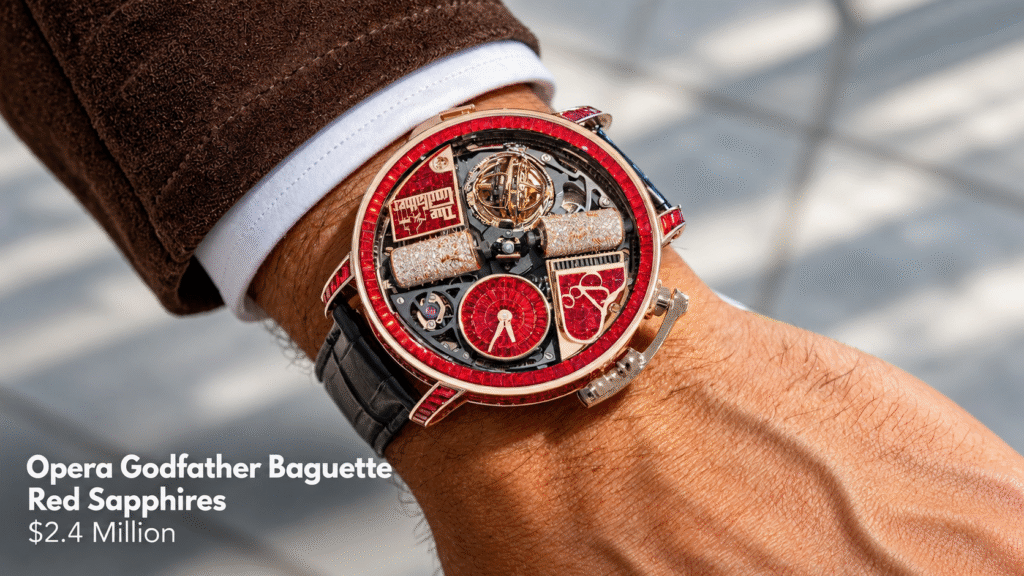
Activating the pusher on the Opera Godfather Baguette Red Sapphires triggers a distinct acoustic sequence that dominates the private viewing room. The watch features a 50-millimeter 18-karat rose gold case completely set with baguette-cut diamonds and red sapphires. The sapphires feature a specific color gradation, transitioning from deep blood red to a bright orange hue. The mechanism of the watch involves a double-axis flying tourbillon and a mechanical music box. The music box features two separate cylinders. Each cylinder features 120 pins. The pins pluck the teeth of two metallic combs as the cylinder rotates. The combs feature 72 teeth. The watchmaker tunes each tooth by filing microscopic layers of metal from the tip, adjusting the pitch to play the theme from The Godfather. The dual cylinders operate in sync, creating a complex acoustic harmony. The acoustic resonance depends entirely on the density of the rose gold case. The gold amplifies the sound waves, projecting them outward through the sapphire crystal. The double-axis flying tourbillon rotates on two separate axes simultaneously. The innermost cage rotates every 24 seconds. The intermediate cage rotates every 8 seconds. This multi-axis rotation completely eliminates positional variance in timekeeping. The watch features a massive 216-hour power reserve. The mechanism achieves this through two series-coupled mainspring barrels dedicated to the music box and two dedicated to the timekeeping. The $2.4 million valuation reflects the sheer density of the complications. The integration of a music box and a double-axis tourbillon forces the movement to contain over 850 individual components. The assembly requires the watchmaker to align the pins on the music cylinder with the teeth of the combs with zero tolerance for error. A single misaligned pin would disrupt the melody.
Epic SF24 Tourbillon Baguette
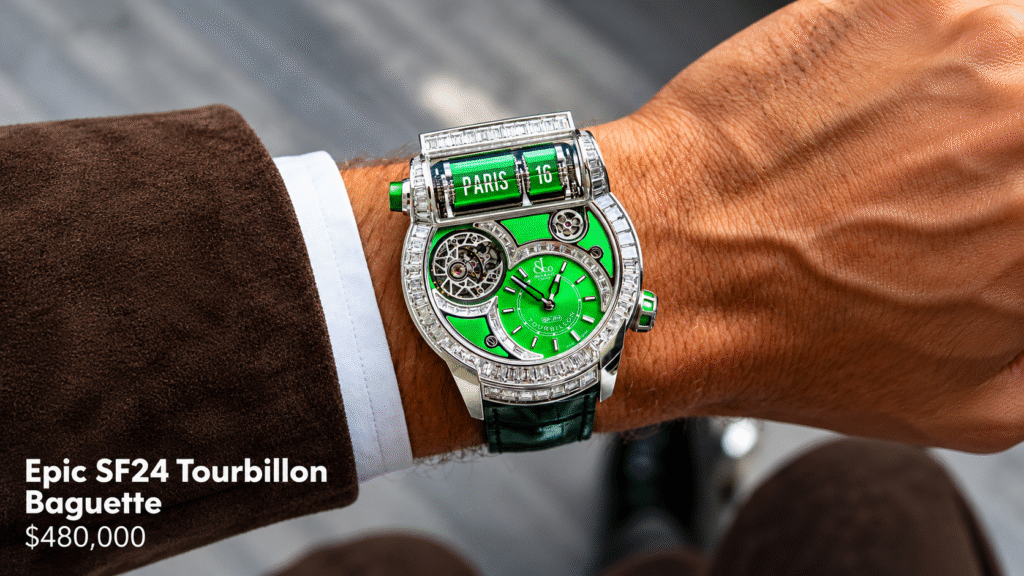
Looking through the massive sapphire dome of the Epic SF24 Tourbillon Baguette reveals a specific architectural homage to Formula 1 racing. The watch features a 44-millimeter 18-karat white gold case set with baguette-cut diamonds. The mechanism involves a 60-second flying tourbillon visible through a sapphire crystal dashboard. The visual anchor of the timepiece is the mechanical chronograph display. The watch utilizes a specialized retrograde complication. The pushers on the side of the case engage a complex system of racks and pinions. The mechanism jumps the minute hand from 60 back to zero, mimicking the timing of a pit stop. The watch features a specialized G-force sensor. The sensor measures the lateral acceleration of the wearer’s wrist. The mechanism utilizes a specialized cantilever beam with a microscopic mass. The mass moves against a calibrated scale, displaying the G-force on a sub-dial. The watch features a 48-hour power reserve. The movement consists of 563 individual components. The engineering of the chronograph requires absolute precision in the jumping mechanism. The jumping minute hand relies on a specialized snail cam and a spring-loaded rack. The cam rotates continuously. The rack drops off the edge of the cam at the 60-second mark, snapping the hand back to zero. The $480,000 valuation reflects the extreme complexity of the jumping mechanism and the integration of the G-force sensor. The diamond setting on the bezel utilizes a specialized channel-setting technique. The setter mills a precise groove into the gold. The diamonds slide into the groove. The setter utilizes a specialized burnisher to push the gold over the edges of the stones. The integration of the automotive theme into the mechanical architecture represents a specific engineering philosophy. The philosophy prioritizes the kinetic display of the complication.
Billionaire III
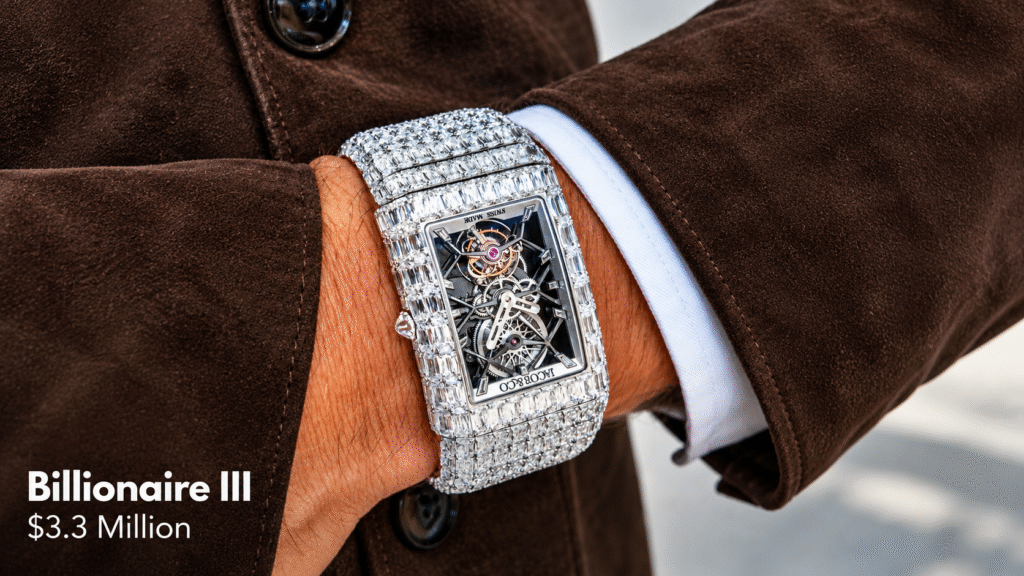
Holding the Billionaire III exposes the extreme density of the gem-setting architecture. The watch features a 52-millimeter 18-karat white gold case completely paved with diamonds. The mechanism of the gem-setting involves a specialized invisible setting technique. The setters utilize diamonds with a specific VVS clarity grading. The diamonds feature microscopic grooves cut into the pavilion. The diamonds slide onto a hidden gold rail, locking into place without any visible metal prongs. The visual result is a continuous wall of diamonds that reflects the ambient light. The watch features a massive 40-millimeter tourbillon cage suspended in the center of the dial. The tourbillon cage rotates every 60 seconds. The cage consists of a lightweight titanium alloy. The watchmaker hand-polishes the titanium to reduce air friction, maximizing the amplitude of the balance wheel. The watch features a 72-hour power reserve. The movement features a specialized skeletonized architecture. The main plate features a frosted finish. The finish is achieved by carefully applying a specialized abrasive compound to the surface with a brass brush. The texture diffuses the light, preventing glare on the internal components. The $3.3 million valuation reflects the absolute scarcity of the raw materials. The watch utilizes over 200 carats of diamonds. The sourcing of the diamonds requires a dedicated supply chain. The watchmaker utilizes a specialized loupe to align the microscopic jewels. The artisan utilizes a 5-axis mill to carve the sapphire components. The object stands as a testament to the physical limits of human precision. The permanence of the mechanics ensures the timepiece will function perfectly when the digital infrastructure of the modern world fails. The physical reality of the gear teeth ensures the rotation of the tourbillon will remain absolutely constant, driven by the unwinding of the mainspring.
Caviar Tourbillon
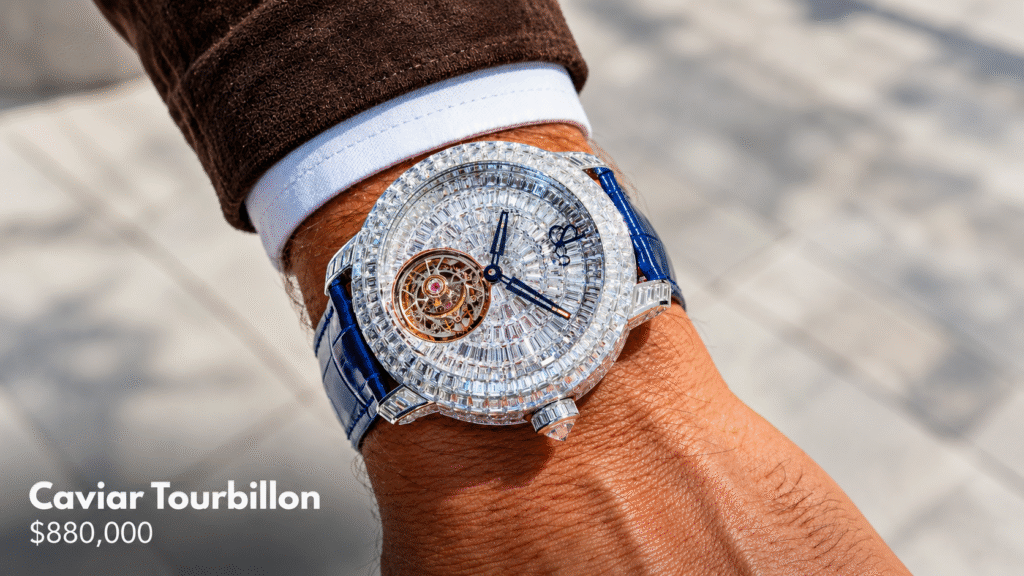
Examining the Caviar Tourbillon reveals a distinct tactile contrast. The case integrates 18-karat 5N rose gold with a matte black carbon fiber composite. The carbon fiber utilizes a T800 grade weave. The engineers lay the carbon fibers in a specific orientation, placing them under 10 bars of pressure in an autoclave at 120 degrees Celsius. The process eliminates all air bubbles, creating a solid, homogenous shell that possesses extreme structural rigidity. The matte finish of the carbon absorbs light, contrasting sharply with the mirror-polished rose gold bezel. The mechanism features a manual-winding caliber JCFM01. The movement operates at 21,600 vibrations per hour. The flying tourbillon sits exposed at 6 oclock. The tourbillon cage consists of a titanium alloy, chosen for its low density and resistance to magnetic fields. The watch features a massive 216-hour power reserve. The mechanism achieves this through two series-coupled mainspring barrels. The barrels utilize a specialized geometric toothing on the mainspring drum. The toothing ensures a constant torque delivery to the gear train, preventing the amplitude of the balance wheel from dropping as the mainspring unwinds. The gear train features hand-beveled bridges. The watchmaker applies black polish to the screw heads, utilizing tin paste and a zinc plate to achieve a perfectly flat reflective surface. The density of the rose gold pushes the total weight of the watch to 155 grams. The integration of aerospace materials with traditional haute horology demonstrates a specific engineering philosophy. The watch utilizes advanced composites to protect the precision of the mechanical movement from external physical shocks. The $880,000 valuation stems from the extreme material science and the hand-finishing required to integrate the carbon fiber with the rose gold. The engineering prioritizes structural longevity and thermal management over traditional aesthetic considerations.
Epic X Chrono Tourbillon Baguette
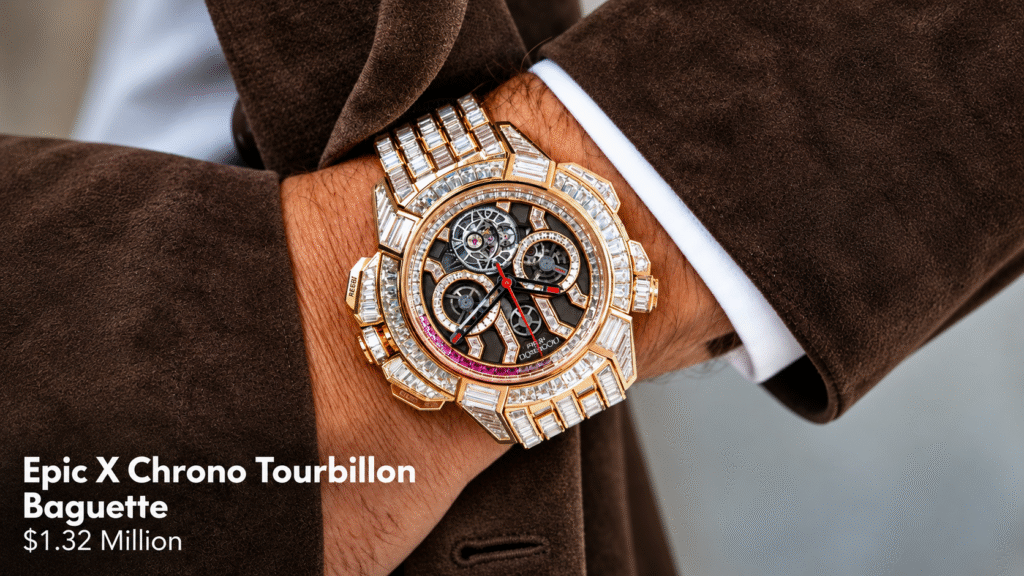
Pressing the pusher on the Epic X Chrono Tourbillon Baguette initiates a complex mechanical sequence. The watch features a 45-millimeter 18-karat white gold case set with baguette-cut diamonds. The mechanism features a manual-winding caliber JCAA03. The movement operates at 21,600 vibrations per hour. The watch integrates a flying tourbillon and a chronograph. The tourbillon sits at 12 oclock. The tourbillon cage rotates every 60 seconds. The chronograph features a column wheel mechanism. The column wheel features precise ratchet teeth that control the start, stop, and reset functions of the chronograph. The mechanism provides a distinct tactile click when the pushers engage. The chronograph utilizes a specialized vertical clutch. The clutch eliminates the jump of the chronograph hand when the mechanism engages. The vertical clutch features two friction plates. The plates engage smoothly, providing a seamless start to the timing sequence. The watch features a 48-hour power reserve. The movement consists of 328 individual components. The diamond setting on the bezel utilizes a specialized channel-setting technique. The setter mills a precise groove into the gold. The diamonds slide into the groove. The setter utilizes a specialized burnisher to push the gold over the edges of the stones. The watch features a specialized sapphire crystal dial. The transparency eliminates the concept of a hidden dial. The light enters the case from every angle, illuminating the gear trains and the winding mechanism. The $1.32 million valuation reflects the extreme complexity of integrating a flying tourbillon with a chronograph. The engineering of the complication requires absolute precision in the placement of the jewel bearings. A microscopic misalignment would cause the chronograph mechanism to bind, halting the movement. The visual asymmetry of the dial demands a perfectly balanced mass distribution to prevent the delicate pivot from wearing down over time.
Brilliant Skeleton Baguette
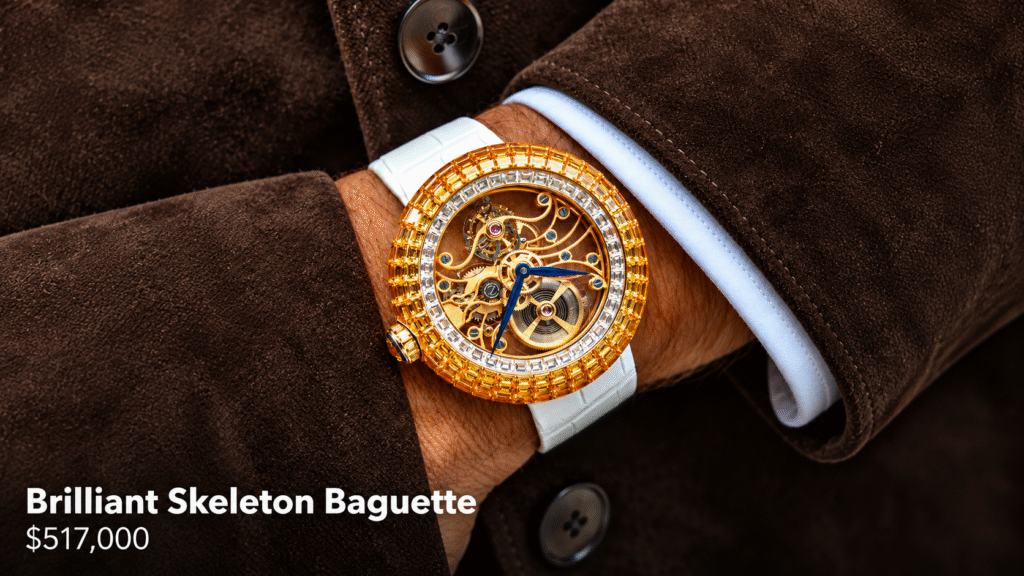
Looking through the front of the Brilliant Skeleton Baguette reveals a multi-layered dial constructed entirely from sapphire crystal. The mechanism of the sapphire machining requires a multi-axis CNC mill running for 400 continuous hours. The crystal starts as a solid block of synthetic corundum. The diamond-tipped cutting tool shaves away microscopic layers of the crystalline structure. The friction generated requires a continuous flood of liquid coolant to prevent thermal cracking. The sapphire possesses a Mohs hardness of 9, making it virtually scratch-resistant. The transparency eliminates the concept of a hidden dial. The light enters the case from every angle, illuminating the gear trains and the winding mechanism. The watch features a 42-millimeter 18-karat white gold case set with baguette-cut diamonds. The mechanism features a manual-winding caliber JCS03. The movement operates at 21,600 vibrations per hour. The movement features a specialized skeletonized architecture. The main plate features a frosted finish. The bridges feature hand-beveled edges. The watchmaker utilizes a rotating buffing wheel charged with diamond paste to melt the metal at a microscopic level, creating a 45-degree angle that catches the ambient light. The watch features a 48-hour power reserve. The movement consists of 287 individual components. The watch features a flying tourbillon at 6 oclock. The tourbillon cage rotates every 60 seconds. The $517,000 valuation reflects the extreme labor required to machine the sapphire components and the hand-finishing required to assemble the movement. The engineering of the skeletonized architecture requires absolute precision in the removal of material. The watchmaker must ensure the structural integrity of the bridges remains absolute. Any microscopic stress fracture would compromise the entire aesthetic and functional purpose of the open-worked architecture. The visual result is absolute optical clarity. The internal components appear to float in space. The sapphire architecture ensures the kinetic display of the tourbillon and the gear train remains completely unobstructed from every viewing angle.
The Permanence of Mechanical Friction and Capital
The physical accumulation of these seven timepieces represents a specific architectural permanence. The Jacob & Co. Extraordinary Watches exist entirely outside the modern paradigm of disposable, smart technology. The mechanical friction that defines these machines creates a direct physical link between the wearer and the internal mechanism. The 18-karat gold, the titanium, and the sapphire crystal anchor these objects to the earth. The internal combustion engines and the mechanical music boxes will outlast the digital infrastructure of the modern world. The bespoke structural geometries ensure the watches cannot be easily replicated. The artisans who hand-trowel the frosted finish and the engineers who design the flying tourbillons leave a specific physical trace on the materials. The valuation of these watches stems from the impossibility of automated mass production. The capital required to engineer a one-off music box or a double-axis tourbillon exceeds the standard residential budget. The permanence of the mechanics ensures these watches will function perfectly when the digital infrastructure of the modern world fails. The physical reality of the gear teeth ensures the rotation of the tourbillon will remain absolutely constant, driven by the unwinding of the mainspring. The assets stand as a testament to the physical limits of human engineering precision. The physical weight of the platinum and titanium ensures these machines will remain anchored to the earth, outlasting the transient digital wealth that facilitated their acquisition. The mechanical friction dictates the operational reality of the collection. The permanence of the assets ensures the mechanical architecture will remain a permanent fixture of the horological landscape, outlasting the legal and financial controversies that surround the industry.
FAQ
What makes the Casino Tourbillon Baguette unique?
The watch features a functional roulette wheel recessed into the dial. A pusher engages a rack that drives a high-speed gear train, spinning a white ceramic ball around a sapphire crystal track. The ball loses momentum through natural friction and drops into a numbered pocket milled into the gold rotor.
How does the Opera Godfather Baguette Red Sapphires produce sound?
The watch features a mechanical music box with two separate cylinders. Each cylinder features 120 pins that pluck the teeth of two metallic combs as the cylinder rotates. The watchmaker tunes each tooth by filing microscopic layers of metal from the tip to adjust the pitch, creating a complex acoustic harmony amplified by the rose gold case.
What is the power reserve of the Caviar Tourbillon?
The Caviar Tourbillon features a massive 216-hour power reserve. The mechanism achieves this through two series-coupled mainspring barrels that utilize a specialized geometric toothing on the mainspring drum to ensure constant torque delivery to the gear train.
How does the Epic X Chrono Tourbillon Baguette chronograph mechanism work?
The chronograph utilizes a specialized vertical clutch with two friction plates that engage smoothly to eliminate the jump of the chronograph hand. A column wheel mechanism featuring precise ratchet teeth controls the start, stop, and reset functions, providing a distinct tactile click when the pushers engage.
What engineering is required for the Brilliant Skeleton Baguette sapphire dial?
The sapphire dial requires a multi-axis CNC mill running for 400 continuous hours. A diamond-tipped cutting tool shaves away microscopic layers of the crystalline structure. The process requires a continuous flood of liquid coolant to prevent thermal cracking, ensuring the structural integrity of the bridges remains absolute.