

The conference room inside Tesla’s Gigafactory in Texas stays quiet for a moment before the next production chart appears on the screen. Battery output climbs quarter by quarter. Engineers study the numbers, not as theory but as scale.
Outside the glass walls, thousands of vehicles move slowly along assembly lines.
This is the environment where the modern discussion about the Elon Musk First Trillionaire possibility begins. Not inside a trading floor or an academic report, but within factories, launch facilities, and software labs that operate across several industries at once.
The idea of a trillionaire once felt hypothetical. Global wealth rankings rarely moved beyond the nine-figure threshold for most of modern economic history. Billionaires themselves appeared extraordinary when the first lists emerged decades ago.
Today the conversation has shifted. The founder behind Tesla, SpaceX, Neuralink, and The Boring Company controls stakes in companies whose combined valuation continues to expand.
If those valuations accelerate through technological adoption, space infrastructure, and artificial intelligence platforms, the pathway toward a trillion-dollar personal fortune begins to appear less theoretical.
The discussion around Elon Musk First Trillionaire therefore reflects a larger story about the scale of modern technology companies.
The Business Forces Behind the Elon Musk First Trillionaire Possibility
The idea of a trillionaire rests on one fundamental principle. Ownership of companies that scale rapidly across global markets.
In Musk’s case, the foundation begins with Tesla, the electric vehicle manufacturer that transformed the perception of battery-powered transportation. Tesla’s valuation has already reached levels once associated only with the largest technology firms.
Unlike traditional automotive companies, Tesla operates at the intersection of multiple sectors.
The company produces vehicles, energy storage systems, battery technology, and software platforms that continue evolving through updates.
Revenue streams therefore extend beyond vehicle sales. Energy infrastructure, autonomous driving technology, and AI-driven mobility systems add additional layers of potential value.
Another pillar supporting the Elon Musk First Trillionaire discussion involves SpaceX.
The private aerospace company has created a launch system capable of sending satellites and cargo into orbit at costs significantly lower than traditional rocket programs.
Reusable rockets form the backbone of that system. Each booster lands vertically after launch, allowing the company to refurbish and reuse hardware instead of building a new rocket for every mission.
This mechanism changes the economics of space transportation.
Lower launch costs enable the deployment of large satellite networks such as Starlink, which provides global internet connectivity from orbit.
Starlink alone operates as a massive infrastructure project. Thousands of satellites orbit the planet, delivering broadband coverage to regions where traditional networks struggle to reach.
If that network continues expanding, analysts expect the service to generate billions in annual revenue.
Combined with Tesla’s growth, SpaceX introduces another engine of wealth creation within the Musk portfolio.
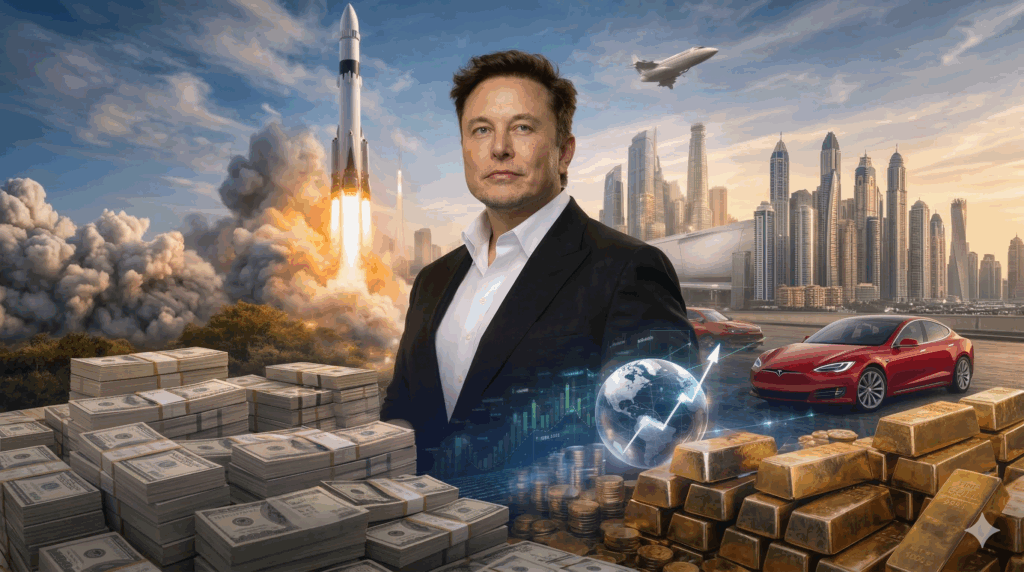
Ownership structure plays a crucial role in the trillionaire discussion.
Unlike many founders who dilute their holdings over time, Musk maintains significant equity stakes in his companies. These shares represent the primary driver of his personal wealth.
When the market value of Tesla rises, Musk’s net worth increases accordingly. When SpaceX attracts new investment rounds at higher valuations, the value of his stake grows as well.
This dynamic explains why the Elon Musk First Trillionaire conversation centers on company valuations rather than traditional income.
The wealth exists mostly in the form of ownership, not liquid assets.
How the Elon Musk First Trillionaire Scenario Could Actually Happen
Reaching the trillionaire threshold requires a combination of market expansion and technological adoption.
Tesla’s growth potential depends heavily on global demand for electric vehicles. Governments across multiple continents continue introducing policies aimed at reducing emissions from transportation.
As electric vehicle adoption accelerates, companies positioned early in the sector benefit from expanding markets.
Tesla also invests heavily in autonomous driving systems. The company collects massive datasets from vehicles operating on public roads. These datasets train machine learning models that guide self-driving capabilities.
If autonomous transportation becomes widely adopted, software services associated with self-driving systems could represent a significant new revenue stream.
Another area influencing the Elon Musk First Trillionaire projection involves artificial intelligence.
Tesla’s AI development supports both autonomous vehicles and robotics projects. The company’s humanoid robot initiative, often referred to as Optimus, aims to automate tasks across industrial environments.
Should such technologies reach large-scale commercial adoption, they would open entirely new markets.
Space infrastructure introduces another dimension.
Starship, the massive spacecraft currently under development by SpaceX, aims to reduce the cost of space travel even further. The vehicle could transport cargo, satellites, and eventually humans on interplanetary missions.
Lower launch costs expand the possibilities for space-based industries such as satellite manufacturing, orbital research platforms, and lunar infrastructure.
The more industries connected to Musk’s companies, the broader the financial ecosystem supporting his wealth.

Of course, wealth projections remain uncertain. Market valuations fluctuate with economic cycles, regulatory environments, and technological breakthroughs.
Even so, the scale of Musk’s ventures creates a rare financial structure.
Few individuals control meaningful stakes in companies operating simultaneously across electric vehicles, aerospace infrastructure, satellite communications, and artificial intelligence.
This diversification amplifies the potential pathway toward trillionaire status.
The Cultural Meaning of a Trillionaire
The idea of a trillionaire carries symbolic weight beyond finance.
Historically, the largest fortunes emerged from industries such as oil, railroads, or telecommunications. Technology companies introduced a new scale of value creation.
Platforms capable of serving billions of users generate wealth at levels that traditional industries rarely achieved.
The Elon Musk First Trillionaire discussion therefore reflects the evolution of modern capitalism.
Global networks, digital infrastructure, and advanced manufacturing create economic opportunities that extend far beyond geographic borders.
If a trillionaire emerges during the coming decades, the milestone will likely originate from industries tied to technology, data, and energy systems.
The sun sets behind the Gigafactory as the final shift of workers leaves the assembly floor. Vehicles continue rolling down the production line under bright lights.
Somewhere above the atmosphere, satellites launched by SpaceX circle the planet.
The wealth attached to those systems rises and falls with every market movement.
Whether the Elon Musk First Trillionaire prediction becomes reality remains uncertain.
What is clear is that the industries shaping that possibility are already changing how the world builds machines, moves information, and reaches beyond Earth.
FAQs
1. Could Elon Musk really become the first trillionaire?
Some financial analysts believe the Elon Musk First Trillionaire scenario is possible if companies like Tesla and SpaceX continue increasing in valuation.
2. What companies contribute to Elon Musk’s wealth?
Musk’s wealth primarily comes from his ownership stakes in Tesla, SpaceX, and other ventures such as Neuralink, Starlink, and The Boring Company.
3. How would Elon Musk reach a trillion dollars in net worth?
Reaching that level would require major valuation growth in Tesla, SpaceX, and related technology businesses where Musk holds large equity stakes.
4. Has anyone in history become a trillionaire?
No individual has officially reached a trillion-dollar personal net worth yet. The concept remains a future financial milestone.
5. Why do analysts discuss Elon Musk as the first potential trillionaire?
Musk controls ownership in companies operating across multiple high-growth sectors including electric vehicles, artificial intelligence, space infrastructure, and satellite internet networks.