
The Vault Access and the Architecture of High Horology
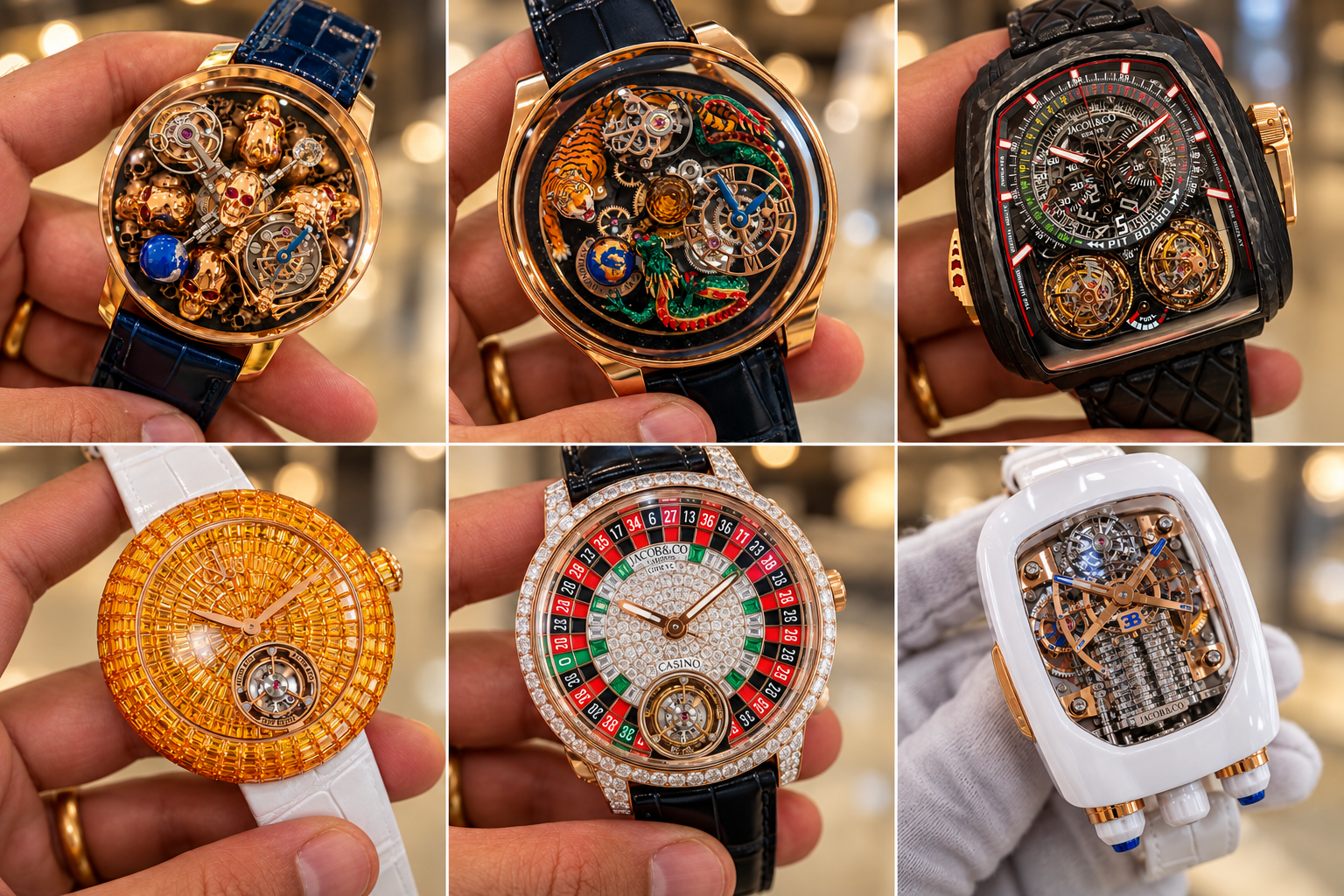
Standing inside the biometric access corridor of a private Geneva vault, the air pressure shifts as the steel doors seal behind you. The room lacks natural light. The humidity remains locked at 43 percent to prevent the microscopic expansion of the oils inside the watch movements. Laid on a matte black carbon fiber table sit six timepieces representing the absolute pinnacle of mechanical engineering. These are the Watches Worth $3.8 Million that bypass the standard retail ecosystem entirely. They do not sit in display windows. They do not feature in the seasonal promotions of Luxury Outlet Shopping. The acquisition of these pieces requires a direct relationship with the manufacture and a willingness to wait years for the assembly of hundreds of microscopic components. The value of these six watches stems entirely from the frictionless interaction of their internal geometries. A single drop of synthetic Moebius oil lubricates the jewels of the escapement. The gear trains transfer kinetic energy from the mainspring barrel to the escapement wheel with zero measurable loss of torque. The cases consist of sapphire crystals machined from solid blocks of corundum. The interior architecture dictates the exterior design. The physical reality of holding these watches provides a distinct sense of mass. The density of the platinum, gold, and titanium creates a tactile weight that anchors the mechanism to the wrist. Every element of these timepieces exists to serve the mechanical precision of the movement. The beauty of the objects arises directly from the functional necessity of the components.
Bugatti Chiron Tourbillon: The Automotive Horological Engine
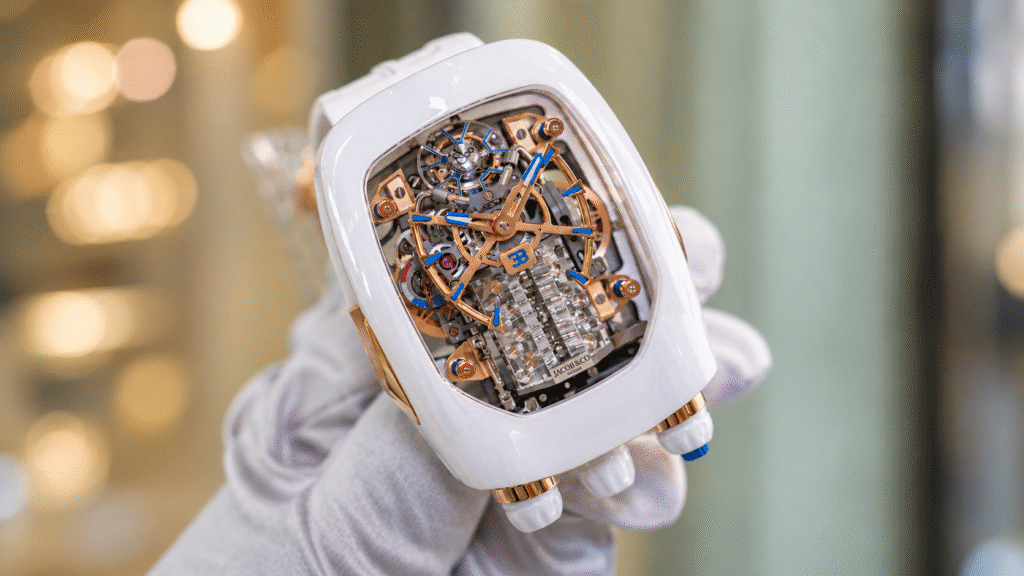
Picking up the Bugatti Chiron Tourbillon reveals a specific architectural homage to the hypercar. The watch weighs exactly 127 grams. The case consists of grade 5 titanium, milled from a single block to mimic the curves of the Chiron’s engine cover. The mechanism features a 30-second flying tourbillon visible through a sapphire crystal dashboard. The true mechanical marvel sits beneath the tourbillon. The watch features a fully functional miniature W16 engine. The mechanics of the engine block operate via a pusher located on the right side of the case. Pressing the pusher engages a complex series of rack and pinion gears. The gears physically drive 16 miniature pistons. The pistons pump up and down, mimicking the combustion cycle of the actual Bugatti engine. The mechanism relies on a secondary power reserve dedicated entirely to the engine animation. The animation runs for 20 seconds on a single press. The engineer designed the camshafts and the valves using a specialized lithography process to ensure the metal components possess the necessary tensile strength to avoid shearing under friction. The tourbillon cage utilizes a titanium bridge, polished by hand to a mirror finish to eliminate any surface friction that could affect the amplitude of the balance wheel. The watch operates at 3 Hertz, providing a precise 42-hour power reserve. The integration of the automotive animation into the mechanical movement represents a structural achievement in micro-engineering. The density of the components forces the watchmaker to assemble the movement under a microscope. The permanence of the mechanism lies in the exact metallurgy of the pistons, engineered to fire thousands of times without suffering metal fatigue.
Casino Tourbillon Diamonds: The Mechanics of the Roulette Wheel
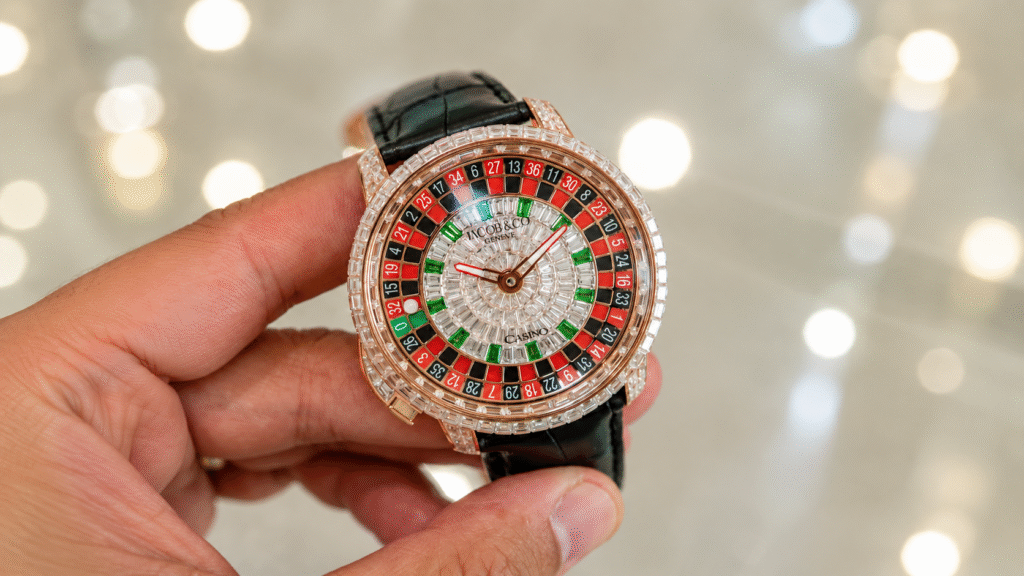
Examining the Casino Tourbillon Diamonds under a loupe reveals the intense concentration of capital in a 42-millimeter space. The watch features an 18-karat white gold case completely set with baguette-cut diamonds. The gem setters utilized a specialized invisible setting technique. They cut microscopic grooves into the pavilion of each diamond. The diamonds slide onto a hidden gold rail, locking into place without any visible metal prongs. The mechanism of the watch centers around a functional roulette wheel recessed into the dial at 6 oclock. The roulette wheel operates via a pusher at 8 oclock. The pusher engages a rack that drives a high-speed gear train. The gear train spins a white ceramic ball around a 12-millimeter sapphire crystal track. The ball loses momentum through natural friction. The ball drops into a numbered pocket milled directly into the gold rotor. The mechanism requires the watchmaker to perfectly balance the rotor to ensure the ball settles fairly. The tourbillon sits at 12 oclock. The tourbillon cage rotates every 60 seconds, counteracting the gravitational pull on the hairspring. The movement features a free-sprung balance wheel with gold micro-metric screws. The screws allow the watchmaker to adjust the inertia of the wheel without altering the active length of the hairspring. The diamonds on the bezel feature a specific D-color grading. The clarity of the stones allows maximum light transmission into the movement, illuminating the gear trains. The acoustic signature of the roulette ball clicking against the sapphire track creates a distinct metallic sound. The engineering of the complication defies the traditional purpose of a watch, introducing an element of chance into a machine dedicated to absolute precision.
Caviar Tourbillon: The T800 Carbon Fiber Architecture
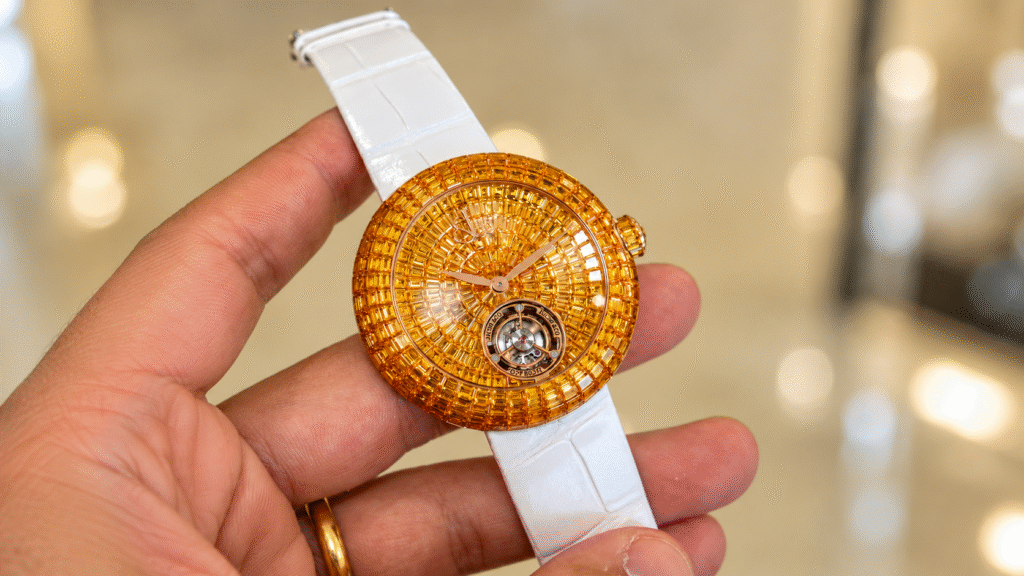
Holding the Caviar Tourbillon provides a distinct tactile contrast. The case integrates 18-karat 4N rose gold with a matte black carbon fiber composite. The carbon fiber utilizes a T800 grade weave. The engineer layed the carbon fibers in a specific orientation, placing them under 10 bars of pressure in an autoclave at 120 degrees Celsius. The process eliminates all air bubbles, creating a solid, homogenous shell that possesses extreme structural rigidity. The matte finish of the carbon absorbs light, contrasting sharply with the mirror-polished rose gold bezel. The mechanism features a manual-winding caliber JCFM01. The movement operates at 21,600 vibrations per hour. The flying tourbillon sits exposed at 6 oclock. The tourbillon cage consists of a titanium alloy, chosen for its low density and resistance to magnetic fields. The watch features a massive 216-hour power reserve. The mechanism achieves this through two series-coupled mainspring barrels. The barrels utilize a specialized geometric toothing on the mainspring drum. The toothing ensures a constant torque delivery to the gear train, preventing the amplitude of the balance wheel from dropping as the mainspring unwinds. The gear train features hand-beveled bridges. The watchmaker applies black polish to the screw heads, utilizing tin paste and a zinc plate to achieve a perfectly flat reflective surface. The density of the rose gold pushes the total weight of the watch to 155 grams. The integration of aerospace materials with traditional haute horology demonstrates a specific engineering philosophy. The watch utilizes advanced composites to protect the precision of the mechanical movement from external physical shocks.
Twin Turbo Furious Carbon: The Acoustic Resonance of the Minute Repeater
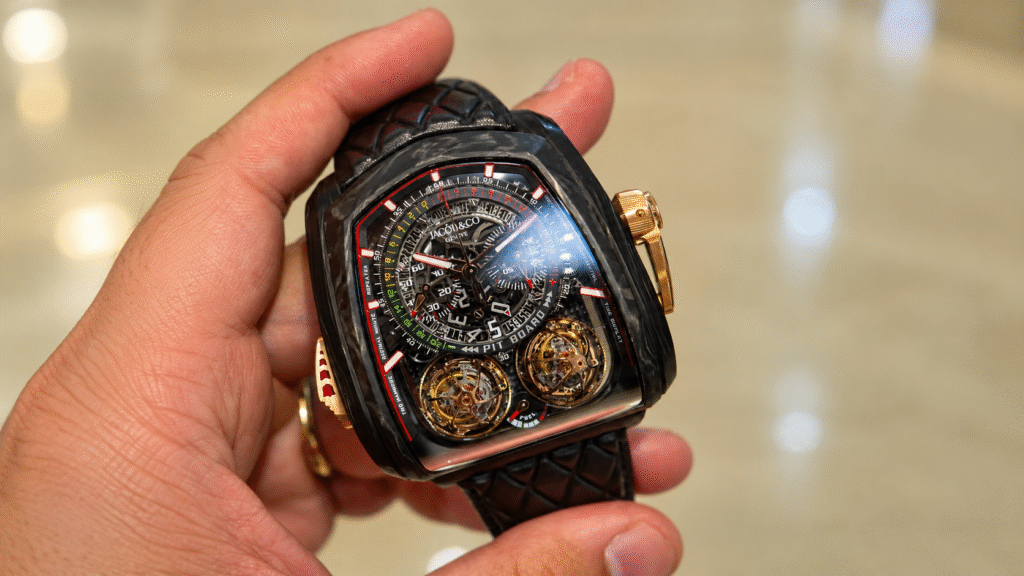
Activating the slide on the Twin Turbo Furious Carbon triggers a distinct acoustic sequence. The watch represents the pinnacle of horological complexity. It features a triple-axis tourbillon, a minute repeater, and a monopusher chronograph. The case utilizes a forged carbon composite. The carbon features a unique matrix, created by compressing random fragments of carbon fiber. The result is a completely unique pattern on every watch. The triple-axis tourbillon rotates on three separate axes simultaneously. The innermost cage rotates every 24 seconds. The intermediate cage rotates every 8 seconds. The outer cage rotates every 60 seconds. This multi-axis rotation completely eliminates positional variance in timekeeping. The minute repeater mechanism strikes the time on demand. The watch features two cathedral gongs. The gongs consist of a specialized steel alloy, drawn into a wire and coiled to precise mathematical calculations. The mechanism utilizes two hammers, striking the hour on a low tone and the minutes on a high tone. The acoustic resonance depends entirely on the density of the forged carbon case. The carbon material does not absorb sound waves. It projects them outward, creating a loud, crisp acoustic profile. The chronograph utilizes a single pusher located on the side of the case. The pusher engages a column wheel mechanism. The column wheel features precise ratchet teeth that control the start, stop, and reset functions of the chronograph hands. The watch features a reference time differential indicator. The mechanism allows the wearer to compare the time on the watch to a reference time, displaying the difference in minutes on a retrograde scale. The density of the complications forces the movement to contain 832 individual components. The assembly requires six months of dedicated labor.
Astronomia Dragon & Tiger: The Kinetic Sculpture Mechanics
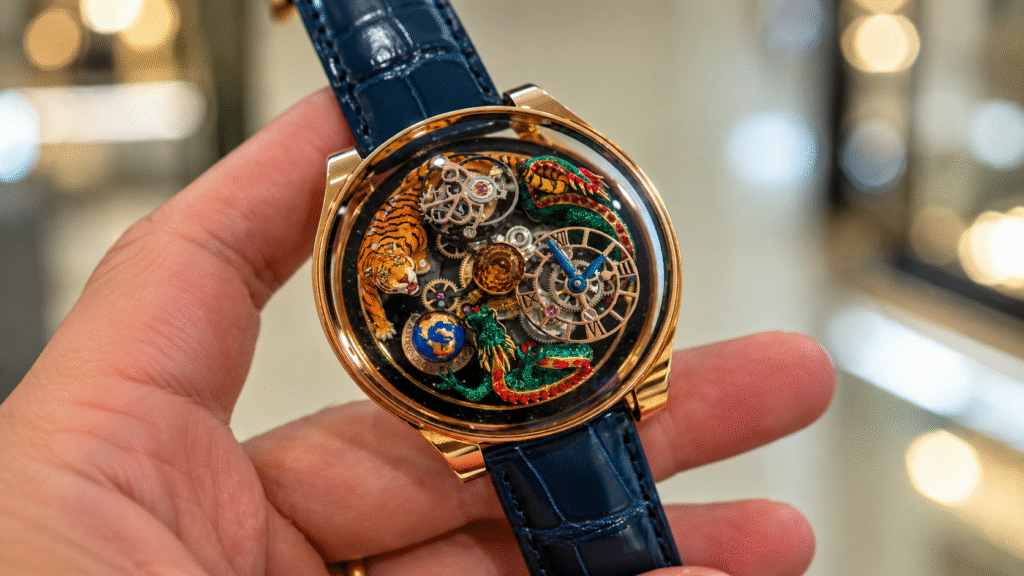
Looking through the massive sapphire dome of the Astronomia Dragon & Tiger reveals a completely unobstructed view of a kinetic sculpture. The watch features a 50-millimeter case. The sapphire crystal consists of a single block of corundum, machined over 400 hours to achieve the complex domed geometry. The movement features a four-axis rotation. The central platform rotates every 20 minutes. Four distinct satellites attach to the central platform. The first satellite features the hours and minutes sub-dial. The sub-dial utilizes a differential gear system. The system ensures the dial remains upright and readable regardless of the rotation of the central platform. The second satellite features a 1-carat diamond. The diamond features 288 individual facets. The diamond rotates on its own axis every 60 seconds. The third and fourth satellites feature hand-engraved 18-karat gold sculptures of a dragon and a tiger. The sculptures feature microscopic detailing. The engraver utilized specialized high-speed pneumatic tools to carve the gold. The detail extends to the individual scales of the dragon and the stripes of the tiger. The central platform rotates via a specialized gear train hidden within the central pivot. The movement utilizes a vertical tourbillon. The tourbillon rotates the entire platform, creating a continuous, hypnotic motion. The visual weight of the gold sculptures requires the watchmaker to balance the central platform perfectly. Any microscopic variance in weight would cause the movement to suffer severe amplitude loss. The watch features a manual-winding movement. The platform rotation utilizes a dedicated gear train, driven by a separate mainspring barrel. The isolation of the rotation power reserve from the timekeeping power reserve ensures the kinetic animation does not drain the timekeeping accuracy. The mechanical architecture prioritizes visual spectacle.
Astronomia Art 4 Skulls: The Macabre Metamorphosis of Rose Gold
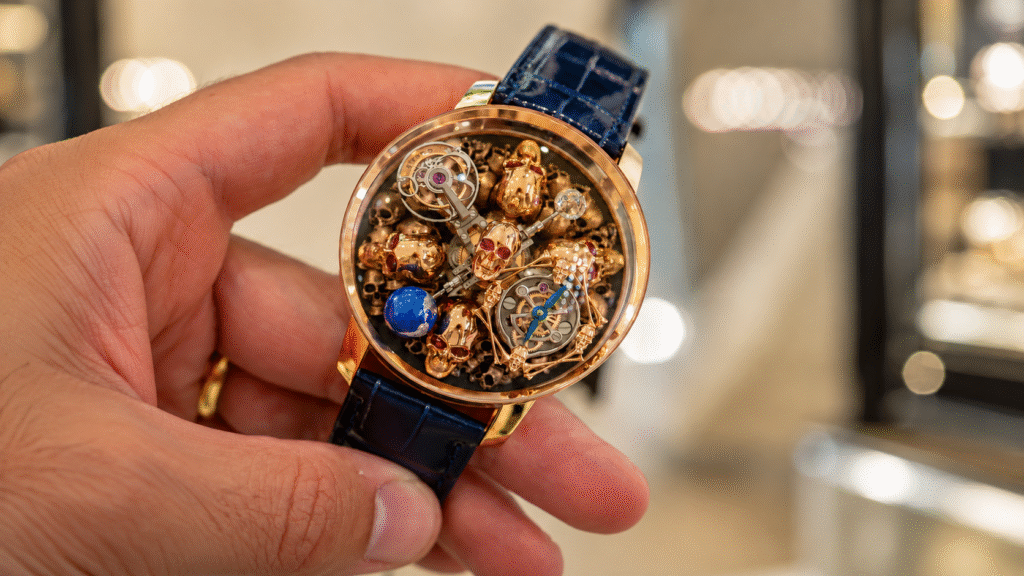
Examining the Astronomia Art 4 Skulls exposes a specific intersection of horology and macabre art. The watch features four distinct skull sculptures machined from solid 18-karat rose gold. The sculptor designed each skull with a unique expression. The machining process utilizes a 5-axis CNC mill. The mill removes microscopic layers of gold, leaving a raw, textured surface that mimics the porous structure of human bone. The skulls undergo a specialized chemical oxidation process. The process darkens the recesses of the skull, highlighting the sharp lines of the cheekbones and the jaw. The central platform rotates every 40 minutes. The four skulls sit at the cardinal points of the platform. The rotation creates a continuous dance of the macabre figures. The movement features a vertical tourbillon. The tourbillon cage consists of a lightweight titanium alloy. The escapement wheel features a specialized LIGA manufacturing process. The process creates a gear with perfectly shaped teeth, eliminating the sliding friction that plagues traditional machined gears. The hours and minutes sub-dial sits opposite the tourbillon. The differential gear system keeps the sub-dial upright. The watch features a 72-hour power reserve. The sapphire case provides a 360-degree view of the movement. The transparency eliminates the concept of a traditional dial. The mechanical components float in space, unbound by a traditional main plate. The structural integrity of the movement relies on a central titanium spine. The spine connects the mainspring barrel to the gear train and the rotating platform. The skulls exert a specific gravitational pull on the platform. The watchmaker must add microscopic amounts of platinum to the internal counterweights to achieve perfect dynamic balance. The watch operates as a physical memento mori, a mechanical reminder of mortality driven by absolute horological precision.
The Permanence of Mechanical Friction
The six timepieces represent a specific architectural permanence. The Watches Worth $3.8 Million exist entirely outside the modern paradigm of disposable technology. The mechanical friction that powers these devices creates a direct physical link between the wearer and the machine. The physical weight of the platinum, gold, and titanium anchors the objects to reality. The 18-karat gold gears will outlast the silicon chips that drive contemporary technology. The sapphire crystals will resist scratching for centuries. The synthetic oils will evaporate, requiring maintenance, but the structural geometry of the movements will remain perfectly intact. The investment in these objects secures a functioning piece of micro-engineering history. The valuation of the watches stems from the impossibility of automated mass production. Every component requires human intervention. The watchmaker utilizes a magnifying loupe to align the microscopic jewels. The gem setter utilizes a specialized graver to cut the invisible grooves. The engraver utilizes a pneumatic chisel to carve the gold. The objects stand as a testament to the physical limits of human precision. The permanence of the mechanics ensures the timepieces will function perfectly when the digital infrastructure of the modern world fails. The physical reality of the gear teeth ensures the rotation of the tourbillon will remain absolutely constant, driven by the unwinding of the mainspring.
FAQ
What defines the mechanical complexity of the Bugatti Chiron Tourbillon?
The Bugatti Chiron Tourbillon features a fully functional miniature W16 engine driven by a secondary gear train. Pressing a pusher engages rack and pinion gears that physically drive 16 titanium pistons, mimicking the combustion cycle of the hypercar. The watch also features a 30-second flying tourbillon and a grade 5 titanium case milled from a single block.
How does the Casino Tourbillon Diamonds roulette mechanism function?
The Casino Tourbillon Diamonds features a functional roulette wheel recessed into the dial. A pusher at 8 oclock engages a rack that drives a high-speed gear train, spinning a white ceramic ball around a sapphire crystal track. The ball loses momentum through natural friction and drops into a numbered pocket milled into the gold rotor, requiring the rotor to be perfectly balanced.
What material engineering defines the Caviar Tourbillon?
The Caviar Tourbillon integrates 18-karat 4N rose gold with a T800 grade carbon fiber composite. The carbon fiber undergoes a specialized autoclave process at 120 degrees Celsius under 10 bars of pressure to eliminate air bubbles. The movement features a 216-hour power reserve achieved through two series-coupled mainspring barrels with geometric toothing for constant torque delivery.
How does the Twin Turbo Furious Carbon achieve its acoustic resonance?
The Twin Turbo Furious Carbon features a minute repeater with two cathedral gongs made of a specialized steel alloy. The forged carbon composite case does not absorb sound waves, projecting the acoustic profile outward. It also features a triple-axis tourbillon with cages rotating every 24, 8, and 60 seconds, eliminating positional variance in timekeeping.
What is the mechanism behind the rotating platform of the Astronomia Dragon & Tiger?
The Astronomia Dragon & Tiger features a four-axis rotation with a central platform rotating every 20 minutes. A differential gear system keeps the hours and minutes sub-dial upright regardless of the platform rotation. The rotation utilizes a dedicated gear train driven by a separate mainspring barrel, ensuring the kinetic animation does not drain the timekeeping power reserve.