
The Initial Handling Experience
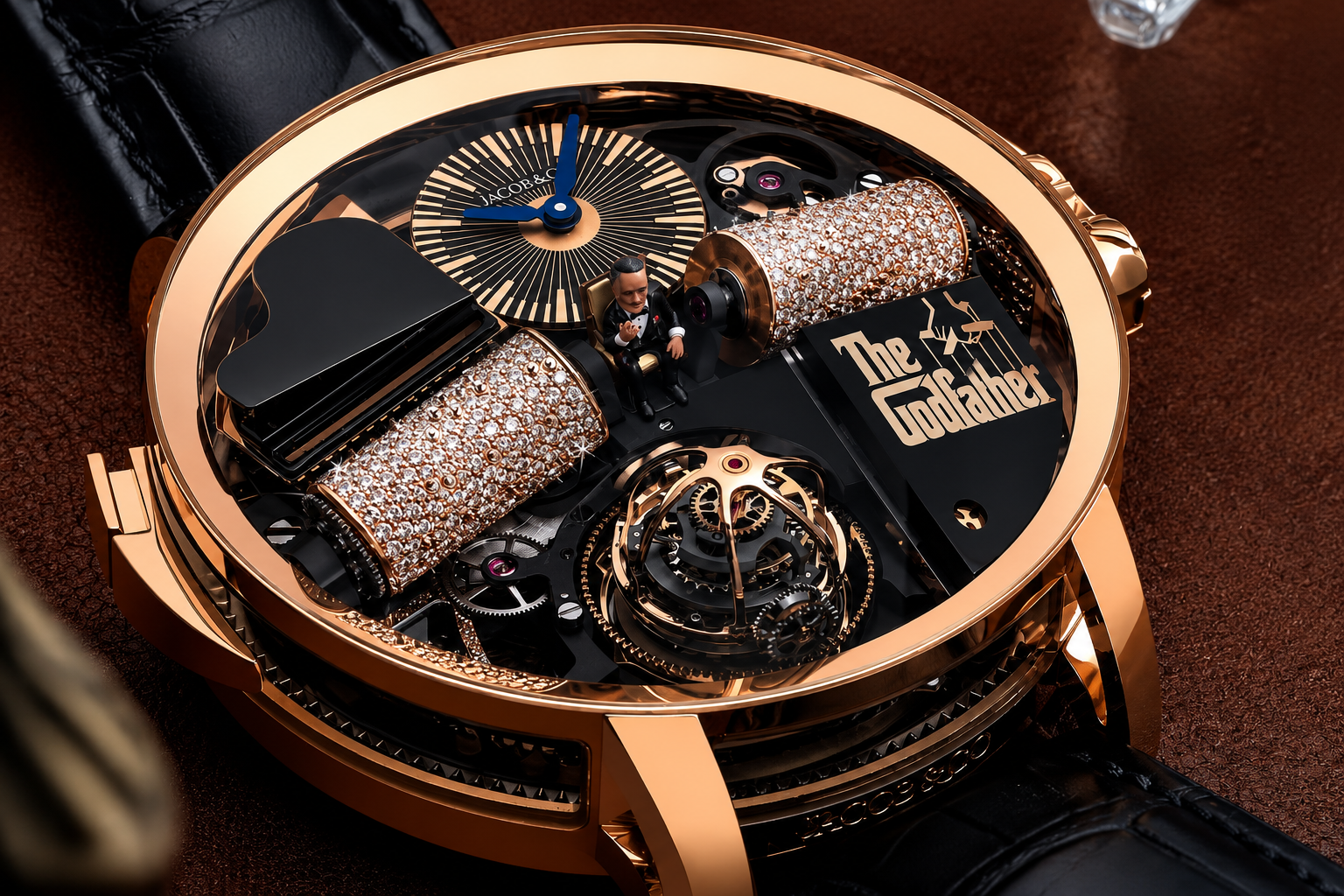
The suede lining of the presentation box gives way to a dense, heavy block of 18k rose gold. The first physical interaction with the Jacob & Co. Opera Godfather is dominated by its sheer mass. Lifting the 47mm case requires a deliberate adjustment of the wrist, a subtle reminder of the mechanical density contained within the walls of the gold shell. The lighting in the room catches the mirror-polished bezel, throwing a sharp reflection across the dark matte surface of the table. The visual weight matches the physical weight perfectly. The black onyx dial absorbs the ambient light, creating a stark, high-contrast backdrop for the moving mechanical elements positioned across the surface. This is a watch designed to anchor a room, demanding visual real estate the moment it leaves the confines of its fitted leather case. The fingers naturally gravitate toward the large pusher on the right flank, hesitating before engaging the complex sequence hidden inside. A technician wipes a microscopic speck of dust from the edge of the sapphire crystal with a lint-free cloth, stepping back to inspect his work.
The Specific Rose Gold Alloy
The specific alloy of the rose gold case carries a distinct, warm hue that leans slightly toward copper, avoiding the brassy tones found in lower-karat variations. Jacob & Co. machines the case middle with a vertical brushing technique, creating microscopic grooves that diffuse light along the sides of the 47mm diameter. The bezel breaks this texture with a continuous, mirror-polished slope. The transition between the brushed side and the polished top requires the casemaker to hand-polish the edge after the brushing process, a step that risks ruining the linear grain if the abrasive cloth touches the side. The lugs flow seamlessly from the case body, featuring a slight downward angle designed to hook the strap over the curvature of the wrist. The gold walls are exceptionally thick, a necessary architectural choice to house the 725 individual components of the musical complication without compromising structural integrity under the torsional stress of the mainspring.
The Black Onyx Dial Surface
Jacob & Co. sources solid blocks of black onyx, cutting and polishing them to serve as the base plane for the dial. The stone provides a surface with absolute zero light reflection, acting as a void that forces the eye to focus entirely on the raised mechanical elements. The onyx is fragile, demanding extreme precision during the machining process to prevent micro-fractures that would ruin the aesthetic. A tiny misstep by the dial maker renders the entire stone useless. The deep black color creates an immediate visual association with the dark, tailored suits worn by the central characters of the film. The stone sits flush within the rose gold case ring, secured by a hidden adhesive layer that prevents any rotational shifting when the watch experiences sudden wrist movement. This absolute stillness of the dial surface amplifies the visual drama when the dual rotating cylinders begin their mechanical sequence.
The Visual Impact of the Cylinders
Two cylinders dominate the upper hemisphere of the dial, positioned side by side beneath the sapphire crystal. These cylinders carry the primary visual mass of the piece. The surface of each cylinder features hundreds of microscopic pins arranged in a specific pattern. Under a loupe, the precision of the pin placement becomes apparent. The pins act as the physical memory of the musical piece, plucking a metallic comb as the cylinder rotates. The rose gold caps on the ends of the cylinders feature a precise guilloche pattern, adding a layer of textural complexity to the rotating masses. The cylinders remain stationary during normal timekeeping operations, sitting dormant like a loaded mechanical weapon. Their presence on the dial dictates the entire layout of the watch, forcing the double-axis tourbillon to a lower, peripheral position to maintain spatial balance.
The Godfather Theme Integration
The decision to encode the iconic theme melody into a mechanical watch requires a translation from audio frequency to physical pin placement. The melody spans roughly thirty seconds of playtime. Jacob & Co. engineers had to map every single note of the composition to a specific pin on the rotating cylinders. The tempo of the music box mechanism dictates the speed of the cylinder rotation. A slight deviation in the gear ratio would alter the tempo, rendering the melody unrecognizable. The Paramount Pictures licensing agreement extends beyond the dial text, applying directly to the exact sequence of notes plucked by the steel comb. The integration elevates the piece from a standard horological complication to a piece of functional cinematic memorabilia. The owner activates a Paramount Pictures license every time they press the side pusher, triggering a cascade of mechanical events that replicate a piece of Academy Award-winning composition.
The Double-Axis Tourbillon Placement
A flying double-axis tourbillon occupies the lower right quadrant of the dial, rotating on two separate planes to counteract the effects of gravity on the balance wheel. The cage completes a full rotation on its primary axis every sixty seconds, while a secondary cage nested inside rotates on a perpendicular axis every thirty seconds. The visual complexity of the tourbillon is staggering, yet it plays a secondary visual role to the music box cylinders. Jacob & Co. finishes the tourbillon cage in rose gold, matching the case material to create a cohesive visual flow across the dial. The bridge holding the tourbillon mechanism is machined from a solid block of gold, featuring sharp, hand-beveled edges that catch the light as the cage spins. The flying tourbillon design removes the top bridge, leaving the rotating cage visually unimpeded, a choice that maximizes the perception of depth and mechanical transparency.
The Music Box Trigger Mechanism
Pressing the pusher at three o’clock actuates a vertical clutch system within the movement. This clutch disengages the timekeeping gear train from the music box gear train, isolating the musical cylinders. A dedicated secondary mainspring barrel releases its stored energy simultaneously. As the barrel unwinds, it drives a central gear meshed with the two rotating cylinders. Tiny pins mounted on the surface of these cylinders pluck a metallic comb machined from a single block of steel. The pitch of each note depends entirely on the precise length of the corresponding tooth on the comb. The entire sequence lasts roughly thirty seconds, during which the twin barrels drain a significant percentage of their total power reserve. The gear teeth must engage with absolute precision, as any friction or misalignment would halt the rotation of the cylinders mid-melody. The vertical clutch system prevents the massive torque of the music box from disrupting the timekeeping function. The vertical clutch mechanism ensures that the massive torque required to spin the heavy cylinders does not disrupt the delicate timekeeping function.
The Acoustic Chamber Engineering
Producing an audible melody inside a sealed rose gold case requires careful manipulation of soundwaves. The 18k gold acts as a dense acoustic barrier, reflecting sound inward rather than allowing it to escape into the surrounding environment. Jacob & Co. engineers designed specific resonance apertures on the side of the case, positioned precisely to allow the sound pressure from the steel comb to exit the chamber without distorting the frequency. The size and placement of these apertures went through multiple iterations during the prototyping phase. An aperture too large weakens the structural integrity of the rose gold case. An aperture too small muffles the melody, reducing it to a faint ticking sound. The final configuration creates a sound profile that is surprisingly loud, filling a quiet room with the clear, metallic chime of the musical comb mechanism. The case back remains solid, forcing all acoustic energy to project outward through the side vents.
The Physical Pusher Interaction
The pusher at three o’clock features a large, ergonomic profile designed to be activated by the thumb. The travel distance of the pusher is remarkably long, requiring a deliberate, firm press to engage the music box mechanism. This extended travel acts as a physical safeguard against accidental activation. The internal spring governing the pusher offers high resistance, creating a tactile sensation of mechanical weight under the thumb. When the pusher reaches the end of its travel, a distinct mechanical click signals the engagement of the vertical clutch. Releasing the pusher does not stop the music. The dedicated mainspring barrel continues to unwind until the thirty-second sequence concludes. The pusher remains depressed in its locked position until the melody finishes, resetting automatically when the cylinder rotation stops. This mechanical sequencing prevents the user from interrupting the melody or damaging the gear train through premature reset.
The Power Reserve Dynamics
The caliber JCFM01 movement features a complex dual-barrel architecture to manage the immense energy requirements of the complication. One barrel supplies a standard 68-hour power reserve for the timekeeping functions. The second barrel stores energy exclusively for the music box. Engaging the musical sequence drains the dedicated barrel rapidly. A full wind of the movement provides enough power for approximately eight to ten plays of the melody before the music box barrel expires. The timekeeping barrel continues to function independently, even if the musical barrel is completely depleted. This separation is critical. If the two functions shared a single power source, playing the melody would drain the timekeeping function, causing the watch to stop telling time. The dual-barrel system ensures the watch remains a reliable timekeeping instrument regardless of how often the owner chooses to trigger the Godfather theme.
The Caliber JCFM01 Movement Architecture
The sheer volume of the JCFM01 caliber requires a case thickness of 18.5 millimeters. The movement contains 725 individual components, a number that places it in the highest echelon of horological complexity. The bridges are machined from German silver, a specific alloy chosen for its structural stability and its ability to take a high-polish finish. The mainplate features extensive hand-engraving, with a pattern that mimics the pinstripes of a tailored suit. The gear train for the music box sits layered above the gear train for the timekeeping functions, creating a three-dimensional mechanical landscape visible through the sapphire case back. The layout forces the watchmaker to assemble the movement in a specific sequence, building from the timekeeping base upward to the musical complications. This manual winding movement requires over 100 hours of assembly time by a single highly skilled watchmaker.
The Italian Flag Detail
A small, tricolor flag of green, white, and red is applied to the dial surface between the cylinders and the tourbillon. The detail is easy to miss at a glance, requiring the viewer to lean in closely to the onyx surface. The flag represents the cultural heritage of the fictional Corleone family and the very real Italian-American identity central to the narrative of the film. Jacob & Co. prints the flag on a microscopic piece of lacquer, applying it flush with the onyx to avoid disrupting the flat plane of the dial. The inclusion is a subtle nod rather than a loud proclamation. High-End collectors often look for these hidden, highly specific details as markers of a brand’s deep engagement with the subject matter. The Italian tricolor detail serves as a quiet signature from the design team, confirming that the watch is a dedicated homage rather than a superficial licensing exercise.
The Pinstripe Dial Motif
The black onyx dial features a series of incredibly fine, vertical lines etched into the stone surface. These lines replicate the pinstripe pattern of a classic men’s business suit, directly referencing the wardrobe choices of the primary characters in the film. The etching process requires a diamond-tipped tool to score the onyx without causing fractures. The lines catch the light at extreme angles, creating a subtle texture that breaks up the absolute blackness of the stone. The pinstripe motif connects the watch directly to the cinematic source material without relying on overt logos or text. The visual reference is sophisticated, appealing to a collector who appreciates subtlety over obvious branding. The pinstripe pattern also serves an aesthetic purpose, providing a visual anchor that grounds the spinning cylinders and the rotating tourbillon to a static, recognizable design language.
The Sapphire Crystal Assembly
The dome of the sapphire crystal rises significantly above the plane of the bezel, creating a massive vault of space over the dial elements. This extra clearance is a strict engineering requirement. The music box cylinders and the double-axis tourbillon extend upward into the case space. A flat crystal would physically strike the rotating components. The sapphire is ground and polished into this complex shape, a process that consumes a large, expensive block of raw sapphire material. The interior of the crystal receives a multi-layer anti-reflective coating to eliminate glare, ensuring the黑色的 onyx dial remains visually deep. The exterior of the crystal is left uncoated to maintain the scratch resistance of the raw sapphire. The domed sapphire crystal acts as a magnifying glass, distorting the edges of the dial slightly and pulling the eye toward the center of the mechanical action.
The Alligator Leather Strap Integration
Jacob & Co. pairs the rose gold case with a large-scaled alligator leather strap. The scales are selected from the belly of the hide, featuring a symmetrical, rectangular pattern that aligns perfectly down the center of the strap. The leather is dyed a deep, matte black to match the onyx dial, creating a seamless visual transition from the case to the wrist. The thickness of the strap matches the proportional weight of the 18k rose gold case. A thin strap would look overwhelmed by the massive watch head. The edges of the strap are hand-painted and burnished to a high gloss, creating a sharp visual border against the matte finish of the scaled surface. The strap attaches to the case using a proprietary quick-release system, allowing the owner to swap the leather for an aftermarket rose gold bracelet without the use of tools.
The Folding Clasp Mechanism
The clasp on the alligator strap is machined from a solid block of 18k rose gold, matching the case alloy exactly. It features a deployant design, folding inward twice to secure the watch to the wrist. The interior of the clasp is engraved with the Jacob & Co. logo, but the engraving is shallow, prioritizing structural rigidity over decorative depth. The clasp operates using a dual-release button mechanism. Pressing both buttons simultaneously unlocks the safety latch, allowing the clasp to unfold. A single-button release would risk accidental opening during rigorous wrist movement. The hinge pins are fitted with tiny spring-loaded balls that click into detents on the clasp arms, preventing the folded clasp from flopping open under its own significant weight. The folding clasp mechanism adds nearly 30 grams to the overall weight of the watch, contributing heavily to the dense, grounded feel on the wrist.
The Wrist Presence and Weight Distribution
The Wrist Presence and Weight Distribution
Wearing the Opera Godfather is a physically demanding experience. The combined weight of the 18k rose gold case, the massive sapphire crystal, and the solid gold folding clasp pushes the total mass well past the 300-gram mark. This weight sits high on the wrist due to the 18.5-millimeter case thickness. The downward angle of the lugs does its best to hook the case over the wrist bone, but the sheer mass prevents the watch from sitting flush against the skin. It balances precariously on the top of the wrist, requiring constant, subtle adjustments from the forearm muscles to keep it upright. This lack of ergonomic perfection is part of the appeal. The watch refuses to compromise its mechanical volume for wearer comfort. The wrist presence is aggressive, dominating the lower half of the sleeve and acting as a physical anchor for the entire arm.
The Cinematic Quality of the Piece
The watch functions as a cinematic prop as much as a timekeeping device. The visual choreography of the complication is designed to be watched. When the music box engages, the twin cylinders begin to spin, the tourbillon rotates on two axes, and the melody fills the room. The sequence is highly theatrical. Traditional high horology values discretion, hiding its complexities beneath a solid dial. Jacob & Co. embraces exhibitionism, placing every gear, pin, and comb in direct view. The rose gold case acts as a frame for this mechanical theater. The owner becomes an active participant in the performance, initiating the sequence with a press of the thumb. The cinematic prop aesthetic aligns perfectly with the source material, translating the dramatic tension of the film into a mechanical sequence that plays out on the wrist in real time.
The Bridge Finishing and Anglage
Viewing the watch through the sapphire case back reveals a different aesthetic approach compared to the front dial. The German silver bridges are finished with a technique called anglage, where the sharp edges of the bridges are hand-filed and polished to a mirror shine. This process cannot be replicated by a machine. A skilled artisan holds the bridge against a rotating polishing wheel, using only their fingers to maintain the perfect 45-degree angle. A single slip ruins the bridge, requiring the watchmaker to start over. The flat surfaces of the bridges receive a circular graining pattern, known as perlage, providing a matte contrast to the shiny beveled edges. The screws are polished steel, blued by hand using a precise application of heat. The hand-beveled edges catch the ambient light, highlighting the immense amount of human labor required to finish a movement of this complexity.
The Winding Experience
Winding the JCFM01 caliber requires patience and physical effort. The crown is large enough to grip easily, featuring a ribbed edge for traction. Turning the crown winds both the timekeeping barrel and the musical barrel simultaneously. The internal gear train creates a dense, gritty sensation under the fingers. The owner can feel the resistance of the twin mainsprings loading with kinetic energy. It takes roughly 40 full turns of the crown to bring the movement from empty to fully wound. The sensation is entirely mechanical, devoid of the smooth, buttery feel associated with modern, ultra-thin calibers. The winding process connects the owner directly to the power source of the mechanical complication. The physical effort required to wind the watch reinforces the understanding that a massive amount of stored energy is necessary to drive the music box and the tourbillon.
The Price Point Justification
The retail price of $500,000 places the Opera Godfather in the upper stratosphere of modern watchmaking. The valuation relies on a combination of factors extending beyond simple material cost. The 18k rose gold case accounts for a fraction of the total price. The value rests in the licensing agreement with Paramount Pictures, the immense research and development required to miniaturize a music box mechanism, and the hundreds of hours of highly skilled labor needed to assemble and finish the 725-component movement. The production volume is exceptionally low, restricting the supply to a handful of pieces annually. This scarcity drives the secondary market value. Buyers are paying for the exclusivity of owning a functional piece of cinematic history, expressed through the medium of high complications. The $500,000 price point reflects the cost of transforming a film score into a wearable, mechanical reality.
The Rarity and Production Constraints
Jacob & Co. produces the Opera Godfather in extremely limited numbers. The complexity of the caliber JCFM01 dictates the production speed. A single watchmaker oversees the entire assembly of each movement, ensuring continuity and accountability. If a component fails during the casing process, the watchmaker must disassemble the entire movement to rectify the issue. The sourcing of the black onyx dials adds another bottleneck. The failure rate during the cutting and polishing of the stone is high, meaning the brand must source a large volume of raw onyx to yield a small number of perfect dials. The combination of these constraints means a client cannot simply walk into a boutique and purchase a piece. Securing an Opera Godfather requires a direct relationship with the brand, a significant deposit, and a willingness to wait months for the completion of the specific piece.
The Visual Choreography of the Melody
Triggering the music box initiates a precise sequence of mechanical events designed to maximize visual impact. The twin cylinders begin their rotation immediately upon pressing the pusher. The double-axis tourbillon continues its perpetual rotation, providing a constant background of motion. As the pins on the cylinders strike the steel comb, the physical vibration of the comb is sometimes visible to the naked eye under strong light. The rose gold hands continue to track the hours and minutes, completely disconnected from the musical chaos occurring above them. The sequence creates a layered visual experience. The eye jumps from the spinning cylinders to the flipping tourbillon cage, down to the stationary hands, and back up to the cylinders. This mechanical choreography prevents the viewer from settling on a single focal point, forcing a constant re-evaluation of the dial landscape.
The Silence After the Sequence
The conclusion of the thirty-second melody is abrupt. The dedicated mainspring barrel reaches the end of its power delivery, and the cylinders halt their rotation instantly. The internal clutch disengages, reconnecting the music box gear train to the timekeeping gear train. The sudden silence following the loud, metallic chime of the Godfather theme is a jarring sensory shift. The room feels emptier immediately after the final note fades. The double-axis tourbillon continues its silent rotation, emphasizing the stillness of the cylinders. This abrupt stop is a deliberate mechanical choice. A slow wind-down would imply a loss of control over the complication. The hard stop reinforces the precision of the engineering, confirming that the sequence played exactly as programmed, draining the exact amount of energy required to complete the musical sequence. The silence that follows the music is the ultimate luxury. It is the absence of noise that defines the ownership experience, highlighting the absolute control the wearer holds over such an immense mechanical effort.
FAQ
How does the music box mechanism in the Jacob & Co. Opera Godfather work?
The music box complication utilizes a dedicated secondary mainspring barrel completely independent of the timekeeping gear train. When the user presses the large pusher at the three o’clock position, a vertical clutch system engages, disconnecting the music box from the timekeeping mechanism to prevent gear binding. The dedicated barrel releases its stored energy, driving a central gear that rotates two cylinders studded with microscopic pins. These pins pluck a steel comb machined from a single block of metal, with the length of each tooth determining the specific pitch of the note. The entire sequence lasts approximately thirty seconds, precisely replicating the iconic theme melody through pure mechanical interaction rather than digital audio replication.
What is the significance of the rose gold case on the Opera Godfather?
The 18k rose gold case provides a specific visual warmth that contrasts sharply with the deep, light-absorbing black onyx dial. Beyond aesthetics, the density of the 18k gold alloy is critical for the acoustic engineering of the piece. The thick gold walls act as a resonance chamber, reflecting the sound waves generated by the steel comb outward through specifically engineered side apertures. A lighter metal like titanium or a hollow case design would fail to produce the necessary sound pressure, resulting in a muffled melody. The rose gold provides the exact mass and structural rigidity required to amplify the music box mechanism effectively.
Why does the Jacob & Co. Opera Godfather cost $500,000?
The valuation reflects the convergence of extreme mechanical complexity, rare material sourcing, and intellectual property licensing. The caliber JCFM01 movement contains 725 individual components, requiring over 100 hours of assembly by a single master watchmaker. The black onyx dial carries a high failure rate during the cutting and polishing phase, making each successful dial rare. Furthermore, the Paramount Pictures licensing agreement for the Godfather theme melody adds a significant premium. The final price accounts for the immense research and development required to miniaturize a music box mechanism to fit within the constraints of a wristwatch case while maintaining acoustic clarity.
Can you wear the Jacob & Co. Opera Godfather every day?
The watch is designed as a statement piece and a mechanical spectacle rather than a daily beater. The 47mm diameter, 18.5mm thickness, and the heavy 18k rose gold case result in a total weight exceeding 300 grams. This massive weight, combined with the tall, domed sapphire crystal, makes the watch highly susceptible to impacts against doorframes or desks. Additionally, the complex 725-component movement requires careful handling. While the timekeeping function is robust, subjecting the music box mechanism to the constant shocks and vibrations of daily wear increases the risk of misaligning the delicate cylinder pins or damaging the vertical clutch system.
How do you wind the Jacob & Co. Opera Godfather?
Winding the watch requires turning the large, ribbed crown to simultaneously energize both the timekeeping mainspring and the dedicated music box mainspring. The process takes roughly 40 full turns of the crown to reach full capacity. The owner will feel a dense, gritty resistance through the crown as the twin barrel springs coil under tension. The physical effort required to wind the movement provides a direct, tactile connection to the immense amount of stored energy needed to drive the complications. The physical effort required to wind the movement provides a direct, tactile connection to the immense amount of stored energy needed to drive the complications.