
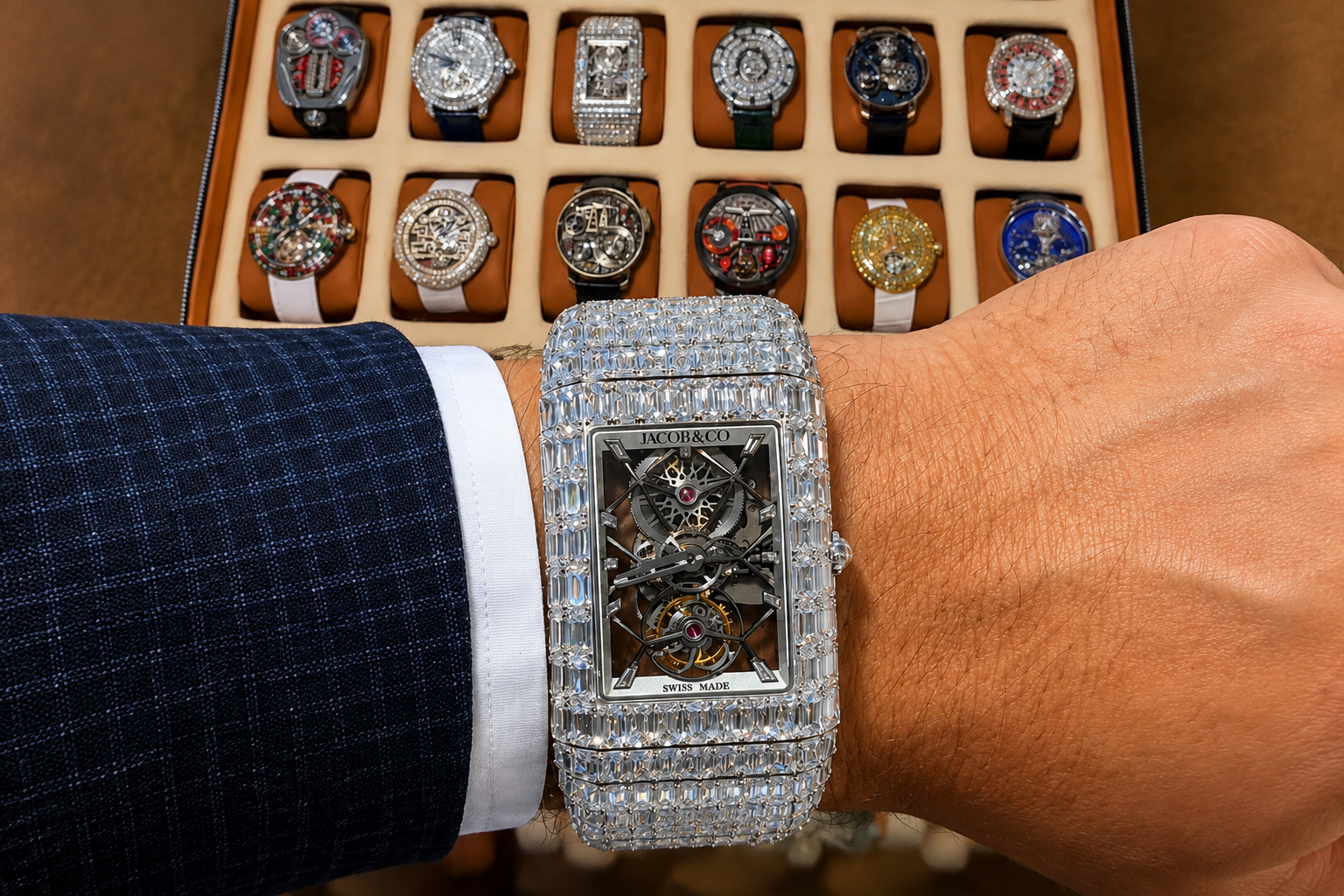
The Vault Environment
The heavy steel door clicks shut, sealing the room with a pneumatic hiss. The air inside the Jacob & Co. vault maintains a constant temperature of 68 degrees Fahrenheit. The humidity is held at exactly 45 percent. A grid of recessed LED panels casts a flat, shadowless light across the display cases. The room smells faintly of the silicone polish used on the watch winders. A technician in white cotton gloves stands to the side, holding a velvet-lined tray. The silence in the vault is absolute, broken only by the low hum of the dehumidification system. This is the physical repository for the brand’s most extreme creations. The secure vault environment ensures the delicate lubricants inside the mechanical movements remain stable. The LED lighting is specifically tuned to a 5000 Kelvin color temperature to replicate natural daylight, allowing the true color of the gemstones and the polished metals to register accurately on the human eye.
Crossing the $10 Million Threshold
The $10 million price point represents a psychological barrier in the collector car market, but in the high-end watch sector, it defines an entirely new tier of asset. A standard high-complication piece from a traditional Swiss manufacture might reach $2 million. The creations inside this vault shatter that ceiling through a combination of extreme mechanical complexity and unprecedented gemstone volume. The price tag reflects the physical reality of the manufacturing process. A single watch can require over 2,000 hours of highly specialized labor by a master watchmaker. The cost of the raw materials, the rose gold, the sapphire crystal, and the internally cut diamonds, adds a fraction of the total value. The buyer is purchasing the thousands of hours of human capital required to assemble these microscopic mechanisms. The $10 million valuation filters the potential ownership pool to a few hundred individuals globally, transforming the watch from a wearable accessory into a standalone financial asset.
The All-In Mechanical Philosophy
Jacob Arabo approaches watchmaking with a philosophy of absolute maximums. Traditional haute horology focuses on refinement, thinness, and subtle elegance. Arabo builds watches that act as mechanical stages. The $10 Million Jacob & Co. Watches refuse to compromise on scale, gemstone count, or complication density. If a tourbillon is good, a triple-axis tourbillon rotating on a four-arm platform is better. If a minute repeater is desirable, a fully integrated music box playing a cinematic theme is superior. The brand ignores the constraints of traditional wristwatch ergonomics. The cases are massive, the domed sapphire crystals are thick, and the overall weight borders on uncomfortable. This aggressive approach alienates purists who value discretion. Arabo targets a specific demographic of new-money collectors who prioritize visual impact and mechanical theatricality over centuries-old Swiss subtlety. The philosophy treats the watch dial as a canvas for engineering excess.
The Astronomia Maestro Architecture
The Astronomia Maestro serves as the foundational blueprint for the brand’s high-end offerings. A 47mm 18k rose gold case houses a massive, domed sapphire crystal that creates an interior space resembling a planetarium. Four separate arms extend from a central rotating platform. One arm holds a hand-finished magnesium globe representing the Earth. A second arm holds a cutout of the sun, crafted from orange sapphire. A third arm carries a 1-carat Jacob-cut diamond, acting as a miniature moon. The fourth arm supports a triple-axis tourbillon. The entire four-arm assembly completes a full rotation every twenty minutes. The visual complexity is staggering. The light penetrates the sapphire dome, refracting through the orange sapphire and scattering off the facets of the rotating diamond. The movement features 439 individual components. The Astronomia Maestro forces the eye to constantly track the multiple axes of rotation occurring simultaneously on the wrist.
The Astronomia Differential Gear Mechanism
The Astronomia Maestro utilizes a mechanical differential gear system to manage the massive energy required to rotate its four-arm platform. Two mainspring barrels supply power to the base movement. This energy feeds into a central differential gear. The differential splits the torque, sending one portion to the standard timekeeping gear train to keep the hours and minutes accurate, and sending the other portion to a vertical axis pivot. This pivot drives a secondary gear that rotates the entire four-arm platform, which includes the triple-axis tourbillon, the earth globe, the moon diamond, and the sun representation. The differential ensures that the heavy, continuous rotation of the platform does not drag down the timekeeping function, maintaining accurate time while the visual spectacle rotates overhead. The system requires constant lubrication to maintain the friction coefficients necessary for smooth, continuous motion. The differential gear system prevents the massive rotating weight from draining the mainspring barrels instantly.
The Bugatti Chiron Tourbillon Form
The Bugatti Chiron Tourbillon abandons traditional horological geometry to mimic the mechanical aesthetics of an automobile engine block. The 18k white gold case is shaped like the iconic Bugatti grille, angled sharply at the front and tapering toward the rear. Transparent sapphire crystal windows on the sides of the case provide a direct view into the interior. A titanium replica of the W16 engine block sits in the center of the movement. The crown is integrated into the chassis like a fuel cap. The watch rests on its front grille when placed on a table, angled upward like a car accelerating out of a corner. The lugs are hidden, flowing seamlessly into the bodywork. The Bugatti Chiron Tourbillon requires over three hundred hours of milling to achieve the complex, aerodynamic curves of the titanium case. The sheer physical mass of the white gold gives the piece a gravitational presence on the wrist.
The Bugatti Inclined Driveshaft Mechanics
The movement inside the Bugatti Chiron discards the traditional flat layout. The balance wheel and the escapement are mounted at a 30-degree angle inside a flying tourbillon cage. This inclination mimics the banking of a race car navigating a high-speed corner. A vertical shaft transfers energy from the horizontal mainspring barrel down to the inclined gear train. The shaft features a bevel gear at each end, changing the plane of rotation by exactly 30 degrees. The W16 engine block replica surrounds the functional gear train. A pusher on the right side of the case actuates a ratchet mechanism that spins the engine block replica on its axis, simulating the revving of an internal combustion engine. The inclined balance wheel requires the watchmaker to account for the effects of gravity on the escapement from multiple vectors, complicating the timing and adjustment process significantly.
The Opera Godfather Mass and Sound
The Opera Godfather lands on the velvet pad with a heavy, dense thud. The 18k rose gold case weighs over 300 grams before the strap is attached. The visual surface is dominated by a solid black onyx dial. The onyx absorbs all ambient light, creating a dark void that forces the eye to focus on the raised mechanical elements. Two rotating cylinders sit side by side under the sapphire crystal, studded with hundreds of microscopic pins. A double-axis tourbillon occupies the lower right quadrant. The dial features a subtle pinstripe engraving, referencing the tailored suits worn by the characters in the film. The rose gold bezel is mirror-polished, reflecting the overhead LEDs. The sheer mass of the gold case gives the watch a physical gravity that alters the wearer’s center of balance. The black onyx dial provides a stark, high-contrast backdrop for the mechanical choreography of the music box complication.
The Opera Godfather Vertical Clutch
Pressing the large pusher at the three o’clock position actuates a vertical clutch system within the movement. This clutch disengages the timekeeping gear train from the music box gear train, isolating the musical cylinders. A dedicated secondary mainspring barrel releases its stored energy simultaneously. As the barrel unwinds, it drives a central gear meshed with the two rotating cylinders. Tiny pins mounted on the surface of these cylinders pluck a metallic comb machined from a single block of steel. The pitch of each note depends entirely on the precise length of the corresponding tooth on the comb. The entire sequence lasts roughly thirty seconds, during which the twin barrels drain a significant percentage of their total power reserve. The gear teeth must engage with absolute precision, as any friction or misalignment would halt the rotation of the cylinders mid-melody. The vertical clutch system prevents the massive torque of the music box from disrupting the timekeeping function.
The Casino Tourbillon Gambling Aesthetic
The Casino Tourbillon translates the visual language of a high-stakes gambling table into a mechanical wristwatch. The 45mm black DLC-coated titanium case features a green lacquered dial mimicking the felt of a roulette table. The hour markers are shaped like playing cards. A fully functional roulette wheel replaces the traditional seconds hand, occupying the lower half of the dial. A tiny titanium ball sits inside the roulette wheel, spinning freely as the mechanism is activated. The tourbillon cage is designed to resemble a poker chip, featuring a red and black engraved pattern. The pusher on the side of the case activates the roulette wheel, spinning the titanium ball through the numbered slots. The Casino Tourbillon merges the thrill of gambling with the precision of haute horology. The aesthetic is loud, colorful, and deliberately tacky, leaning into the vulgar aesthetics of the casino floor rather than the restraint of traditional watchmaking.
The Casino Random Number Generator
The roulette wheel mechanism relies on a purely mechanical system to randomize the outcome. When the user presses the pusher, a mainspring releases energy to a gear train connected to the roulette wheel. The wheel spins rapidly. A separate mechanical governor, similar to the regulator in a music box, controls the deceleration of the wheel. As the wheel slows, the titanium ball falls through a series of deflectors mounted on the inner track. The path of the ball is subject to microscopic variations in friction, the exact amount of energy released by the mainspring, and the ambient temperature. These variables ensure the ball lands in a different slot every time. The mechanism cannot be rigged or predicted. The mechanical randomization process provides a genuine element of chance, transforming a passive timekeeping device into an interactive game of luck. The ball eventually settles into a numbered slot, indicating the result.
The Ghost Floating Architecture
The Ghost represents a radical departure from traditional movement construction. The caliber appears to float entirely unsupported inside the sapphire crystal case. Jacob & Co. achieved this illusion by machining the mainplate and the bridges from a single block of transparent sapphire crystal. The gears, wheels, and screws are mounted directly into the sapphire structure using microscopic titanium inserts. The hands are attached to gear posts that rise vertically through the transparent mainplate. The absence of metal bridges reveals the entire mechanical architecture of the watch from every angle. The only visible metal components are the functional gears, the screws, and the rose gold crown. The sapphire mainplate is incredibly difficult to manufacture. The material is extremely brittle. A single mistake during the milling process shatters the entire block, wasting hundreds of hours of machining time. The sapphire crystal mainplate creates an optical illusion of zero gravity, making the mechanical components appear to hover in space.
The Ghost Sapphire Machining Process
Machining a functional mainplate from solid sapphire requires specialized diamond-tipped tooling operating at extreme rotational speeds. The sapphire block is bonded to a ceramic fixture and submerged in a continuous stream of liquid coolant. The diamond drills carve out the recesses for the gear trains and the pivot holes for the balances. The tolerance for these pivot holes is measured in single-digit microns. If the hole is too tight, the friction will seize the gear wheel. If the hole is too loose, the wheel will wobble, disrupting the timekeeping accuracy. After the milling process, the sapphire mainplate undergoes a multi-stage polishing process using diamond paste. The polishing removes the microscopic scratches left by the milling tools, restoring the transparent optical properties of the crystal. The titanium inserts are then pressed into the sapphire using a hydraulic press, providing a diamond-tipped tooling anchor point for the steel screws that hold the movement together.
The Palatial Grand Complication Scale
The Palatial exists as the brand’s ultimate expression of mechanical excess. The 53mm case is crafted from 18k rose gold. The dial is a chaotic, multi-layered landscape of complications. A flying tourbillon occupies the lower left quadrant. A retrograde perpetual calendar spans the top half of the dial, displaying the day, date, and month. A minute repeater mechanism is built into the case band, activated by a slide on the left side. The gongs are visible through apertures in the case side. The sheer volume of components requires a massive case height of 22 millimeters. The rose gold is heavily engraved with a floral motif, adding hours of hand-chasing to the finishing process. The Palatial Grand Complication represents thousands of hours of assembly time. The watchmaker must coordinate the interaction of the perpetual calendar, the repeater, and the tourbillon, ensuring the complex gear trains do not interfere with each other.
The Twin Turbo Furious Dual Tourbillons
The Twin Turbo Furious features a case design that looks like a piece of military hardware. The 57mm case is machined from black DLC-coated titanium. Sharp, angular lines dominate the profile, intersecting at aggressive creases. The pushers on the side of the case look like triggers on a weapon. The dial is a complex, multi-layered construction of carbon fiber and sapphire crystal. A pair of triple-axis tourbillons sit side by side, rotating on three separate planes simultaneously. The visual chaos of the twin tourbillons contrasts with the strict, angular lines of the case. The watch features a decimal minute repeater, a rare complication that chimes the time in a different format than the standard quarter-hour repeater. The massive size of the case is a physical requirement. The twin triple-axis tourbillons require immense vertical clearance inside the case, forcing the black DLC-coated titanium shell to extend far above the wrist.
The Twin Turbo Decimal Striking Mechanism
A traditional minute repeater chimes the hours, the quarter-hours, and the remaining minutes. The Twin Turbo Furious utilizes a decimal repeater mechanism. This system chimes the hours, the ten-minute intervals, and the remaining single minutes. The mechanical advantage of this system lies in its efficiency. A decimal repeater requires fewer chimes to communicate the time. To strike 10:49, a traditional repeater requires fourteen chimes. The decimal repeater requires only six chimes. This reduction in strikes saves time and conserves the tension in the mainspring barrel. The gongs are made of hardened steel, wound into a coil inside the case middle. When the repeater slide is activated, hammers strike the gongs, producing a specific acoustic frequency. The decimal minute repeater mechanism requires a completely different rack-and-snail configuration compared to a traditional system, demanding bespoke engineering to translate the time display into ten-minute intervals.
The Ghost Baguette Rainbow Aesthetics
The Ghost Baguette Rainbow Aesthetics
The Ghost Baguette Rainbow applies an extreme level of gemstone setting to the sapphire crystal movement platform. The case, lugs, and clasp are paved with invisible-set baguette-cut diamonds in a continuous rainbow gradient. The gradient transitions seamlessly from vivid reds at the twelve o’clock position through oranges, yellows, greens, and blues, ending in deep violets at the six o’clock position. The internal bridges of the sapphire movement are also set with matching baguette-cut stones, transforming the mechanical gear train into a field of color. The gemstones completely obscure the metal structure of the watch, making the piece look like a solid block of crystallized light. The setting style leaves no visible metal between the stones. The facets of the baguette cuts align perfectly with the facets of the adjacent stones, creating a continuous surface of refracted light. The rainbow gradient requires the gem-setter to sort through thousands of stones to find the exact sequence of colors.
The Brilliant Star Diamond Optics
The Brilliant Star focuses entirely on the optical properties of a single, massive diamond. A 288-facet Jacob-cut diamond serves as the centerpiece of the dial. The diamond is mounted on a rotating arm, spinning slowly to catch the ambient light. The specific cut of the diamond was developed internally by Jacob & Co. to maximize the internal light refraction. The 288 facets create a dazzling display of spectral colors that dominate the visual field. The diamond weighs exactly 2.77 carats. The surrounding dial is paved with white diamonds to amplify the brilliance of the center stone. The case is crafted from 18k white gold to provide a neutral backdrop that does not compete with the fire of the diamond. The Jacob-cut diamond acts as a mechanical sun, rotating on its own axis while the hour and minute hands orbit around the edge of the dial.
The Caviar Tourbillon Textural Play
The Caviar Tourbillon draws inspiration from the visual texture of luxury food packaging. The 46mm case is crafted from 18k black gold, an alloy with a high percentage of palladium that creates a deep, matte grey finish. The entire surface of the case and the dial is covered in tiny, raised gold spheres. The spheres are applied individually by hand, creating a granular, caviar-like texture. A flying tourbillon sits in the lower half of the dial, spinning against the textured background. The hour markers are applied rose gold cubes, matching the spherical theme. The clasp of the strap features the same granular texture, ensuring the aesthetic continuity extends to the underside of the wrist. The black gold texture requires hundreds of hours of microscopic application. A single misplaced sphere ruins the visual rhythm of the pattern, forcing the artisan to remove and reapply the surrounding elements.
The Global 3 Time Zone Mechanics
The Global 3 Time Zone Mechanics
The Global 3 caters to the lifestyle of the ultra-high-net-worth individual who operates across multiple continents. The dial features a central display for the local time, surrounded by three smaller subdials. Each subdial displays the time in a different global city. The cities are printed on a rotating ring, allowing the wearer to change the reference time zones as they travel. The mechanical complexity lies in the isolation of the three separate time displays. Each subdial is driven by an independent gear train, allowing the wearer to set different times for each location without affecting the central timekeeping function. A series of hidden corrector pushers in the case band allow the user to advance the subdials individually. The global city ring is a physical component that must be machined to exact tolerances to align the city names with the corresponding subdial windows.
The Global 3 Jumping Hour Snap
The subdials on the Global 3 utilize a jumping hour display to conserve dial space. A standard hour hand would overlap with the minute hand in the small subdial apertures. The jumping hour mechanism relies on a star wheel with twelve teeth. A spring-loaded lever rests against the teeth of the star wheel. As the minutes elapse, the tension on the lever builds. At the exact moment the minute hand passes the sixty-minute mark, the lever releases, snapping the star wheel forward by one tooth. This snapping motion advances the hour disc in the subdial window instantly. The action produces a distinct mechanical click, providing tactile and auditory confirmation of the hour change. The jumping hour mechanism in each of the three subdials must be synchronized perfectly with the central minute hand. The jumping hour disc eliminates the need for an overlapping hand, maintaining the legibility of the three distinct time zones.
The Epic X Titanium Industrialism
The Epic X represents a shift toward a more industrial, architectural design language. The 44mm case is machined from grade 5 titanium. The design features sharp, linear bridges that extend from the center of the movement outward, integrating directly into the structure of the case lugs. The bridges are finished with a stark, matte bead-blasting that contrasts with the polished titanium edges. The dial is completely open-worked, exposing the large, squared-off balance wheel at the seven o’clock position. The design aesthetic draws inspiration from structural engineering and modern skyscraper design. There are no rounded, traditional horological shapes. Every component features sharp corners and straight lines. The oversized date window sits at the two o’clock position, displaying the date through two separate, vertically aligned apertures. The grade 5 titanium construction keeps the massive watch relatively lightweight on the wrist.
The Mystery Tourbillon Floating Illusion
The Mystery Tourbillon Floating Illusion
The Mystery Tourbillon creates an optical illusion of a tourbillon cage floating in mid-air. Two transparent sapphire crystal discs occupy the front and back of the watch. The tourbillon cage is mounted between these two discs. The discs are connected by a peripheral gear mechanism hidden inside the bezel. As the movement powers the gear train, the bezel rotates, turning the front sapphire disc. The rotation of the front disc causes the tourbillon cage to orbit around the center of the dial. The hands are mounted on the front sapphire disc, orbiting the dial as well. The hour and minute hands are painted directly onto the sapphire, appearing as floating lines of ink. The mystery tourbillon mechanism completely obscures the mechanical connection between the movement and the rotating cage, creating a pure magic trick executed in precious metals and crystal.
The Mystery Tourbillon Peripheral Drive
The mechanism driving the mystery tourbillon relies on a fixed central gear attached to the mainplate. The rear sapphire crystal disc features an internal gear ring that meshes with this fixed central gear. As the mainspring barrel turns the gear train, it drives the outer edge of the rear sapphire disc. Because the central gear is fixed, the rear sapphire disc is forced to rotate around it. The tourbillon cage is bridged between the front and rear sapphire discs. As the rear disc rotates, it drags the front disc and the tourbillon cage along with it. The hands are attached to the front disc, rotating with the hour. A separate gear train drives the minute hand through a central axis, allowing the minute hand to rotate independently of the hour hand orbit. The peripheral gear mechanism requires absolute precision in the machining of the sapphire discs to ensure the internal gear teeth mesh smoothly without binding.
The Mechanical Permanence of the Vault
The technician places the final piece back into the felt-lined slot. The LED lights dim automatically as the motion sensor detects the technician leaving the room. The heavy door locks with a solid clunk. The $10 million watches sit in the dark, their mainsprings slowly unwinding. The market will fluctuate. The tastes of the ultra-wealthy will shift toward the next mechanical novelty. The auction houses will eventually move on to the next record-breaking sale. The physical machines remain indifferent to the financial columns written about them. The gears will continue their calculated rotations. The tourbillons will keep spinning. The music boxes will stay silent until the next pusher activation. The mechanical permanence of these watches outlasts the trends that birthed them. The silence of the vault is the ultimate validation of their engineering. The sheer weight of the gold ensures they will remain exactly where they are left.
Why do $10 Million Jacob & Co. Watches cost more than traditional high complications?
The $10 million price point reflects a combination of extreme mechanical complexity, unprecedented gemstone volume, and the sheer scale of the manufacturing process. Traditional high complications from Swiss maisons focus on thinness, subtlety, and historical reference. Jacob & Co. focuses on visual maximums. The Astronomia and Opera watches contain massive, power-hungry mechanisms like rotating platforms and music boxes that require hundreds of additional components compared to a standard tourbillon. Furthermore, the brand utilizes immense volumes of internally cut diamonds and custom-shaped sapphires. The price covers the thousands of hours of labor required to machine the complex cases, set the stones, and assemble the multi-axis tourbillons. The buyer is paying for the sheer physical volume of precious materials and the extreme engineering required to make those materials move.
How does the differential gear system in the Jacob & Co. Astronomia function?
The Astronomia utilizes a differential gear system to manage the immense energy required to rotate its four-arm platform. Two mainspring barrels supply power to the base movement. This energy feeds into a central differential gear. The differential splits the torque, sending one portion to the standard timekeeping gear train to keep the hours and minutes accurate, and sending the other portion to a vertical axis pivot. This pivot drives a secondary gear that rotates the entire four-arm platform, which includes the triple-axis tourbillon, the earth globe, the moon diamond, and the sun representation. The differential ensures that the heavy, continuous rotation of the platform does not drag down the timekeeping function, maintaining accurate time while the visual spectacle rotates overhead.
What is the mechanism behind the Casino Tourbillon roulette wheel?
The roulette wheel mechanism relies on a purely mechanical system to randomize the outcome. When the user presses the pusher, a mainspring releases energy to a gear train connected to the roulette wheel. The wheel spins rapidly. A separate mechanical governor, similar to the regulator in a music box, controls the deceleration of the wheel. As the wheel slows, the titanium ball falls through a series of deflectors mounted on the inner track. The path of the ball is subject to microscopic variations in friction, the exact amount of energy released by the mainspring, and the ambient temperature. These variables ensure the ball lands in a different slot every time, providing a genuine element of chance.
How does Jacob & Co. machine a sapphire crystal mainplate for the Ghost watch?
Machining a functional mainplate from solid sapphire requires specialized diamond-tipped tooling operating at extreme rotational speeds. The sapphire block is bonded to a ceramic fixture and submerged in a continuous stream of liquid coolant. The diamond drills carve out the recesses for the gear trains and the pivot holes for the balances. The tolerance for these pivot holes is measured in single-digit microns. If the hole is too tight, the friction will seize the gear wheel. If the hole is too loose, the wheel will wobble, disrupting the timekeeping accuracy. After the milling process, the sapphire mainplate undergoes a multi-stage polishing process using diamond paste to restore transparent optical properties.
What makes the Opera Godfather music box mechanism distinct from a standard minute repeater?
A standard minute repeater chimes the hours, quarters, and minutes using hammers striking steel gongs. The Opera Godfather utilizes a fully integrated music box mechanism featuring two rotating cylinders studded with microscopic pins. These pins pluck a steel comb machined from a single block of metal, playing a specific melody rather than a simple time code. The mechanism features a dedicated secondary mainspring barrel to power the thirty-second musical sequence. A vertical clutch disengages the timekeeping gear train during the musical performance to prevent the massive torque of the music box from disrupting the accuracy of the watch. The complexity of mapping a musical composition to a mechanical pin matrix far exceeds the engineering required for a standard repeater.