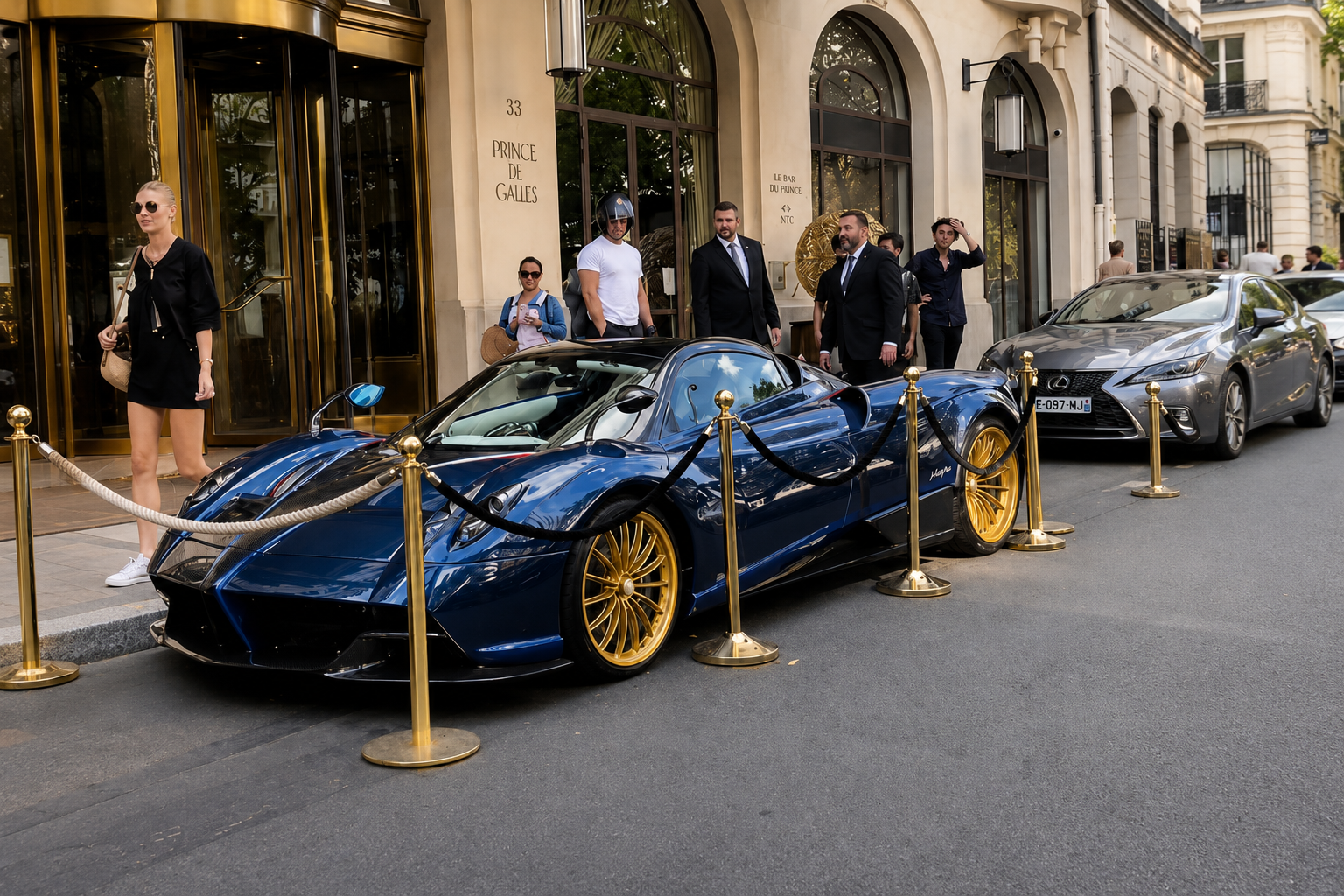
Paris has seen plenty of supercars, but few stop people quite like a Pagani. When a Pagani Huayra Roadster was spotted on the streets of the French capital, the photos and videos spread rapidly through car-spotting communities online. With its low nose, open cockpit and intricate carbon bodywork reflecting the city’s stone façades, it looked less like a car and more like a piece of sculpture that had wandered out of a museum.
What We Know About the Sighting
Cars this rare are almost never seen on public roads, and owners usually prefer to stay private, so details about who was driving or why are not public. What can be said is that Huayra Roadsters are among the rarest modern hypercars in existence, and any appearance in a city setting is a genuine event for enthusiasts.
It is also worth being precise about which Huayra it might be. Pagani built the standard Huayra Roadster in a run of 100 cars, while the more extreme Huayra Roadster BC was limited to just 40. Headlines describing the car as “one of 40” point to the BC version; spotters often look for its larger rear wing and more aggressive aerodynamics to tell the two apart.
Why Rarity Changes Everything
Forty, or even 100, cars is a tiny global population. Spread across collectors in dozens of countries, many of them kept in climate-controlled garages or used only on special occasions, the chance of seeing one in traffic is extremely small. That is why each sighting becomes news among enthusiasts.
How the Huayra Roadster Works
Horacio Pagani’s company, based in San Cesario sul Panaro near Modena, Italy, is famous for its obsessive attention to materials. The Huayra Roadster’s chassis is built from carbon-titanium and carbo-triax, advanced composites that combine extreme stiffness with low weight. Remarkably, the Roadster was lighter than the Huayra coupé despite losing its fixed roof, with a dry weight of around 1,280 kg.
Active aerodynamic flaps at the front and rear adjust automatically to improve stability and grip at speed, a signature feature of the Huayra family.
The AMG V12 at Its Heart
Power comes from a 6.0-litre twin-turbocharged V12 developed exclusively for Pagani by Mercedes-AMG. In the standard Roadster it produces around 764 hp and 1,000 Nm of torque, while the Roadster BC pushes output to around 800 hp.
The engine’s character is a big part of the appeal: immense, turbocharged torque combined with a dramatic soundtrack, delivered through a seven-speed automated manual gearbox.
Driving a Hypercar Through Paris
Paris is not built for hypercars. Narrow streets, cobblestones, speed bumps, tight parking and heavy traffic all present challenges for a low, wide car worth several million dollars. Every manoeuvre draws attention, and a single scrape could be extraordinarily expensive to repair.
That makes the decision to drive one through the city all the more striking. Many owners would simply never risk it.
Paris as a Stage
For all its practical challenges, Paris makes a spectacular backdrop. The contrast between centuries-old architecture and a modern carbon-fibre hypercar is visually irresistible, which is exactly why the photos travelled so far online. The city is also home to a significant number of wealthy collectors and regularly hosts visiting supercars during the summer.
What You Notice Up Close
Photographs rarely capture Pagani’s level of detail. Up close, the exposed carbon weave is perfectly aligned across panels, and even the bolts are bespoke, many engraved with the Pagani logo. The interior combines leather, aluminium and carbon in a style that feels closer to high-end watchmaking than conventional car design.
The Roadster’s Relationship With the City
Removing the roof changes how the car interacts with its surroundings. The driver is visible, the sound of the V12 fills the street, and passers-by feel part of the experience. A roadster invites attention in a way a closed coupé does not.
Why Pagani Numbers Matter
Pagani builds only a few dozen cars a year. Each one is effectively hand-made, and many are personalised to their owner’s taste, so no two are exactly alike. Low production keeps demand high and helps Paganis hold their value better than most cars.
The Collector Market
The Huayra Roadster originally cost around €2.3 million before taxes. Today, values on the secondary market are typically well above that, with the BC versions commanding even more. Condition, specification, mileage and documentation all affect price.
Does Driving Help or Hurt Value?
Collectors debate whether rare cars should be driven. Very low mileage tends to support higher prices, but cars that are never used can develop mechanical issues. Many owners strike a balance, enjoying occasional drives while maintaining the car meticulously.
How Hypercars Move Between Cities
Most owners ship their cars in enclosed transporters rather than driving them long distances. Specialist logistics companies handle transport, insurance and security, delivering cars to events, residences or service centres around Europe.
Privacy and Viral Sightings
Every viral sighting raises privacy questions. Number plates, locations and faces can reveal more than owners might like. Responsible car-spotters often blur personal details, focusing on the car rather than the person behind the wheel.
Why It Still Stands Out
Newer hypercars, including Pagani’s own Utopia, have since arrived. Yet the Huayra Roadster remains distinctive thanks to its flowing design, craftsmanship and rarity. It represents a high point in Pagani’s history.
What Remains After the Car Leaves
Moments like this are brief. The Huayra Roadster passes, the crowd disperses and the street returns to normal. But for those who saw it, and the many more who watched online, it was a rare glimpse of automotive art in motion.
FAQ
How rare is the Pagani Huayra Roadster?
Very. Pagani built 100 standard Huayra Roadsters and just 40 examples of the more powerful Huayra Roadster BC.
What engine does it use?
A 6.0-litre twin-turbocharged V12 built by Mercedes-AMG, producing around 764 hp in the Roadster and about 800 hp in the Roadster BC.
Why is a sighting in Paris significant?
With so few cars built and most kept in private collections, seeing one driven on city streets is extremely rare.
How much is a Huayra Roadster worth?
It originally cost around €2.3 million before taxes, and today it typically trades for considerably more, depending on version and condition.
Who builds Paganis?
Pagani Automobili, founded by Horacio Pagani and based near Modena, Italy.