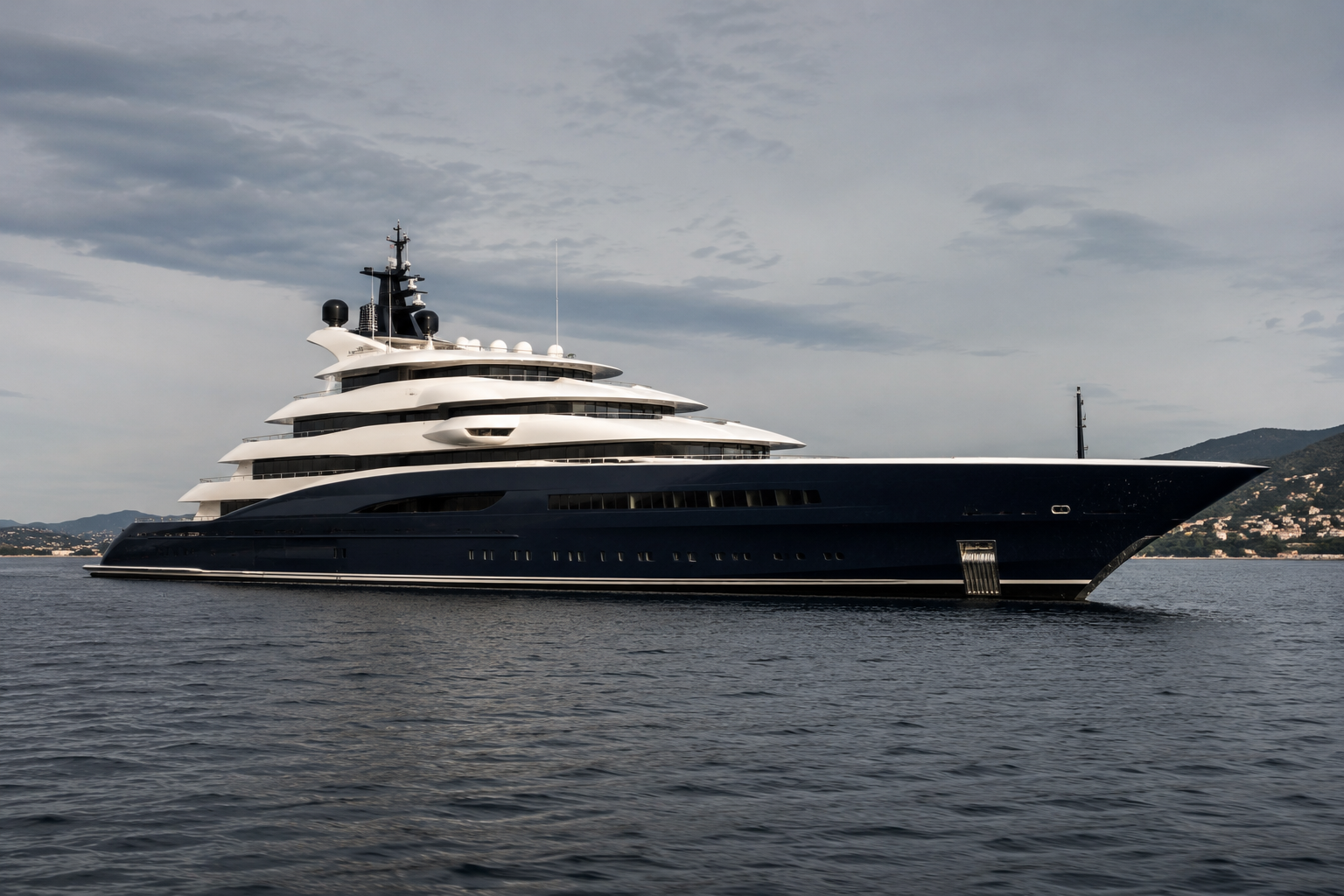
The hull appeared briefly through morning fog along the Bremen shipyard before disappearing again behind security barriers and temporary construction walls. Crew vehicles moved quietly between hangars while drone restrictions extended across the surrounding airspace. Even among elite yacht projects, the atmosphere surrounding the Lurssen 88m Thunderball superyacht felt unusually controlled. No public launch spectacle. No aggressive teaser campaign. Just fragments, dimensions whispered between brokers, shadowed renderings, and occasional sightings of a steel-grey silhouette emerging deeper into construction. That secrecy has only intensified fascination around the vessel itself. At approximately 88 meters, Project Thunderball occupies a category where superyachts stop functioning purely as luxury assets and begin resembling mobile sovereign environments engineered around privacy, autonomy, and architectural ambition. For serious yachting circles, the project represents more than another large build. It reflects how modern ultra-wealthy owners increasingly prioritize invisibility, technological sophistication, and operational independence over visible extravagance.
Why Lürssen Remains the Benchmark for Mega Yacht Construction
Lürssen occupies a rare position within yacht building because the company consistently delivers vessels operating at the absolute edge of scale, engineering complexity, and discretion. The shipyard has built some of the most technically advanced private yachts ever launched, often for owners demanding total confidentiality throughout construction. The fascination surrounding the Lurssen 88m Thunderball superyacht begins partly with the reputation of the yard itself. Lürssen projects tend to combine naval-grade engineering with hospitality standards approaching private resorts. German yacht engineering, custom superyacht construction, and ultra-private shipbuilding define a culture where operational capability matters just as much as visual impact.
The Exterior Design and Why Silence Became the New Status Symbol
Project Thunderball reportedly embraces a restrained exterior profile compared with more aggressive contemporary yacht designs. Long horizontal lines, reduced visual clutter, and carefully integrated deck structures create an atmosphere of controlled authority rather than theatrical display. This matters because many ultra-high-net-worth owners now prefer discretion over visibility. The mechanism behind modern yacht design increasingly revolves around reducing radar signatures, minimizing visual exposure, and integrating hidden technical systems directly into the architecture. Within discussions surrounding the Lurssen 88m Thunderball superyacht, minimalist yacht exteriors, stealth-inspired marine design, and privacy-focused architecture reveal how luxury itself is evolving inside the top tier of yachting.
Engineering the Hull for Stability, Silence, and Range
88 meters, hull engineering becomes extraordinarily complex because the yacht must balance comfort, efficiency, and structural durability across multiple ocean conditions. Stabilization systems likely combine advanced fin technologies with dynamic positioning capabilities designed to reduce movement both underway and at anchor. Acoustic isolation also becomes critical. Owners at this level expect near-total silence within guest spaces regardless of engine load or sea conditions. This matters because achieving this calm requires floating floors, vibration-dampening mount systems, and carefully isolated machinery compartments hidden deep inside the vessel. The Lurssen 88m Thunderball superyacht therefore represents not just visual design, but a highly engineered sensory environment built around stillness at sea.
Interior Speculation and the Rise of Floating Residential Architecture
Although official interior imagery remains tightly controlled, vessels in this category increasingly resemble private residences rather than traditional yachts. Double-height salons, wellness decks, spa facilities, private cinemas, and full-beam owner suites now operate as standard expectations among billionaire-level clients. Materials have also shifted noticeably in recent years. Instead of overtly glossy interiors, many elite projects now favor matte woods, textured stone, brushed metals, and indirect lighting systems inspired by contemporary architecture. In conversations surrounding the Lurssen 88m Thunderball superyacht, floating penthouse interiors, wellness-focused yacht design, and bespoke marine architecture reveal how luxury onboard has become quieter, more tactile, and psychologically calmer.
The Hidden Technology Behind Modern Superyachts
The most sophisticated systems onboard modern mega yachts are rarely visible to guests. Satellite communications, cybersecurity infrastructure, climate stabilization, water purification systems, and power redundancy networks operate continuously behind walls and beneath deck structures. Some vessels now function almost like private floating compounds capable of maintaining operational independence for extended periods. The mechanism behind this autonomy involves layered engineering redundancy similar to what exists in aviation and naval operations. Within the ecosystem of the Lurssen 88m Thunderball superyacht, marine cybersecurity, self-sustaining yacht systems, and advanced naval infrastructure reveal how these vessels increasingly blur the line between luxury hospitality and strategic engineering.
Security, Privacy, and the Billionaire Demand for Invisibility
Security at this level extends far beyond guards and surveillance cameras. Modern yachts increasingly integrate encrypted communications, anti-drone technology, compartmentalized access systems, and highly controlled crew protocols. Owners want environments where business conversations, family life, and travel patterns remain invisible to the outside world. The Lurssen 88m Thunderball superyacht reflects this broader shift toward operational privacy. Private maritime security, anti-surveillance yacht systems, and secure luxury travel now shape design decisions just as heavily as aesthetics or entertainment spaces.
Crew Infrastructure and the Operational Reality of an 88m Yacht
Running a yacht of this scale requires an organizational structure resembling a luxury hotel combined with a maritime operations center. Captains, engineers, chefs, wellness specialists, aviation personnel, and hospitality teams work within tightly coordinated systems operating around the clock. Crew circulation routes, service elevators, provisioning systems, and technical workspaces are designed to remain largely invisible to guests. This becomes especially important here because true luxury onboard depends on operational invisibility. The Lurssen 88m Thunderball superyacht likely includes infrastructure capable of supporting dozens of crew while maintaining complete separation between guest experience and logistical complexity.
The Economics of Building a Yacht This Secretive
Extreme confidentiality significantly increases project complexity and cost. Restricted shipyard access, confidential supply chains, custom engineering, and discreet subcontracting structures all require additional operational layers. Certain materials and technologies may even be sourced through specialized channels unavailable to ordinary marine projects. Within the broader world of the Lurssen 88m Thunderball superyacht, custom yacht economics, private build contracts, and high-security marine construction explain why projects of this magnitude often remain partially hidden even after launch.
Why Secretive Yacht Projects Fascinate the Luxury World
Part of the fascination surrounding Project Thunderball comes from absence itself. The less information released publicly, the more intensely elite circles speculate about ownership, engineering, and onboard features. This dynamic reflects a broader cultural shift happening within extreme wealth. Visibility no longer functions as the ultimate luxury signal. Privacy does. The strongest ultra-high-net-worth assets increasingly operate quietly, away from public performance and social visibility. The deeper implication surrounding the Lurssen 88m Thunderball superyacht is that the future of luxury may belong to experiences and environments intentionally designed to remain partially unseen.
FAQ
What is Project Thunderball?
Project Thunderball is a highly secretive 88-meter superyacht reportedly under construction by Lürssen, one of the world’s most respected mega yacht builders.
Why is the Lürssen Thunderball yacht considered secretive?
Very limited official information, restricted shipyard access, and minimal public imagery have made the project one of the most closely guarded yacht builds in recent years.
How large is the Lürssen 88m Thunderball superyacht?
The yacht measures approximately 88 meters, placing it within the elite mega yacht category designed for ultra-high-net-worth ownership.
What features are expected onboard Project Thunderball?
Although details remain private, yachts in this category often include wellness areas, cinemas, beach clubs, helipads, private suites, and advanced security systems.
Why do billionaires prefer secretive yacht projects?
Privacy, operational security, and exclusivity increasingly matter more than public visibility among many ultra-high-net-worth yacht owners.