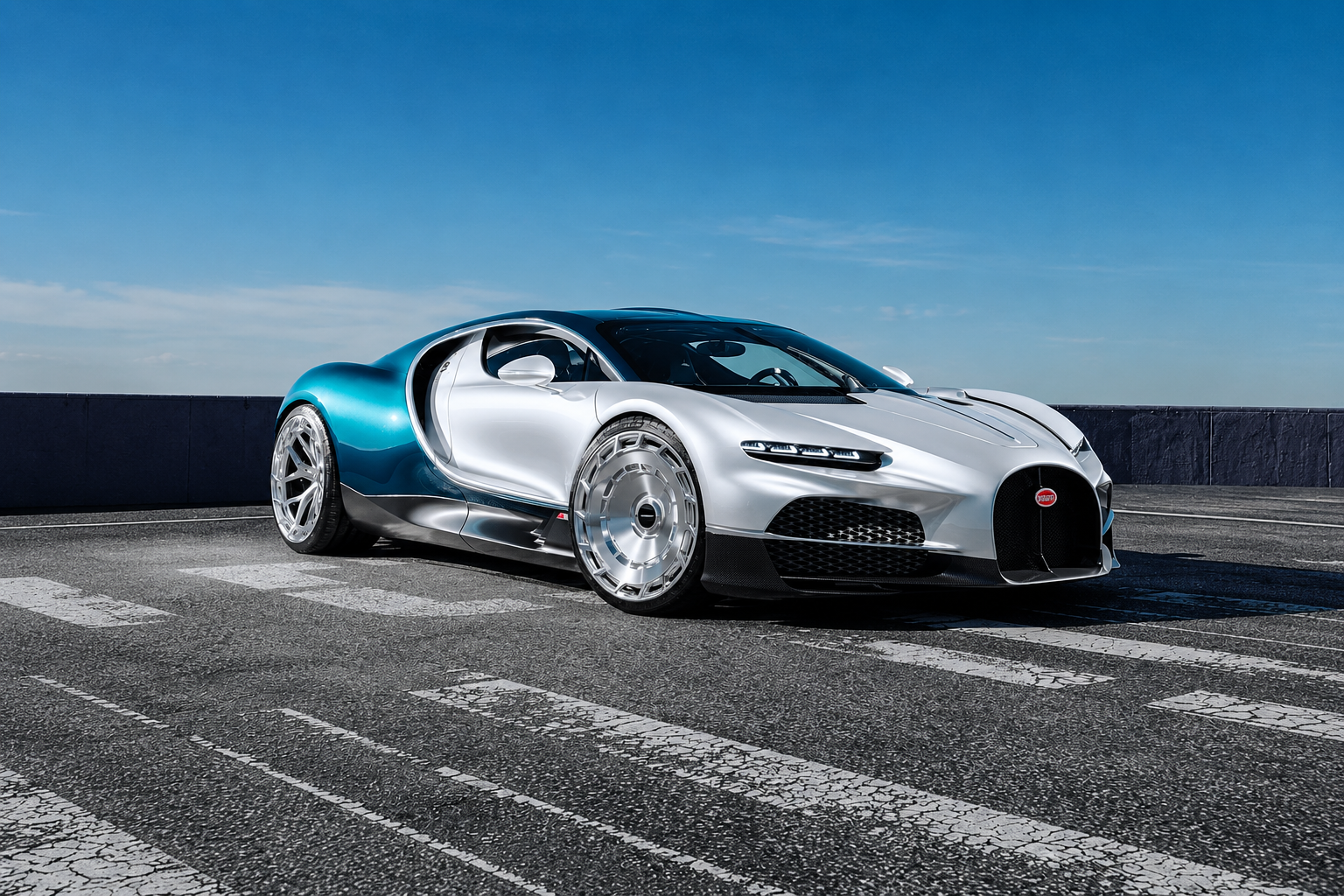
The first impression arrives before the car moves. In the stillness around it, every surface appears under tension, as if the body has been pulled tightly over something mechanical and unusually precise. The analog gauges in the cabin float on crystal and titanium. Behind the seats, sixteen cylinders line up like the movement of an oversized watch. Even before the performance figures enter the conversation, the Bugatti Tourbillon specs price 2026 story begins with an unusual decision: to build a new flagship around permanence rather than trend.
Bugatti Tourbillon
$4.5 million before personalization, and with production capped at 250 cars worldwide, the Tourbillon replaces the W16 era with a naturally aspirated 8.3-liter V16 hybrid powertrain producing 1,800 horsepower.
The Tourbillon was engineered like a mechanical object meant to outlast the software age.
This is not a successor in the usual sense. It is a reset.
The Name Borrowed from Horology
The word tourbillon comes from high watchmaking.
In mechanical timepieces, a tourbillon rotates the escapement and balance wheel to counter the effects of gravity on accuracy. It is a solution developed not for convenience, but for precision and intellectual satisfaction. It exists because engineers and artisans decided that perfecting a mechanism was worth extraordinary effort.
Tourbillon complication
Bugatti chose the name because the car follows the same philosophy.
Mechanism Reveal: Why the Name Matters
A tourbillon in a watch does not simplify the movement. It adds complexity to achieve a more stable result. The Bugatti Tourbillon applies that logic at full scale.
Rather than carry forward the existing W16 architecture and layer in electric assistance, Bugatti and its engineering partners designed an entirely new combustion engine, new battery system, new carbon composite chassis, and new user interface. Each subsystem was reconsidered from first principles.
The result is a car that uses advanced electronics while presenting itself as a fundamentally mechanical object.
Bugatti Tourbillon Specs Price 2026 at a Glance
For owners evaluating where the Tourbillon sits in the current hypercar landscape, the raw numbers provide the starting point.
| Specification | Bugatti Tourbillon |
| Base Price | $4.5 million |
| Production | 250 units |
| Engine | 8.3-liter naturally aspirated V16 |
| Electric Motors | 3 |
| Combined Output | 1,800 hp |
| Combustion Output | 1,000 hp |
| Electric Output | 800 hp |
| Battery Capacity | 25 kWh |
| Electric Range | Approximately 60 km (37 miles) |
| Transmission | 8-speed dual-clutch |
| Drivetrain | All-wheel drive |
| Top Speed | Electronically limited beyond 275 mph, key-enabled higher mode |
| 0-100 km/h | About 2.0 seconds |
| 0-200 km/h | Under 5.0 seconds |
| 0-300 km/h | Under 10.0 seconds |
| Delivery Start | Expected in 2026 |
Bugatti production numbers
The significance of these figures lies less in scale than in composition. Bugatti chose a large, naturally aspirated engine at a moment when many manufacturers moved toward smaller turbocharged systems.
The 8.3-Liter Naturally Aspirated V16
Open the rear glass and the engine dominates the visual field.
This is not an updated W16. It is a completely new 90-degree V16, developed to produce 1,000 horsepower at high engine speed without turbochargers.
Naturally aspirated V16 engine
The proportions are striking. The engine is long, narrow, and architectural. Its intake system sits like a structural element rather than an accessory.
The absence of turbochargers changes the character of the entire car, not only its soundtrack.
Mechanism Reveal: Why Bugatti Removed the Turbochargers
Turbochargers compress intake air to increase power, but they also add heat, plumbing, and rotational inertia.
By eliminating them, Bugatti reduced thermal complexity and sharpened throttle response. Every movement of the accelerator pedal alters airflow directly through the engine rather than through boosted pressure controlled by turbines.
The engine can respond with the immediacy associated with racing engines and large displacement grand touring units.
The decision also shifts where the drama occurs. Power builds with engine speed, accompanied by an acoustic character that changes from mechanical hum to sustained metallic crescendo.
Dimensions and Character
8.3 liters, the displacement itself communicates intent.
Modern engineering often pursues efficiency through reduction. Bugatti pursued emotional and mechanical clarity through scale. Sixteen cylinders fire in rapid sequence, each contributing a smaller portion of the total load, which helps create exceptional smoothness.
The engine is not oversized for effect. It was chosen because no other layout could deliver the combination of output, response, and theatricality Bugatti wanted.
The Hybrid System That Adds 800 Horsepower
Electric propulsion in the Tourbillon is not decorative.
Three electric motors contribute 800 horsepower. Two are mounted at the front axle, and one is integrated at the rear.
Tri-motor hybrid system
Together, they transform the car at low speed and fill the power band before the V16 reaches peak intensity.
Mechanism Reveal: Torque Vectoring at the Front Axle
Each front motor can control torque independently.
If the car enters a corner and the outside front wheel can accept more load, the control system directs greater torque to that wheel. This helps rotate the car into the bend while maintaining stability.
Instead of using braking to correct attitude after the fact, the Tourbillon adjusts propulsion proactively.
The sensation is subtle. The car turns with less apparent mass than its dimensions suggest.
Battery Packaging
The 25 kWh battery is integrated into the chassis structure.
This placement lowers the center of gravity and improves torsional rigidity. Rather than treating the battery as cargo, Bugatti uses it as a structural element.
That approach mirrors aerospace and motorsport practice, where every component is expected to serve multiple purposes.
1,800 Horsepower and the Shape of Acceleration
The headline figure is 1,800 horsepower, but the more relevant fact is how that power is delivered.
Electric motors provide immediate torque. The V16 builds output with increasing revs. The overlap produces a nearly continuous surge rather than distinct phases.
1,800 horsepower hypercars
Mechanism Reveal: Layered Power Delivery
At low speed, electric motors shoulder much of the initial load.
As speed rises, the V16 contributes increasing power, eventually becoming the dominant force. Because the electric motors remain active, there is no perceptible handoff.
The powertrain behaves like a single expanding source of energy.
Performance Figures
Bugatti’s published estimates place the Tourbillon among the fastest production cars ever conceived.
The car is expected to reach:
- 100 km/h in roughly 2.0 seconds
- 200 km/h in under 5.0 seconds
- 300 km/h in under 10.0 seconds
- 400 km/h in well under 30 seconds under ideal conditions
Numbers of this scale are easy to recite and difficult to contextualize.
The more meaningful detail is repeatability. Thermal management, electrical discharge rates, and gearbox durability must sustain these outputs consistently, not once for a demonstration.
The Carbon Composite Chassis
Under the bodywork sits a new carbon composite structure designed around both the V16 and the battery pack.
The chassis acts as the car’s central skeleton. It must resist twisting forces from suspension loads, acceleration, and aerodynamic pressure.
Mechanism Reveal: Why Rigidity Matters
When a chassis flexes, suspension geometry changes in unpredictable ways.
By keeping the tub extremely stiff, engineers ensure that spring and damper movements occur as intended. Steering inputs become more precise because the underlying structure does not absorb the driver’s commands.
This is one of the least visible aspects of performance and one of the most important.
The fastest cars feel coherent because their structures refuse to negotiate with force.
Lightweight Materials
Bugatti combines carbon composites with aluminum and titanium where appropriate.
Titanium appears in both visible and hidden areas, reducing mass while providing corrosion resistance and structural strength.
The material choices are driven by function first, then aesthetics.
Suspension Designed for Two Contradictory Roles
A Bugatti must cover continents and sustain circuit-level loads.
The Tourbillon’s suspension architecture addresses both expectations.
Mechanism Reveal: Pushrod Suspension Layout
The car uses an advanced suspension arrangement that relocates springs and dampers inward.
By moving these components away from the wheel wells, engineers reduce unsprung mass and improve airflow. The wheels can react more quickly to surface changes because less weight moves directly with them.
The same concept appears in top-level motorsport.
Ride Quality at Hypercar Speeds
Moderate road speeds, the Tourbillon is engineered to remain composed rather than theatrical.
The real challenge is preserving body control at velocities where aerodynamic loads increase dramatically. As speed climbs, the suspension works with active aero systems to keep the platform level and predictable.
Aerodynamics Without Visual Noise
The Tourbillon carries less visual clutter than many modern hypercars.
Its aerodynamic surfaces are integrated into the body rather than appended as separate elements.
Active aerodynamics Rolls-Royce Reveals Its Most Artistic Electric Vehicle to Date, Priced at $5 Million
Mechanism Reveal: Managing Air Pressure
Aerodynamics is the controlled creation of pressure differences.
When air travels faster beneath specific surfaces, pressure drops, pulling the car toward the road. Adjustable elements fine-tune this balance, increasing downforce or reducing drag depending on the driving mode.
The car’s shape performs multiple jobs simultaneously: cooling radiators, stabilizing the chassis, and minimizing resistance.
Speed Key Philosophy
Bugatti retains the concept of a dedicated high-speed mode.
In this configuration, ride height, aero settings, and electronic parameters adjust for maximum velocity. The physical act of using a key underscores that extreme speed remains a deliberate choice rather than a menu setting.
Mechanical rituals matter because they make extraordinary capability feel intentional.

The Cabin and the Rejection of Disposable Interfaces
Inside, the Tourbillon makes a philosophical argument.
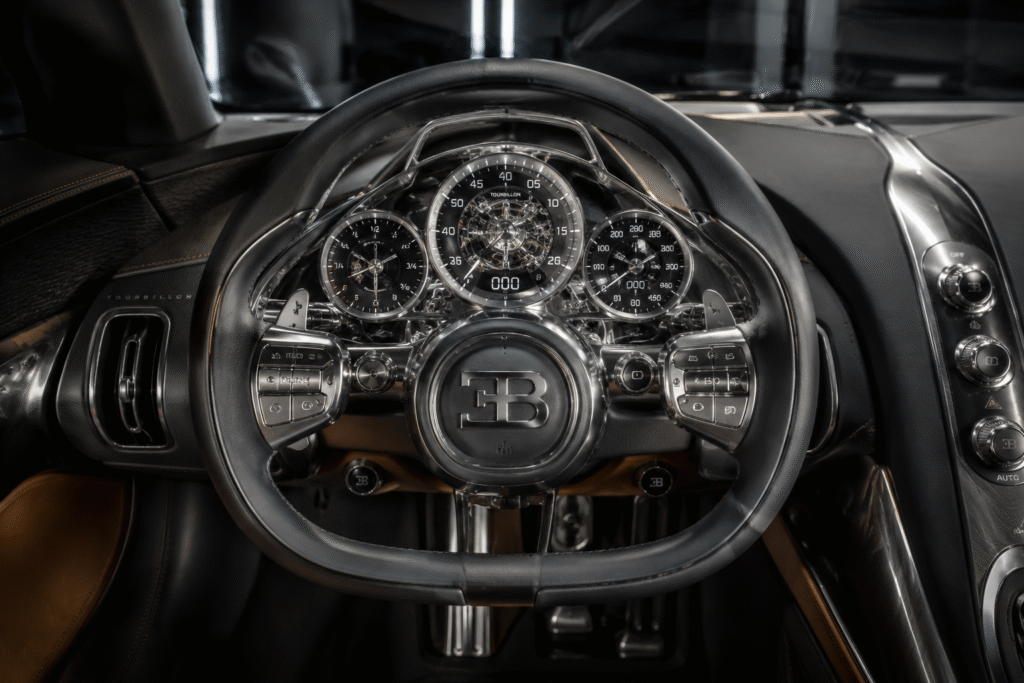
The fixed analog instrument cluster is constructed with watchmaker-level components, including titanium and sapphire crystal. The steering wheel rotates around it, allowing the gauges to remain visually stable.
Analog instrument cluster
Mechanism Reveal: Fixed Hub Architecture
In a conventional car, gauges move with the steering wheel.
Bugatti mounts the instrument assembly to the steering column structure so it remains stationary. The wheel rim and controls rotate independently around the cluster.
This arrangement preserves visibility and turns the instruments into a central object rather than a screen-based accessory.
Hidden Digital Layer
A digital display can deploy when navigation or media functions are required.
When not in use, it retracts to preserve the visual purity of the cabin.
The concept is straightforward. Technology should appear when useful and disappear when unnecessary.
Materials Chosen for Longevity
The Tourbillon’s interior avoids decorative excess.
Machined metal, leather, crystal, and carbon fiber dominate the environment. The tactile quality is deliberate. Surfaces are meant to age, not date.
Mechanism Reveal: Why Mechanical Interfaces Endure
A milled aluminum switch retains relevance because its function and feel do not depend on software support.
Touchscreens rely on operating systems, processors, and display standards that become obsolete. Mechanical controls continue to work as long as their materials and tolerances remain intact.
The Tourbillon treats this distinction as central rather than nostalgic.
Price, Options, and the Economics of Scarcity
The Bugatti Tourbillon price begins at approximately $4.5 million before taxes, duties, and bespoke commissions.
Few cars remain at their base specification.
Owners typically commission custom paint formulations, interior materials, engraved components, and individualized finishes. Final transaction values can rise substantially.
Mechanism Reveal: Why Limited Production Supports Engineering Freedom
Mass-market products must amortize development costs across large volumes.
A 250-unit production run allows Bugatti to prioritize technical ambition over manufacturing efficiency. Components can be designed for excellence rather than optimized solely for cost reduction.
This business model resembles haute horlogerie and coachbuilding more than conventional automotive production.
Expected Ownership Costs
Insurance, climate-controlled storage, transportation, and specialist maintenance become part of the ownership equation.
For most clients, these expenses are secondary to access and allocation.
The larger financial story concerns asset behavior. Historically, Bugatti halo models have maintained exceptional market attention because supply remains fixed and engineering significance remains evident.
Tourbillon vs Chiron: A Different Interpretation of Speed
The Tourbillon succeeds the Bugatti Chiron, but the two cars embody different engineering priorities.
| Attribute | Bugatti Chiron | Bugatti Tourbillon |
| Engine | 8.0-liter quad-turbo W16 | 8.3-liter naturally aspirated V16 |
| Hybrid Assistance | None | Three electric motors |
| Total Output | 1,500 to 1,600 hp depending on variant | 1,800 hp |
| Instrumentation | Digital and analog mix | Mechanical analog cluster with hidden screen |
| Production Philosophy | Evolution of Veyron concept | Clean-sheet architecture |
| Electric Range | None | Approximately 60 km |
| Deliveries | Completed | Expected from 2026 |
The Chiron represented the apex of turbocharged W16 engineering.
The Tourbillon shifts the focus toward immediacy, mechanical expression, and long-term relevance.
Tourbillon vs the Modern Hypercar Field
The Tourbillon enters a rarefied group that includes hybrid and naturally aspirated flagships from a small number of manufacturers.
Some competitors pursue lightweight minimalism. Others emphasize electric torque and active aerodynamics.
Bugatti’s differentiator is conceptual consistency.
The engine, interface, and materials all support the same thesis: technology should enhance mechanical permanence rather than obscure it.
Coachbuilding at Industrial Scale
Every Bugatti is assembled with a degree of manual oversight uncommon in the broader automotive sector.
Panel alignment, paint depth, leather stitching, and hardware finishing receive scrutiny more typical of bespoke objects.
Mechanism Reveal: Multi-Layer Paint Application
Complex exposed-carbon finishes often require numerous coats of tinted clear and polish cycles.
Each layer adds visual depth while preserving the weave pattern beneath. Variations measured in fractions of a millimeter alter the final optical effect.
Paint becomes part of the engineering presentation.
The Ownership Experience Begins Before Delivery
Allocation itself is selective.
Returning clients and collectors with established relationships often receive priority. Specification sessions involve material libraries, color samples, and technical consultations.
Mechanism Reveal: Digital Modeling of Bespoke Configurations
Before production begins, clients review highly detailed renderings and material references.
Engineers confirm that custom finishes meet thermal, durability, and manufacturing requirements. Personalization remains extensive, but every decision must coexist with the car’s functional demands.
This process can extend over months.
Why 2026 Matters
The expected delivery timeline places the Tourbillon at a pivotal point.
By 2026, regulatory pressure, electrification mandates, and software-defined vehicles will shape much of the automotive industry. The Tourbillon responds by preserving an engine architecture that many assumed would disappear.
Future of naturally aspirated engines
The car is not a retreat from technological change. It is a selective acceptance of it.
Electric propulsion is embraced where it improves response and usability. Mechanical craft is preserved where it contributes emotional and practical longevity.
The Sound of Sixteen Cylinders
No specification sheet can adequately describe the acoustic identity of a naturally aspirated V16.
At idle, combustion pulses merge into a low, densely textured rhythm. As revs rise, the sound acquires clarity and then intensity, each cylinder adding to a continuous metallic wave.
Mechanism Reveal: Why Cylinder Count Changes Sound
Exhaust sound is the cumulative result of firing frequency, manifold design, and engine speed.
With sixteen cylinders, individual combustion events occur in rapid succession. The intervals between pulses shorten, creating an unusually smooth and layered tone.
The auditory experience becomes less percussive and more orchestral.
Sixteen cylinders do not merely increase power, they alter the texture of time.
Designing for a Fifty-Year Horizon
Most high-technology products reveal their age quickly.
Displays dim. Interfaces become unsupported. Software aesthetics turn dated.
The Tourbillon was designed to resist this cycle.
Mechanical Time vs Digital Time
A mechanical watch from the mid-twentieth century can remain desirable because its relevance does not depend on external ecosystems.
Bugatti applies the same principle to the cabin. The most important information is delivered through physical instruments made from enduring materials.
The car will age mechanically, not electronically.
What Owners Are Really Buying
At this level, the transaction extends beyond performance.
Owners are acquiring engineering authorship, restricted production, and a distinct point of view about how advanced machines should be built.
The Tourbillon offers modern electrification without surrendering the tactile and acoustic qualities that made internal combustion emotionally significant.
Mechanism Reveal: Scarcity and Cultural Weight
Objects gain stature when three conditions converge: technical originality, limited availability, and recognizability.
The Tourbillon satisfies all three.
Its V16 hybrid architecture is unique. Production is fixed at 250 units. Its design and name create immediate identity.
These attributes support both collectability and historical importance.
The Future Seen Through a Mechanical Lens
The Tourbillon does not reject software.
It refuses to let software become the primary character of the object.
That distinction is increasingly rare.
In many modern vehicles, digital systems define the ownership experience. In the Tourbillon, electronics operate as supporting infrastructure. The central experience remains mechanical, visual, and physical.
The analog gauges, exposed engine architecture, and deliberate rituals all suggest a different understanding of progress.
Progress can involve choosing what not to replace.
Engineering the Transmission and Driveline
The Tourbillon uses an 8-speed dual-clutch transmission mounted as part of the rear transaxle.
Dual-clutch gearboxes are often discussed in terms of shift speed, but in a car of this caliber their greater value lies in continuity. One clutch preselects the next ratio while the other delivers torque. During an upshift, one clutch opens as the other closes. The interruption in power is measured in milliseconds.
Mechanism Reveal: Why Seamless Shifts Matter at 300 km/h
At ordinary road speeds, a brief pause between gears feels inconsequential. At 300 km/h, the car is covering more than 80 meters every second.
A long interruption in torque unsettles weight distribution and extends acceleration time. By maintaining near-continuous thrust, the Tourbillon preserves stability and keeps the hybrid system synchronized with the engine’s rising output.
The transmission casing is designed to withstand forces that would overwhelm most competition gearboxes. It must digest sixteen-cylinder torque, electric motor intervention, and repeated full-throttle launches while remaining civil in urban traffic.
All-Wheel Drive With Intentional Character
The front electric motors and rear combustion drivetrain create an all-wheel-drive system with unusual flexibility.
At lower speeds, the front axle can contribute a larger percentage of total torque. As aerodynamic load increases and the V16 enters its most intense operating range, the rear axle assumes a more dominant role.
This gives the car two personalities.
In town, it feels composed and nearly effortless. On an open road, the rear axle becomes the emotional center, pushing the car with the mechanical authority expected of a Bugatti.
The most advanced drivetrains disappear from conscious thought, leaving only the sense that the car is always in the correct gear.
Cooling a 1,800 Horsepower Powertrain
Extreme performance begins with thermal management.
Combustion engines convert only a portion of fuel into motion. The remainder becomes heat. Batteries and electric motors add their own thermal demands. If temperatures rise beyond narrow thresholds, output must be reduced.
The Tourbillon’s body is therefore a cooling device as much as a sculpture.
Mechanism Reveal: Air as a Working Fluid
The front apertures channel air through radiators, condensers, and heat exchangers. Ducting directs high-pressure air to the exact components that need it, then evacuates the warmed air with minimal turbulence.
This process sounds simple. It is not.
Every duct competes with aerodynamic efficiency, pedestrian impact regulations, and design purity. The most elegant solution is often invisible.
Battery and Motor Temperature Control
The battery operates within a preferred temperature window for both performance and longevity.
Liquid cooling circuits move heat away from the cells during aggressive driving and can warm the pack when conditions are cold. This allows the car to deliver consistent electric assistance whether it is departing a climate-controlled garage in Geneva or arriving at a mountain pass before dawn.
The same philosophy applies to the front motors, power electronics, and charging system.
Braking From Speeds Few Roads Permit
Acceleration headlines dominate conversation, yet deceleration is the greater engineering challenge.
A car capable of exceeding 400 km/h must repeatedly convert enormous kinetic energy into heat without fading.
Mechanism Reveal: Carbon-Ceramic Discs
Carbon-ceramic brakes are created by infiltrating carbon fiber structures with ceramic compounds at high temperatures.
The resulting discs tolerate intense heat and weigh less than traditional iron rotors. Reduced mass at the wheel improves suspension response, while the material’s heat resistance maintains pedal consistency.
At this level, the brakes are not merely stronger. They are more repeatable.
Regenerative Braking Integration
The electric motors can recover energy during deceleration.
When the driver lifts or applies the brake pedal, the motors act as generators, converting momentum into stored electrical energy. The friction brakes and regenerative system are blended so that pedal feel remains linear.
The process is complex beneath the surface.
The experience is simple. The car slows with the same confidence it uses to accelerate.
Speed is impressive. The ability to erase speed repeatedly is where engineering reveals its discipline.
The Design Language of Mechanical Honesty
The Tourbillon is visually restrained relative to many contemporary hypercars.
There are dramatic proportions, certainly, but fewer decorative gestures. The forms appear to arise from packaging, airflow, and structure rather than stylistic improvisation.
Mechanism Reveal: The Centerline Spine
A defining Bugatti theme is the central dorsal line that runs from the roof to the rear.
In the Tourbillon, this element performs aesthetic and functional roles. It visually divides the body and helps organize airflow toward the engine bay. It also reinforces continuity with historic Bugatti design.
The line is unmistakable from any angle.
Proportions That Reveal Packaging
The long rear section accommodates the V16 and transmission. The cabin sits forward, emphasizing the powertrain’s scale. The greenhouse remains compact, giving the car a cab-forward stance without sacrificing the dramatic engine presentation.
The body communicates exactly where the mass resides.
Personal Commissioning and Bespoke Possibilities
The published price is only the opening number.
Clients can request exposed carbon tints, one-off paint formulations, engraved components, unique leather combinations, and materials drawn from personal references.
A favorite watch dial, a yacht interior, or a historic racing livery can become part of the brief.
Mechanism Reveal: Translating Ideas Into Manufacturable Parts
Bespoke requests are filtered through engineering and production teams.
A custom finish must withstand ultraviolet exposure and temperature cycles. Special materials must meet flammability and durability standards. Engraving depths are tested to ensure structural integrity.
Personalization remains expansive, but every deviation from standard specification must function as reliably as the base car.
The Quiet Value of Restraint
The most compelling configurations often rely on subtle distinctions.
A slightly warm titanium finish, a deep translucent blue over exposed carbon, or a leather tone visible only in natural light can create greater impact than obvious contrast.
At this level, specification becomes authorship.
Collectability and Historical Position
Some automobiles are valuable because they are scarce.
Others matter because they capture a decisive shift in engineering.
The Tourbillon combines both conditions.
Mechanism Reveal: Why Certain Cars Become Reference Points
Collectors tend to assign lasting importance to vehicles that close one era and open another.
The Tourbillon ends the W16 chapter, introduces a naturally aspirated V16 hybrid architecture, and embeds a design philosophy centered on mechanical permanence. Those attributes are unlikely to be repeated at scale.
Its significance does not depend on market speculation.
It rests on the probability that future historians will view this car as a deliberate answer to the software-defined automobile.
Driving the Tourbillon in the Real World
Much of the discussion centers on maximum capability, yet most owners will experience the Tourbillon on roads where restraint matters more than outright speed.
That is where the hybrid system and chassis tuning become especially relevant.
Mechanism Reveal: Low-Speed Refinement
Electric motors can move the car quietly and with exceptional precision.
Parking maneuvers benefit from immediate torque and finely controlled throttle response. The absence of turbochargers means the V16 also responds predictably when called upon, without waiting for boost to build.
The result is a car that can feel surprisingly measured.
Grand Touring Credentials
Bugatti has always balanced extreme performance with long-distance comfort.
The seats, cabin acoustics, and suspension calibration are designed so that a transcontinental journey remains part of the ownership brief, not an afterthought.
This duality distinguishes Bugatti from machines optimized solely for lap times.
FAQ
Q: What is the Bugatti Tourbillon price in 2026?
A: The Bugatti Tourbillon starts at approximately $4.5 million before taxes and personalization. Most examples will exceed that figure because buyers typically commission bespoke finishes, materials, and design details. Production is limited to 250 cars, which reinforces both exclusivity and long-term collector interest.
Q: What engine does the Bugatti Tourbillon use?
A: The Tourbillon uses an 8.3-liter naturally aspirated V16 paired with three electric motors. The combustion engine produces 1,000 horsepower, and the hybrid system adds 800 horsepower for a combined total of 1,800 horsepower.
Q: How many Bugatti Tourbillons will be made?
A: Bugatti plans to build only 250 Tourbillons worldwide. This fixed production number makes the car one of the most exclusive hypercars of its generation and supports its significance as a landmark engineering project.
Q: What is the top speed of the Bugatti Tourbillon?
A: The Tourbillon is engineered to exceed 275 mph, with a dedicated high-speed mode that adjusts aerodynamic and chassis settings. Final top speed depends on configuration and operating conditions, but it is designed to rank among the fastest road cars ever produced.
Q: Why is the Bugatti Tourbillon important?
A: The Tourbillon combines a new naturally aspirated V16 with advanced hybrid technology and a mechanically focused interior. It demonstrates that electrification can enhance performance without replacing the tactile qualities that give exceptional machines lasting cultural value.
The Permanence Test
The Tourbillon leaves behind an unusual afterimage. Not the speed, though the numbers are extreme. Not the price, though the entry point places it among the most expensive production cars ever offered. The lasting impression is that one of the world’s most technically capable manufacturers chose to spend its resources preserving mechanical meaning. In a period increasingly defined by invisible code, Bugatti invested in visible gears, exposed cylinders, machined metal, and deliberate rituals. The question that lingers is larger than this car. When technology can do almost anything, which choices are worth making permanent?