Opening Scene, Weissach Before the Doors Open
The car sits low, roof folded, body still warm from an early test run. Engineers speak in short exchanges, precise, almost coded. One of them reaches into the cabin, rests a hand on the gear lever for a second longer than necessary.
This is where the Porsche 911 GT3 S/C begins to make sense, not as a headline, but as a decision. Someone chose to keep the gearbox manual. Someone approved a convertible structure for a platform that traditionally resists compromise.
Porsche 911 GT3 S/C, Engineering the Convertible Without Losing GT3 DNA
The challenge was structural before it was emotional. Removing the roof changes everything. Torsional rigidity drops. Aerodynamics shift. Weight distribution requires recalibration.
The Porsche 911 GT3 S/C addresses this through targeted reinforcement rather than excess mass. The chassis integrates lightweight structural bracing, placed where flex would otherwise develop under load.
How it actually works:
The rigidity lost from the missing roof is partially recovered through underbody reinforcement and recalibrated suspension geometry. Engineers adjust damping rates to account for micro flex under cornering forces. The result holds composure at speed without dulling feedback.
The manual gearbox remains central to the experience. Gear ratios are tuned to keep the engine within its most responsive range, rather than chasing outright acceleration numbers.
Design Language, Open Air with Intent
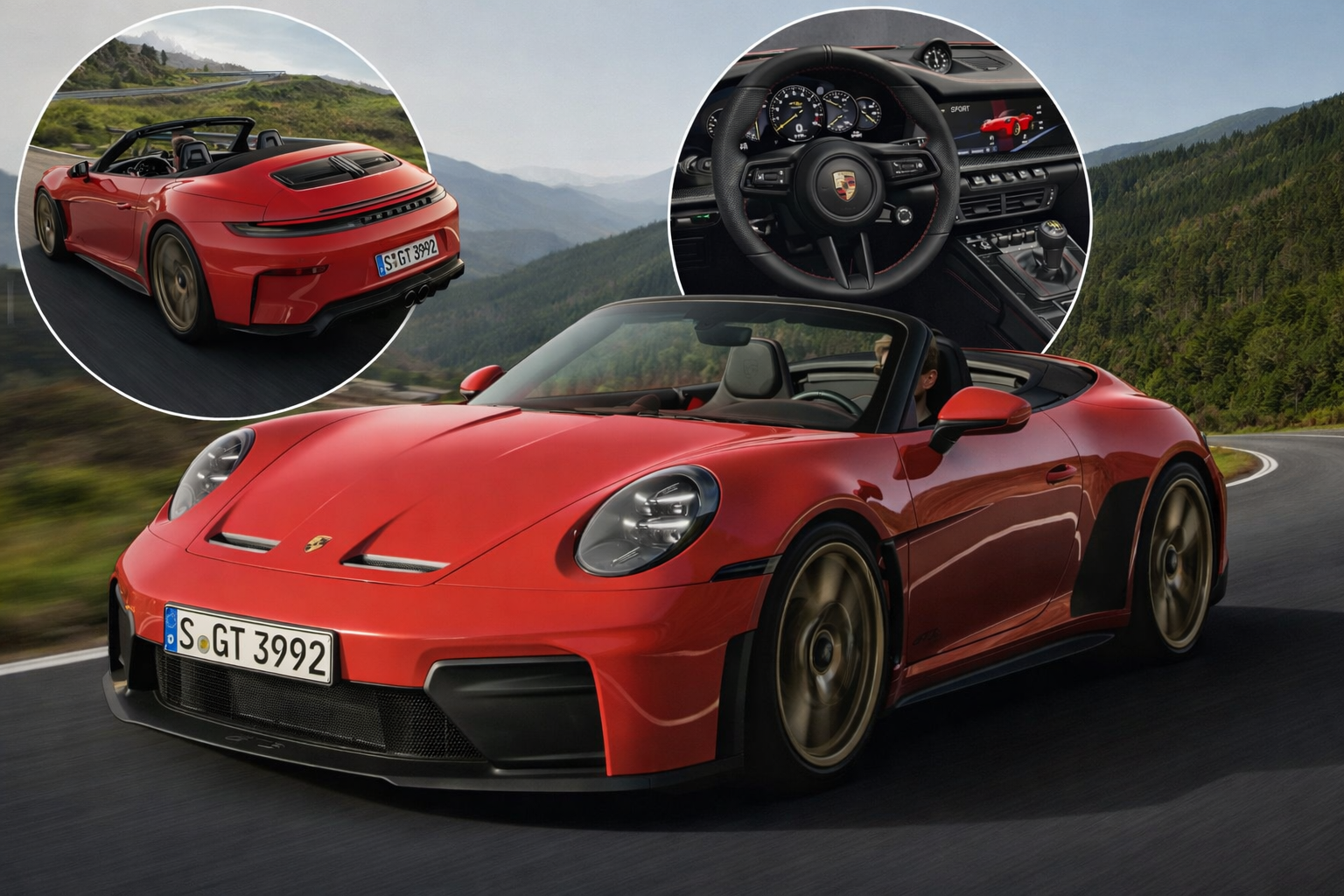
The silhouette stays familiar, yet the absence of a fixed roof shifts proportion subtly. The rear deck extends with purpose. Airflow management becomes visible, not hidden.
Inside, the cabin avoids unnecessary layering. Alcantara surfaces, exposed stitching, and a precise gear lever define the space. There is no attempt to soften the car’s intent.
Notable design elements:
- Active aerodynamics adjusted for open-top airflow
- Rear wing tuned for stability at higher speeds
- Lightweight materials used selectively, not uniformly
Performance Profile, Numbers That Support Feel
The engine remains naturally aspirated. High revving, immediate, consistent.
Expected performance figures position the Porsche 911 GT3 S/C close to its coupe counterpart, with slight adjustments due to weight distribution and structural additions.
Core performance highlights:
- Naturally aspirated flat-six engine
- Manual transmission calibrated for driver engagement
- Track-focused suspension adapted for convertible dynamics
The experience shifts subtly. Wind becomes part of the equation. Sound travels differently. The car feels less insulated, more direct.
Exclusivity and Collector Positioning
Production is expected to remain controlled. Allocation will likely favor existing clients with established relationships.
For collectors, the Porsche 911 GT3 S/C introduces a rare combination. A GT3 platform with a manual gearbox and convertible configuration creates a distinct category within Porsche’s lineage.
Why it matters for collectors:
- First GT3 convertible with manual transmission
- Limited production enhances long-term scarcity
- Strong alignment with Porsche’s motorsport heritage
Ownership extends beyond driving. It becomes part of a broader portfolio of automotive assets that carry cultural and financial weight.
Driving Experience, Where Mechanics Become Personal
The first shift defines the rhythm. The clutch engages with precision. There is no excess travel, no ambiguity.
With the roof down, sensory input increases. Engine note, road texture, wind resistance. Each element layers into the driving experience without overwhelming it.
This is where the manual gearbox earns its place. Control remains deliberate. Timing matters.
Market Context, Porsche’s Strategic Direction
The release of the Porsche 911 GT3 S/C signals a measured expansion rather than a shift. Porsche maintains its core identity while exploring variations that appeal to a narrower, more defined audience.
Electrification continues across the broader lineup, yet models like this preserve mechanical engagement as a parallel path.
Final Note, After the First Drive Ends
The car returns to the garage. Heat rises from the rear deck. The roof closes with a quiet mechanical movement.
Nothing about this feels transitional.
Some cars mark change. Others reinforce continuity in a way that holds value over time.
The Porsche 911 GT3 S/C sits in that second category.
FAQs
1. What is the Porsche 911 GT3 S/C?
The Porsche 911 GT3 S/C is the first GT3 model offered as a convertible with a manual gearbox, combining track performance with open-air driving.
2. Does the GT3 S/C affect performance compared to the coupe?
Performance remains close to the coupe, with adjustments made to maintain rigidity and handling balance.
3. Why is the manual gearbox significant?
The manual transmission enhances driver control and engagement, which remains highly valued among enthusiasts and collectors.
4. Will the Porsche 911 GT3 S/C be limited production?
Production is expected to be limited, increasing exclusivity and collector appeal.
5. Is the GT3 S/C a good investment car?
Due to its rarity, unique configuration, and brand heritage, it holds strong potential as a collector-grade automotive asset.