
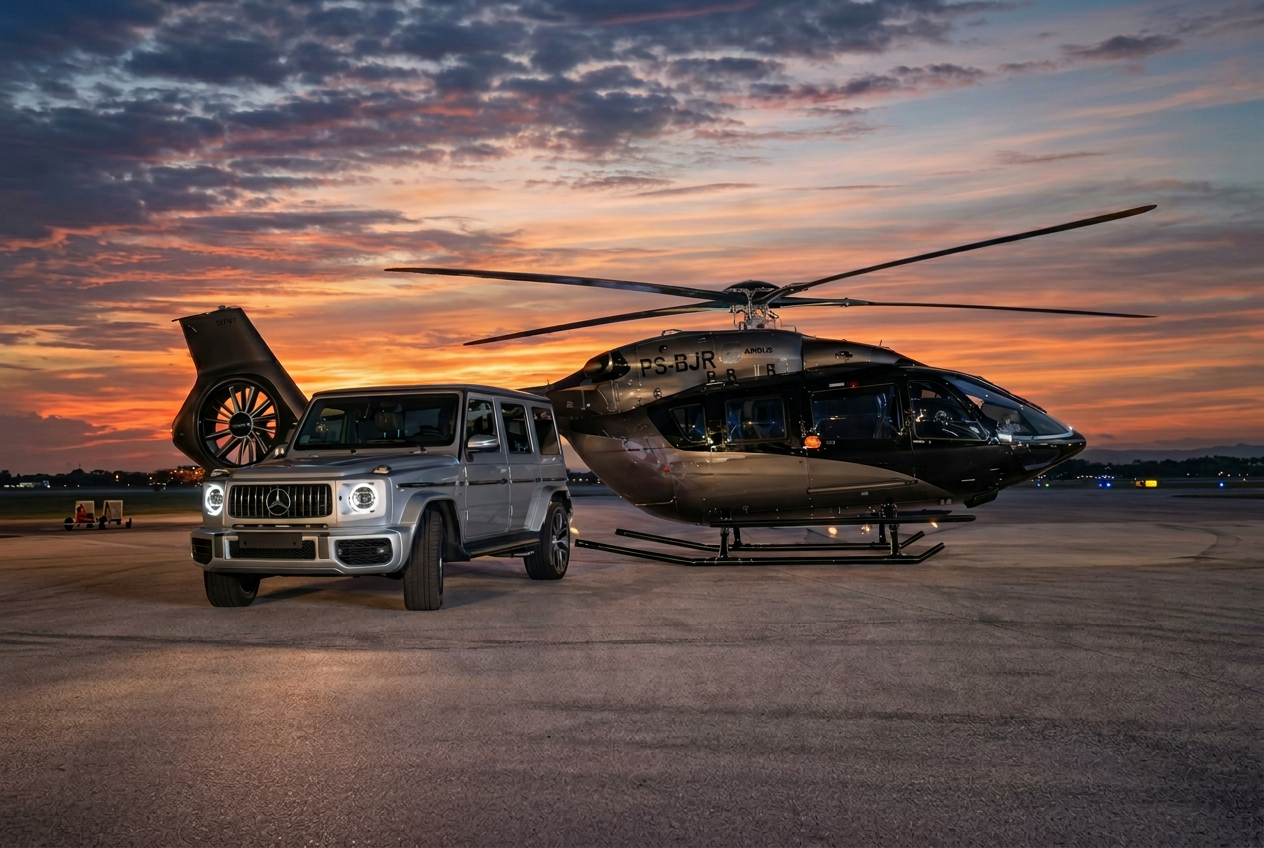
Palm Beach, early afternoon. The rotor blades are still. Sunlight slides across polished metal as the cabin door lifts quietly upward.
Inside, the cabin does not resemble the interior of a helicopter. The atmosphere feels closer to a private lounge waiting above the ground. Deep leather seats, flowing surfaces, and subtle ambient lighting reveal the influence immediately. The Airbus $10 Million Helicopter arrives with a design language shaped by Mercedes-Maybach, and the result is unmistakably deliberate.
Airbus did not approach this aircraft as a machine that simply transports passengers from one landing pad to another. The project treats the helicopter as an environment, a private extension of the spaces that wealthy travelers already inhabit. Many of the buyers who will consider this aircraft already operate private jets, maintain superyachts, or travel between residences across continents.
The helicopter becomes the final movement in that journey. It carries passengers from airport runways to marina decks, from urban rooftops to coastal estates. The experience inside the cabin matters as much as the speed of arrival.
The Airbus $10 Million Helicopter represents a shift in how manufacturers think about rotorcraft. The focus moves away from utility. The emphasis moves toward atmosphere, design, and precision engineering that supports a quieter, smoother ride.
Inside the Airbus $10 Million Helicopter Cabin Experience
The cabin establishes its presence immediately. Surfaces are soft to the eye and tactile to the hand. Materials come from the same world that shapes high-end automobiles.
The seats are wrapped in hand-stitched Nappa leather, finished with restrained detailing rather than decorative excess. Polished aluminum accents appear along the seat frames and side panels. Open-grain wood surfaces bring warmth to the cabin walls.
The layout breaks away from conventional helicopter seating. Instead of narrow rows facing forward, the Airbus $10 Million Helicopter adopts a lounge configuration. Large reclining chairs face one another across the cabin floor, creating a natural environment for conversation or quiet travel.
Spacing between seats is generous. Passengers can stretch comfortably without feeling confined by the aircraft structure. The floor remains uncluttered, which gives the cabin an unexpected sense of openness.
Airbus designers also paid attention to lighting. Ambient LED panels run along the ceiling edges and behind select surfaces. The brightness can shift depending on the time of day. During daylight flights the cabin feels bright and clear. Evening arrivals bring a warmer tone that resembles the interior of a private club.
Another detail becomes noticeable after a few minutes inside the aircraft. The air feels calm. Ventilation flows gently through discreet outlets integrated within the seat structure and side panels. The mechanism remains hidden, which keeps the visual lines of the cabin uninterrupted.
Passengers familiar with the interior of a Mercedes-Maybach S-Class will recognize the same philosophy here. Comfort appears effortless because the engineering hides beneath the surfaces.
Acoustic refinement forms another important layer of the experience. Helicopters are traditionally loud environments. Rotor vibration travels through the aircraft frame and resonates inside the cabin.
Airbus engineers addressed that issue through structural adjustments beneath the flooring and interior panels. Specialized dampening materials reduce the transmission of vibration from the rotor system.
As a result, the cabin atmosphere changes dramatically compared with traditional helicopters. The sound becomes a low mechanical rhythm rather than a constant roar. Conversations remain clear without raised voices.
For executives who conduct meetings during short flights between cities, this refinement transforms the helicopter into a productive workspace.
Small details reinforce the sense of thoughtful design. Storage compartments disappear into the sidewalls. Personal devices connect easily through discreet charging ports. Even the seat recline mechanism moves slowly and smoothly, similar to the motion found in luxury automotive seating.
These touches add up to something larger. The cabin begins to feel less like transportation and more like a private environment floating above the ground.
Engineering Behind the Airbus $10 Million Helicopter
Luxury inside the cabin only works if the aircraft beneath it performs with precision. The Airbus $10 Million Helicopter relies on engineering decisions that improve stability, safety, and efficiency during flight.
The aircraft uses a twin-engine configuration, which increases reliability during operations in dense urban areas or offshore environments. Each engine provides the necessary power to maintain controlled flight even if one system experiences an issue.
Rotor blade design plays a central role in the helicopter’s flight behavior. Airbus engineers refined the aerodynamic profile of each blade to improve lift efficiency while minimizing vibration.
The rotor system also works in coordination with advanced digital flight assistance. Sensors positioned throughout the aircraft constantly monitor wind conditions, rotor movement, and aircraft attitude.
Micro-adjustments occur continuously during flight. These adjustments stabilize the aircraft against sudden gusts or atmospheric shifts. Passengers feel a smoother ride because the system corrects small disturbances before they become noticeable.
Pilots experience a different advantage. The flight controls respond with greater precision during delicate maneuvers such as rooftop landings or yacht deck approaches.
Range and performance also support the helicopter’s role within luxury travel networks. The aircraft can comfortably connect destinations several hundred miles apart without refueling.
That capability allows owners to travel between metropolitan centers, coastal resorts, and private estates without the delays associated with ground transportation.
One technical detail deserves attention. Engineers carefully balanced the aircraft’s structural components around the center of gravity. Heavy systems such as fuel tanks and transmission elements sit in positions that maintain equilibrium throughout the flight envelope.
The helicopter therefore behaves predictably during climb, hover, and descent. Stability increases passenger comfort and pilot confidence at the same time.
Why High-Net-Worth Buyers Are Turning Toward Ultra-Luxury Helicopters
Private helicopters once served narrow functions within corporate operations. They transported executives between industrial facilities, construction sites, or oil platforms.
The profile of buyers has expanded significantly during the past decade.
Many high-net-worth individuals now treat helicopters as part of a larger personal mobility ecosystem. The aircraft complements other assets such as private jets, luxury automobiles, and maritime vessels.
A helicopter solves a specific challenge that wealth alone cannot eliminate: distance within congested regions.
Large cities present travel delays that even chauffeur-driven cars cannot overcome. Ground journeys that stretch beyond an hour shrink to twenty minutes in the air.
The Airbus $10 Million Helicopter fits perfectly into that lifestyle. A passenger can land at a private airport, step directly into the helicopter, and arrive at a downtown rooftop helipad shortly afterward.
Privacy also plays an important role. Helicopter travel bypasses crowded terminals and public transportation hubs. Movements remain discreet and controlled.
Many yacht owners maintain helicopters for transfers between coastal airports and vessels anchored offshore. The aircraft lands directly on the yacht’s helipad, eliminating long boat transfers.
Helicopters therefore become extensions of a private travel infrastructure that operates quietly behind the scenes of global luxury.
Mercedes-Maybach Influence on the Helicopter’s Design
The collaboration between Airbus and Mercedes-Maybach shaped the aircraft’s visual identity in meaningful ways.
Maybach designers approached the cabin as a continuation of their automotive philosophy. Lines flow smoothly across surfaces rather than breaking abruptly between panels. Storage compartments blend into the architecture of the cabin walls.
Restraint defines the aesthetic. Instead of chrome accents or dramatic ornamentation, surfaces remain calm and balanced. The eye moves naturally across the interior without distraction.
Seat stitching patterns echo those found in Maybach automobiles. The geometry appears subtle, yet the craftsmanship becomes obvious during close inspection.
Air vents provide an interesting example of integrated design. Traditional helicopter vents often protrude from cabin walls or ceilings. In this aircraft, the ventilation system hides within the seat structures and side panels.
Passengers experience gentle airflow without noticing the mechanism behind it.
Lighting design follows the same philosophy. Illumination sits behind layered panels that diffuse the light softly across the cabin surfaces.
The goal was not to create visual drama. The intention was to create an atmosphere that feels calm, composed, and quietly luxurious.
For passengers who arrive from a Mercedes-Maybach limousine, the transition into the helicopter cabin feels natural rather than abrupt.
The Market Position of the Airbus $10 Million Helicopter
The ultra-luxury helicopter market remains small in numbers yet influential in perception.
Aircraft manufacturers understand that a relatively limited number of buyers define the tone of the entire category. When those buyers demand exceptional craftsmanship and advanced technology, the industry responds accordingly.
The Airbus $10 Million Helicopter occupies a distinct position within this market.
The aircraft targets individuals who already operate within the upper tiers of private aviation. These buyers may own multiple residences across continents or travel regularly between financial centers and coastal destinations.
For them, helicopters serve as connectors between larger transportation systems.
The price reflects both engineering sophistication and interior craftsmanship. Around the $10 million range, the helicopter sits comfortably within the budgets of buyers who invest far more in aircraft, yachts, or real estate.
Ownership rarely stops with the aircraft purchase itself. Many buyers commission customized interiors, dedicated maintenance programs, and specialized pilot training.
Each delivered helicopter therefore becomes a tailored asset within a broader mobility strategy.
The Future of Ultra-Luxury Air Mobility
Helicopters like the Airbus $10 Million Helicopter reveal a broader direction within aviation design.
Manufacturers increasingly treat aircraft cabins as architectural spaces rather than purely mechanical enclosures. Collaborations with automotive designers and luxury studios will likely expand.
Technology will continue evolving quietly beneath the surface. Hybrid propulsion systems, improved rotor efficiency, and advanced stabilization technologies are already under development across the industry.
Yet the most significant transformation may involve experience rather than hardware.
Elite travelers expect continuity between environments. The journey from residence to aircraft to destination should feel seamless.
Helicopters occupy an essential position within that chain. They bridge distances between large airports and private destinations where conventional aircraft cannot land.
The Airbus $10 Million Helicopter demonstrates how seriously manufacturers now treat that role. The aircraft preserves the atmosphere its passengers inhabit long before they arrive at the landing pad.
Rotor blades eventually slow to silence after each flight. The cabin remains waiting for the next journey, quiet, composed, and ready to lift another small circle of travelers above the landscape.
FAQs
1. What is the Airbus $10 Million Helicopter?
The Airbus $10 Million Helicopter is a luxury executive rotorcraft featuring a Mercedes-Maybach inspired interior, advanced twin-engine performance, and a premium cabin designed for elite private travel.
2. Which Airbus helicopter features a Mercedes-Maybach interior?
Airbus partnered with Mercedes-Maybach designers to create a bespoke luxury interior for its executive helicopter platform, blending automotive craftsmanship with aviation engineering.
3. Who buys luxury helicopters like the Airbus $10 Million Helicopter?
Typical buyers include high-net-worth individuals, business executives, superyacht owners, and private aviation clients who require fast and discreet transportation between destinations.
4. How far can the Airbus $10 Million Helicopter fly?
The aircraft offers a range of several hundred miles, allowing direct travel between cities, resorts, and private estates without frequent refueling stops.
5. Why are luxury helicopters becoming popular among wealthy travelers?
Luxury helicopters reduce travel time in congested cities, provide greater privacy, and connect airports with locations where private jets cannot land.